
The A to Z of Digital Advertising Media
What Is Digital Advertising Media? (And Why It Matters Now)
Digital advertising media refers to any paid promotional content delivered through internet-connected channels — including search engines, social media platforms, websites, apps, email, video, and digital screens in public spaces.
Here’s a quick breakdown of the main types:
| Type | Example |
|---|---|
| Search ads | Google ads triggered by search queries |
| Display ads | Banner ads on websites and apps |
| Social media ads | Sponsored posts on Instagram or Facebook |
| Video ads | Pre-roll ads on YouTube |
| Email ads | Promoted content in email newsletters |
| Native ads | Sponsored articles that match editorial content |
| DOOH | Digital billboards in airports, malls, and transit |
The scale of this industry is hard to overstate. Over $626 billion is expected to flow into digital advertising this year alone. And it’s not hard to see why — 68% of all digital journeys start with a search engine, meaning your audience is actively looking for products like yours online, right now.
Unlike a print ad or a TV spot, digital advertising lets you reach the exact right person, at the right moment, with a message you can adjust in real time. That’s a fundamental shift from how advertising used to work.
I’m Adam Bocik, founder of Evergreen Results, and I’ve spent my career helping active lifestyle brands cut through the noise using smart digital advertising media strategies that actually move the needle. In the sections below, I’ll walk you through everything you need to know — from how digital ads work to how to measure whether they’re working for you.
Digital advertising media glossary:
Introduction
The shift from traditional to digital has been nothing short of a revolution. Remember when the only way to reach a mass audience was a billboard on I-25 or a spot on local TV? Those days aren’t gone, but they’ve certainly been eclipsed. Today, $626.86 billion is expected to flow into digital advertising, reflecting a world where our lives are lived increasingly through screens.
Whether you are a specialty food brand in Boulder or an outdoor gear shop in Fort Collins, the internet is where your customers live. Because 68% of digital journeys start with a search engine, being invisible on the web is no longer an option. Digital media offers a level of precision that traditional media simply can’t touch—it’s the difference between shouting into a crowd and having a meaningful conversation with a friend.
Defining Modern Digital Advertising Media
At its core, digital advertising media is the process of using electronic channels to deliver promotional messages. But it’s more than just “ads on the internet.” It’s a sophisticated ecosystem designed for:
- Ad Delivery: Using complex algorithms to place content where it will be seen by the right eyes.
- Electronic Channels: Leveraging everything from mobile apps to smart refrigerators.
- Brand Awareness: Building a recognizable identity in a crowded digital marketplace.
- Consumer Engagement: Turning passive viewers into active participants through clicks, likes, and shares.
Core Formats and Types of Digital Media
To master digital advertising media, we first need to understand the tools in our shed. Each format serves a different purpose in the “marketing funnel,” from the first time someone hears your name to the moment they click “Buy Now.”
- Display Ads: These are the visual banners you see on websites. They range from simple static images to interactive “rich media” that expands or plays video.
- Search Marketing (SEM): These are the sponsored results at the top of Google. They are incredibly effective because they catch users exactly when they are looking for a solution.
- Social Media: Platforms like Instagram and Facebook allow for hyper-specific targeting based on interests (like “trail running” or “organic snacks”).
- Video Content: This is the heavy hitter of modern media. In fact, 91% of companies now incorporate video content into their marketing. It’s immersive, emotional, and highly shareable.
- Native Advertising: These ads are designed to look like the editorial content around them. They feel less like an interruption and more like a helpful recommendation.
- Retargeting: Ever looked at a pair of hiking boots online and then seen them follow you around the web? That’s retargeting. It reminds interested users to come back and finish their purchase.
Mobile and Email Advertising
We can’t talk about digital advertising media without mentioning the device currently in your hand or pocket. By 2026, mobile platforms will account for 70% of all digital advertising. If your ads aren’t mobile-optimized, you’re essentially ignoring 70% of the market.
Then there’s the “old reliable” of the digital world: Email. While it might not seem as flashy as a TikTok ad, its effectiveness is legendary. Email advertising delivers $36 earned for every $1 spent. It offers direct inbox placement and a level of ROI that makes it an essential part of any Digital Advertising Service.
How Digital Advertising Media Works: From Direct to Programmatic
In the early days of the web, if we wanted to place an ad, we had to call a publisher and negotiate a price. Today, while “direct purchase” still happens for premium placements, the majority of the heavy lifting is done by machines.
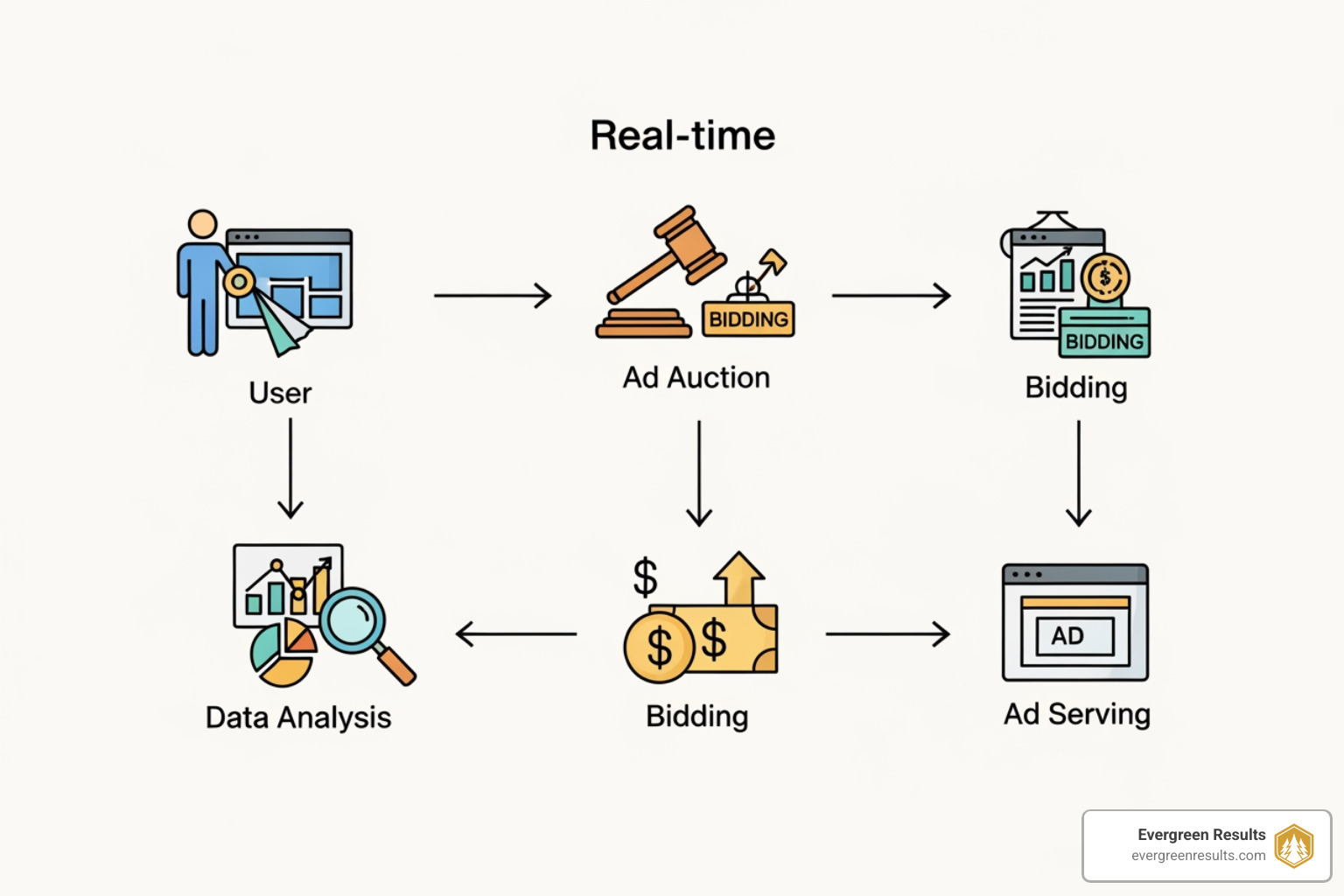
Programmatic advertising is the automated buying and selling of ad inventory in real-time. Here is the basic flow:
- A user lands on a website.
- The website (the publisher) puts an ad impression up for auction.
- Advertisers bid on that impression based on the user’s data (location, interests, etc.).
- The highest bidder’s ad is shown—all in the few milliseconds it takes for the page to load.
This “Real-Time Bidding” (RTB) ensures that we aren’t just buying space on a website; we are buying access to a specific person who is likely to care about our brand.
Common Pricing Models
Understanding the “cost of entry” is vital for any business in Denver or Colorado Springs looking to scale. Digital media is incredibly flexible, allowing you to pay only for the results you want.
| Model | What it Stands For | Best For… |
|---|---|---|
| CPC | Cost-Per-Click | Driving traffic to your website. You only pay when someone actually clicks. |
| CPM | Cost-Per-Mille (Thousand) | Building brand awareness. You pay for every 1,000 times your ad is shown. |
| CPA | Cost-Per-Acquisition | Direct sales. You only pay when a specific action (like a sale) is completed. |
This budget flexibility is a massive win for smaller brands, as it allows you to start small and scale up as you see results.
Precision Targeting and Real-Time Benefits
The “superpower” of digital advertising media is targeting. In traditional advertising, if you put an ad in a magazine, you’re paying to reach everyone who reads that magazine—even if they have zero interest in your product. In the digital world, we can be much more surgical.

We use several layers of data to find your “tribe”:
- Behavioral Data: Targeting people based on their past actions, like visiting your site or searching for “best gluten-free flour.”
- Geotargeting: Showing ads only to people in specific zip codes, like Lakewood, Castle Rock, or Monument.
- Demographic Filters: Narrowing down by age, gender, income, or job title.
- Real-Time Analytics: Seeing exactly how many people saw, clicked, and bought from your ad within minutes of it going live.
The Advantage of Digital Over Traditional
Why do we love digital? It’s all about the “Four M’s”: Measurable, Modifiable, Meaningful, and Mobile.
- Flexibility: If an ad isn’t performing by Tuesday morning, we can change the image or the copy by Tuesday afternoon. You can’t do that with a printed flyer.
- Instant Adjustments: We can shift budget from a platform that isn’t working to one that is, maximizing every dollar.
- Measurable Results: We don’t have to guess if the ad worked. We have the data to prove it.
- Audience Granularity: We can speak to a mountain biker in Boulder differently than we speak to a chef in Fort Collins.
Digital Out-of-Home (DOOH): The New Frontier
You might think “Out-of-Home” (OOH) means old-school static billboards, but the industry has gone digital. Digital Out-of-Home (DOOH) refers to digital screens in public places—from the huge boards in downtown Denver to small screens at gas pumps or in gyms.
It’s a massive growth area. Digital OOH is forecast to represent nearly 44% of total OOH revenue by 2030. Consumers actually like these ads because they are unskippable, ad-blocker proof, and often provide helpful information. In fact, 73% of U.S. consumers view DOOH ads favourably, which is significantly higher than the favorability for TV or social media ads.
Driving Consumer Action
DOOH doesn’t just look pretty; it drives results. Because these screens are often located near points of purchase (like malls or grocery stores), they are great at nudging people toward a decision.
- Ad Recall: Studies show that OOH formats drive some of the highest ad recall in the industry.
- Foot Traffic: Screens near your physical location can drive a 46% increase in footfall.
- Sales Lift: Using contextually relevant messaging (like showing an ad for hot coffee when it’s snowing in Castle Pines) can lead to a 16% increase in sales.
It’s incredibly effective: 76% of U.S. consumers reported taking some form of action after seeing a DOOH ad, whether that was visiting a website or heading straight into a store. If you’re looking for a Digital Billboard strategy, this is the place to start.
Building a Strategy and Measuring Success
Throwing money at digital advertising media without a plan is a quick way to go broke. We believe in a structured approach to ensure your campaigns actually build community and drive growth.
- Goal Setting: Are you looking for brand awareness, or do you need sales right now? Your goal dictates your strategy.
- Audience Research: We dive deep into who your customer is. Where do they hang out online? What are their pain points?
- Creative Development: We build ads that stop the scroll. This means high-quality visuals and copy that speaks directly to the user.
- KPI Tracking: We monitor the Key Performance Indicators that matter.
Optimizing Your Digital Advertising Media Performance
The launch is just the beginning. To get the most out of your budget, we constantly perform:
- A/B Testing: Running two versions of an ad to see which one performs better.
- Click-Through Rates (CTR): Measuring how compelling your ad is.
- Conversion Rates: Tracking how many people actually completed the goal (e.g., bought a product or signed up for a newsletter).
- ROI Analysis: Ensuring that for every dollar you spend, you’re getting a healthy return.
Success in Digital Ads Colorado requires staying adaptable. The digital landscape changes every day, and what worked last month might not work this month.
Frequently Asked Questions about Digital Advertising
What is the difference between programmatic and direct advertising?
Direct advertising is like renting an apartment—you talk to the landlord (the publisher), sign a contract for a specific spot, and pay a fixed price. Programmatic is more like a high-speed auction. Software handles the purchase of individual ad impressions across thousands of sites simultaneously based on your specific targeting criteria. Programmatic is generally more efficient and scalable, while direct is better for high-profile, “guaranteed” placements.
How do ad blockers affect digital advertising media?
Ad blockers are a reality of the modern web, with some estimates suggesting that up to 27% of users employ them. This makes it harder for traditional display ads to reach certain audiences. However, formats like native advertising, email marketing, and DOOH are largely “ad-block proof.” The best way to beat ad blockers is to create content that is so relevant and valuable that users don’t want to block it.
Why is mobile-first advertising becoming the industry standard?
Simply put: it’s where the eyeballs are. With mobile usage projected to hit 70% of all digital ad spend by 2026, the “desktop-first” mindset is officially dead. Mobile-first advertising considers shorter attention spans, smaller screens, and the unique ways people interact with their phones (like swiping and tapping). If your Paid Digital Advertising for Specialty Food Brands doesn’t look great on a smartphone, you’re missing the majority of your digital journey.
Conclusion
Navigating digital advertising media can feel like trying to hike a new trail without a map. There are dozens of formats, complex pricing models, and a constant stream of new data to analyze. But when done right, it is the most powerful tool in your marketing arsenal.
At Evergreen Results, we aren’t just another agency. We are a team of outdoor enthusiasts and foodies based right here in Colorado—from Boulder to Colorado Springs. We specialize in helping active lifestyle and food/beverage brands find their footing in the digital world. Whether you need Paid Digital Advertising for Food & Beverage or a comprehensive Digital Advertising Services package, we are here to help you build sustainable growth and a lasting community.
Ready to take your brand to the next level? Let’s get to work.