
Grow Business Online: The Digital Expansion Playbook
Why So Many Businesses Struggle to Grow Online (And What Actually Works)
If you want to grow business online, the short answer is: build a strong foundation, show up where your customers are searching, and create systems that scale.
Here’s what works in 2026:
- Optimize for local and organic search — 46% of all Google searches are local, and 31% of customers won’t consider a business without a website
- Build a conversion-ready website — fast, mobile-friendly, and easy to navigate
- Use paid ads to accelerate — Google Ads, Meta Ads, and retargeting campaigns drive targeted traffic fast
- Automate email and CRM — nurture leads and retain customers without manual effort
- Track everything — measure what moves revenue, cut what doesn’t, and double down on what works
The opportunity is real. The UK ecommerce market alone is projected to grow nearly 23% by 2030. In the US, 99.9% of businesses are small businesses — and the ones pulling ahead are investing in digital systems, not just tactics.
But here’s the problem most business owners run into: they try everything at once, get scattered results, and burn budget without a clear strategy. Growth isn’t about doing more — it’s about doing the right things in the right order.
I’m Adam Bocik, founder of Evergreen Results, and I’ve spent my career helping active lifestyle and purpose-driven brands grow their business online through performance media, SEO, email marketing, and smart web development. In this playbook, I’ll walk you through exactly how to build a digital growth engine that compounds over time.
Relevant articles related to Grow business online:
The Core Pillars to Grow Business Online in 2026
To build a sustainable digital growth engine, we must step away from erratic “growth hacks” and focus on a structured framework. In 2026, the global digital transformation market is projected to reach $3.4 trillion. Yet, history shows that only 35% of digital transformation initiatives actually achieve their objectives. Why? Because businesses often build fancy tools on top of shaky strategic foundations.
Sustainable expansion requires a balance of deep market research, robust customer retention, and a clear understanding of your Ideal Customer Profile (ICP). If we don’t know exactly who we are selling to, our digital acquisition spend is merely expensive trial and error.
Additionally, we must prioritize customer retention. Industry data consistently shows that retaining an existing customer is five times less expensive than acquiring a new one. A modest 5% improvement in retention can boost bottom-line profits by 25% to 95%. When we align our digital marketing to serve both new and existing cohorts, we unlock compounding growth.

To help visualize how to allocate your energy and budget, let’s compare the two primary digital customer acquisition engines:
| Feature | Organic Growth (SEO & Content) | Paid Acquisition (PPC & Social Ads) |
|---|---|---|
| Primary Benefit | High margin, compounding value, builds long-term brand authority. | Instant visibility, highly targeted, scalable on-demand. |
| Time to Results | 3 to 12 months (requires patience and consistent effort). | Hours to days (immediate traffic generation). |
| Cost Structure | Upfront content/SEO investment; traffic is “free” once ranking. | Pay-per-click (PPL/CPC); costs rise with market competition. |
| Retention Potential | High; organic visitors actively seek answers and trust editorial content. | Moderate; requires retargeting to prevent “one-time buyer” syndrome. |
| Best Used For | Establishing market authority and sustainable lead flow. | Launching new offers, seasonal promos, and scaling validated funnels. |
Establishing these core pillars is the first step toward building a resilient brand. For a deeper dive into establishing a foundation that stands the test of time, check out our guide on Sustainable Growth Strategies: Building a Business That Actually Lasts.
How to Grow Business Online Through Local SEO
If you operate a service-based business or a physical storefront, local SEO is your highest-leverage digital asset. Consider this: 46% of all Google searches have local intent. If someone is searching for “organic cold-pressed juice” or “outdoor gear shop” in your area, and you aren’t visible in the local map pack, you are actively giving away revenue to competitors.
To dominate local search, we must treat our Google Business Profile as a second homepage. This means:
- Claiming and verifying your listing with precise category selections.
- Keeping operational hours, phone numbers, and physical addresses perfectly consistent across the web.
- Actively gathering and responding to customer reviews (aiming to respond in under 24 hours to signal high engagement to Google’s algorithms).
- Adding high-quality, localized photos of your team, products, or projects weekly.
For local service providers, local visibility is about being there at the exact moment of decision. To make this transition seamless, explore our comprehensive resource on how to Get Found Online: SEO From Invisible to Indispensable. Local growth also relies heavily on understanding the economic landscape of your community. For instance, businesses expanding in the Front Range can leverage resources like the Economic Development – City of Lone Tree to align their digital presence with local market growth and municipal opportunities.
Building a Strong Website Foundation
Your website is the digital storefront of your brand. You can run the most creative ad campaigns in the world, but if your landing page is sluggish or confusing, your marketing budget is wasted.
Statistically, 25% of visitors will abandon a website if it takes more than 4 seconds to load. Furthermore, 31% of consumers completely refuse to consider a business that lacks a website. Your digital foundation must be built for speed, mobile responsiveness, and clear conversion paths.
To optimize your website for maximum conversions:
- Prioritize Site Speed: Optimize images, utilize content delivery networks (CDNs), and choose premium hosting.
- Ensure Flawless Mobile Responsiveness: Over 60% of web traffic originates from mobile devices. If your checkout process or contact form is clunky on a smartphone, you are losing customers.
- Create Clear Calls to Action (CTAs): Make it incredibly easy for visitors to contact you, buy a product, or schedule a call. Use action-oriented verbs and place CTAs above the fold.
- Incorporate Trust Signals: Highlight customer testimonials, security badges, and clear satisfaction guarantees to ease purchase anxiety.
Ready to build a website that converts casual browsers into obsessed fans? Take a look at our complete Digital Growth Roadmap to map out your site’s technical and structural evolution.
Scaling Operations with AI and Automation
As a business grows, operational complexity naturally increases. Unfortunately, McKinsey reports that smaller firms adopt critical technologies at only half the rate of large enterprises. This lag in technology adoption leaves many small business owners feeling overwhelmed—in fact, Gartner reports that 75% of business managers feel overwhelmed and 73% do not feel equipped to lead organizational change.
This is where artificial intelligence and automation become game-changers. Scaling your business online doesn’t mean you need to double your working hours or hire a massive administrative team. By implementing modern CRM systems and task automation, you can run a highly efficient, lean operation.
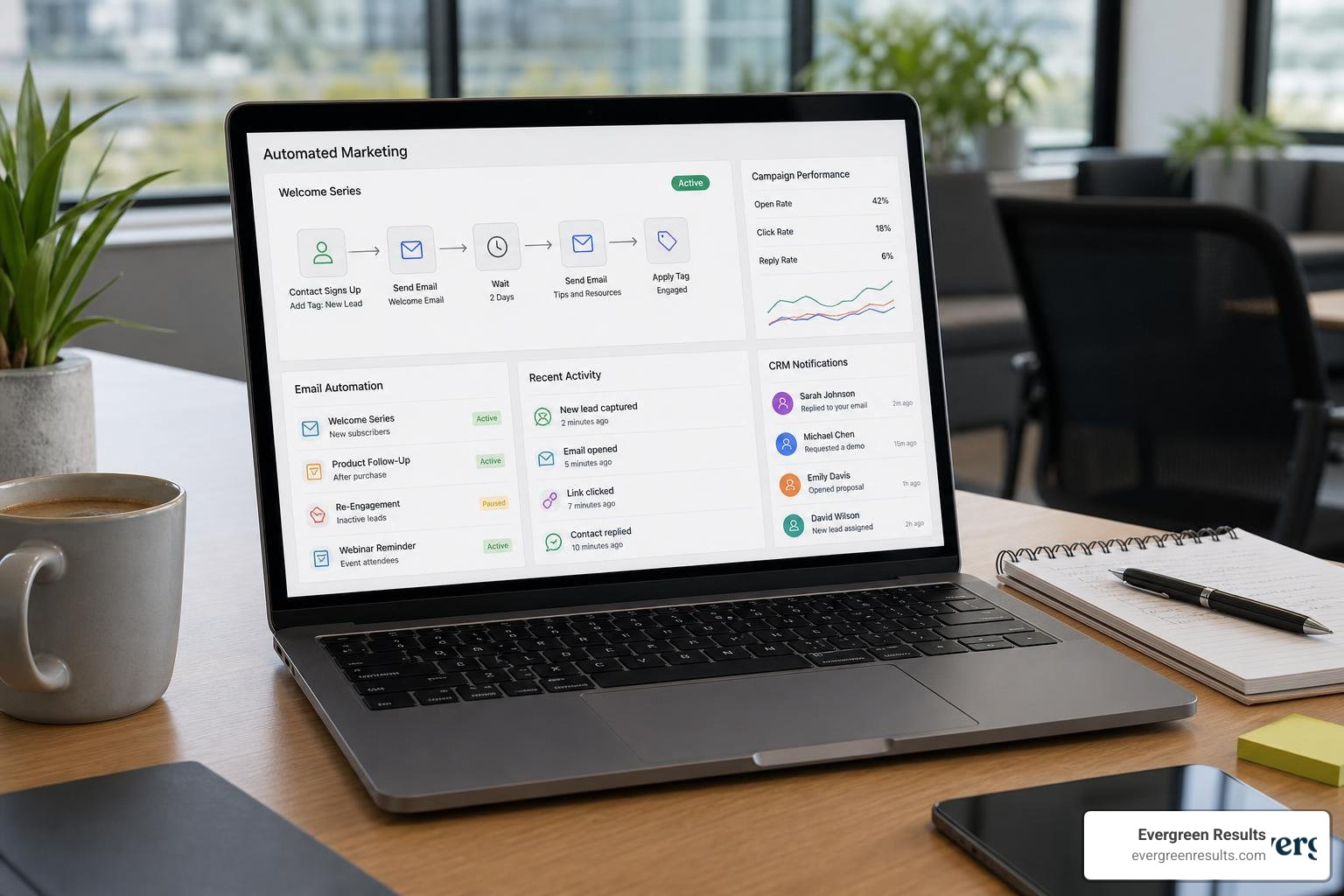
By deploying smart automation, we can capture and nurture leads automatically:
- Missed-Call Text-Back: If a customer calls your business and you are on a job or helping another client, an automated system can instantly text them back: “Hi! Sorry we missed your call. How can we help you today?” This simple automation prevents leads from calling the next business on Google.
- Automated Review Generation: Send automated SMS or email requests with a direct QR link to your Google Business Profile immediately after a service is completed or a product is delivered.
- AI-Powered Lead Routing: Ensure that inbound inquiries are routed to the right team member instantly, keeping response times under the critical 5-minute mark.
Streamlining Customer Relationships
A Customer Relationship Management (CRM) system is the heartbeat of your sales operations. Instead of tracking leads on scattered spreadsheets, a unified CRM allows you to monitor customer behavior, segment your audience, and build automated follow-up sequences.
When you streamline customer relationships, you shift from transactional interactions to building a community of loyal brand advocates. This transition requires consistent, personalized communication and a commitment to delivering exceptional service at every touchpoint. For a deep dive into building an irresistible brand experience, check out The Ultimate Guide to Making Your Customers Obsessed With You.
Multi-Channel Marketing: SEO, Paid Ads, and Email
Relying on a single marketing channel is one of the most common reasons online businesses hit a growth plateau. If you rely solely on organic social media, an algorithm shift can cut your reach overnight. If you rely exclusively on paid ads, rising customer acquisition costs (CAC) will slowly squeeze your profit margins.
The most resilient brands use an omnichannel strategy where SEO, paid ads, and email marketing work in tandem.
SEO attracts high-intent searchers at the top of the funnel. Paid ads capture immediate demand and retarget warm prospects. Email marketing nurtures those relationships, turning one-time buyers into repeat customers. To stop relying on guesswork and start building an integrated marketing ecosystem, read our guide on how to Stop Guessing and Start Growing with Digital Marketing.
Leveraging Paid Advertising to Grow Business Online
Paid advertising is the fastest way to drive targeted traffic to your website. While SEO is a long-term compounding asset, paid search and social campaigns allow you to get in front of ready-to-buy customers today.
To maximize your return on ad spend (ROAS):
- Implement Conversion Tracking: Never run ads without tracking exactly which keywords, creatives, or campaigns generate actual revenue.
- Leverage AI-Powered Campaigns: Platforms like Google’s Performance Max use advanced machine learning to optimize ad formats and placements across Search, YouTube, Maps, and Display in real-time.
- Focus on High-Intent Keywords: Target search terms that indicate a strong readiness to purchase (e.g., “buy organic climbing chalk” rather than just “climbing gear”).
To set up your first highly profitable campaign, explore Reach Customers & Sell More with Online Advertising – Google Ads. For a straightforward, no-nonsense roadmap to navigating the paid search landscape, check out our guide, Unlock Your Business Potential: A No-Nonsense Guide to Google AdWords.
Email Marketing and Customer Retention
Two-thirds of initial visitors who find your website through an ad may never return if you don’t capture their contact information. Email marketing remains the most cost-effective channel for nurturing leads and driving repeat purchases.
By segmenting your email list based on customer behavior—such as past purchases, browsing history, or email engagement—you can send highly personalized offers that resonate. Automated sequences, such as welcome series, abandoned cart reminders, and post-purchase follow-ups, work around the clock to drive consistent revenue. Learn how to turn email into your primary revenue driver with The Secret Sauce for Sustainable Growth.
Regional Strategies for Colorado Businesses
While digital marketing allows us to reach a global audience, local and regional relevance builds an unshakeable community foundation. For Colorado-based businesses, digital expansion must be paired with regional compliance, local partnerships, and community engagement.
Whether you are operating in the mountain towns or along the Front Range, understanding local business landscapes is essential. For instance, navigating local guidelines such as the Business Permits & Applications | City of Castle Pines ensures your operations remain compliant as you scale your digital footprint. To see how we tailor digital strategies specifically for the unique culture of our state, explore our dedicated resource on Digital Marketing Colorado.
Denver and Front Range Digital Expansion
The Denver metro area and the surrounding Front Range communities represent a highly competitive, fast-growing market. To stand out here, businesses must combine sophisticated digital marketing with active community involvement.
In Greenwood Village, for example, local businesses can tap into community-focused networks like the Partners in Business | Greenwood Village Official Website to build strategic partnerships that amplify their online reach. To capture the attention of active, health-conscious consumers in this region, explore our Denver Digital Marketing Ultimate Guide.
Fort Collins and Northern Colorado Growth
Northern Colorado, including Fort Collins and Superior, has its own distinct economic character. Consumers here deeply value sustainability, local craftsmanship, and outdoor lifestyles.
If you are looking to scale in Northern Colorado, your digital messaging should reflect these values. To learn how to position your brand in this vibrant region, check out our guide on Digital Marketing Fort Collins. Additionally, connecting with regional business networks, such as those found via Superior Colorado | The Gateway to Boulder Valley, can provide the regional credibility needed to fuel your online expansion.
Frequently Asked Questions About Digital Growth
What is the most cost-effective way to grow business online?
The most cost-effective way to grow business online is to focus on organic SEO and content marketing. While paid ads require continuous budget to maintain traffic, high-quality, SEO-optimized content continues to attract organic visitors for months or even years after it is published. To understand how to measure the return on your marketing investments, use our simple guide: Unlock Your Marketing Power: A Simple ROI Formula.
How long does it take to see results from online marketing?
The timeline depends heavily on the channels you choose. Paid advertising (PPC) can drive traffic and sales within hours of launching a campaign. Organic SEO and content marketing typically take 3 to 12 months to show significant momentum, but they provide a much higher long-term return on investment. For a realistic timeline and strategic planning framework, refer to our Colorado Digital Marketing Agency Guide 2025.
Why is mobile optimization critical for online growth?
With the majority of web traffic originating from mobile devices, a non-optimized mobile site directly hurts your bottom line. Search engines like Google practice mobile-first indexing, meaning they rank your website based on how well it performs on a smartphone. Slow load times, hard-to-read text, or broken mobile navigation will cause visitors to bounce, damaging both your conversion rates and your search engine rankings.
Conclusion
To grow business online in 2026, you don’t need to chase every passing digital trend. Instead, focus on building a robust, high-performing website, mastering local search, implementing smart operational automation, and executing a balanced, multi-channel marketing strategy.
At Evergreen Results, we specialize in helping active lifestyle and food and beverage brands build sustainable digital growth engines. We combine our deep passion for the outdoors with data-driven performance marketing to help purpose-driven businesses scale predictably and build lasting communities.
Ready to take your digital presence to the next level? Explore our full suite of Digital Marketing Services and let’s build a growth engine that lasts.