
Why Keyword Research is Your Compass in the Colorado Springs Market
Colorado Springs keyword research is the process of identifying the words and phrases your local customers use in search engines. Here’s what you need to know:
- What it is: Finding and analyzing search terms that Colorado Springs residents use to find businesses like yours.
- Why it matters: 46% of all Google searches are for local information. Understanding these searches helps you show up when it counts.
- Key components: Search volume (how many people search), difficulty (how hard to rank), and intent (what they’re looking for).
- Local focus: Including geographic modifiers like “Colorado Springs,” neighborhood names, or landmarks (e.g., “near Garden of the Gods”).
Colorado Springs is a unique market with over 4.2 million monthly searches, nearly double the national average. Its mix of military families, outdoor enthusiasts, and tourists creates distinct search patterns across neighborhoods. What works in Briargate won’t necessarily work Downtown.
Studies show that location-specific keywords can boost local search visibility by up to 25%. Optimizing for terms like “best hiking gear shop near Peterson Space Force Base” instead of just “hiking gear” speaks directly to your community’s needs.
Businesses that understand their local keyword landscape outperform those using generic strategies. The right approach helps you capture customers in your specific service area, from the Powers Corridor to Broadmoor.
I’m Adam Bocik, founder of Evergreen Results. I’ve helped active lifestyle brands across Colorado master their digital marketing, including keyword research that drives real growth. Let’s explore how to find and leverage the keywords that will put your business on the map.
The Foundation of Local SEO: Mastering Colorado Springs Keyword Research
Think of Colorado Springs keyword research as learning your customer’s language. People in Briargate search differently than those in New York, using phrases that reflect our unique mountain community. Understanding this difference is key to online success.
Instead of a national term like “best running shoes,” a local store should target “running shoe store Colorado Springs” or “trail running shoes near Manitou Springs.” These phrases have lower search volume but connect you with actual customers.
Google understands local intent even when it’s not spelled out. A search for “restaurants near me” while at the Pikes Peak Center yields local results. This is why your Google Business Profile is essential for capturing these proximity-based searches.
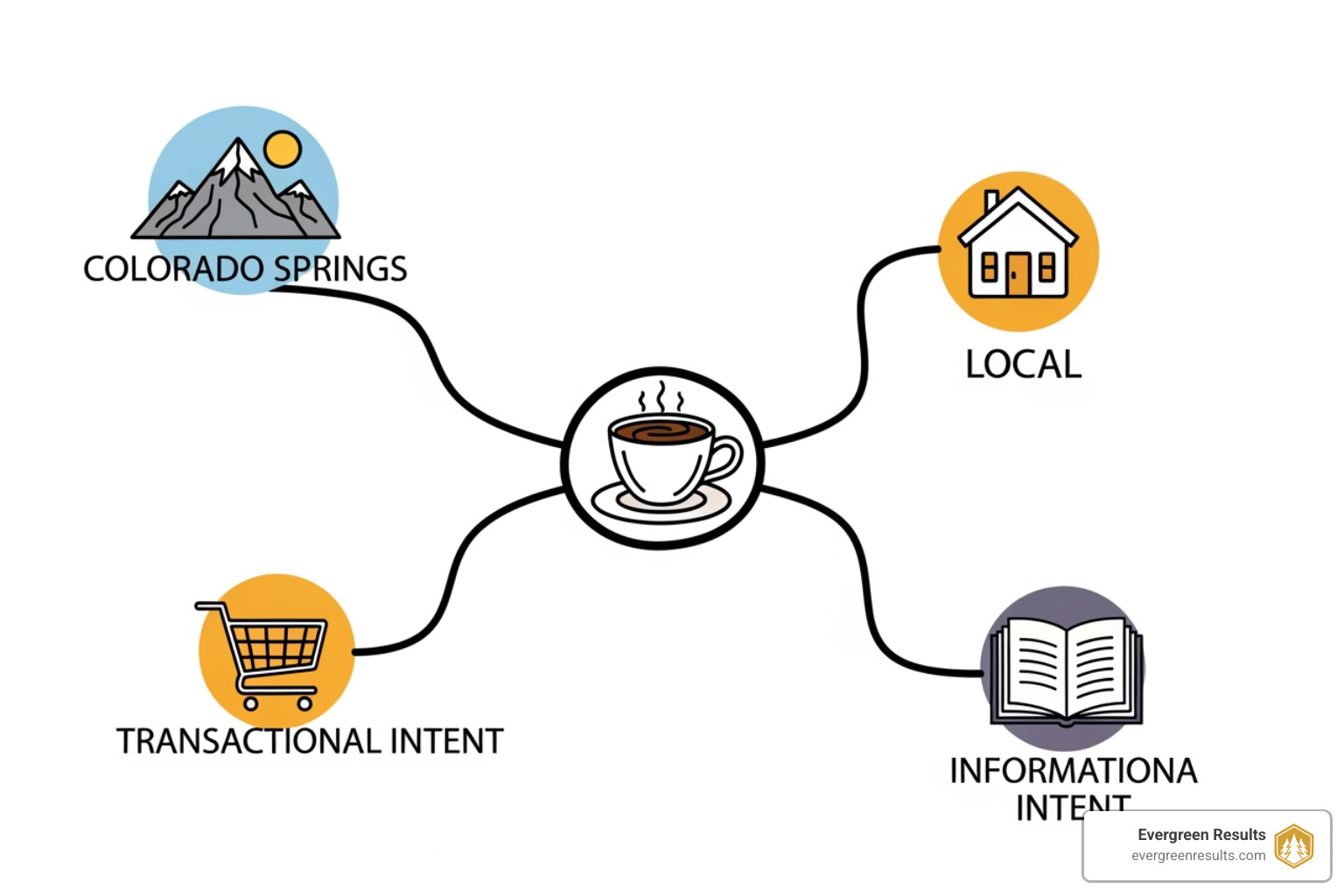
Beyond location, you must understand why people are searching. Are they looking for information (informational intent) like “best hiking trails Colorado Springs”? Are they ready to buy (transactional intent) with a search for “buy mountain bike Colorado Springs”? Or are they comparing options (commercial investigation intent) with “mountain bike rental reviews Colorado Springs”?
Each intent requires a different approach: informational searches need blog posts, transactional searches need clear product pages, and commercial investigation searches need reviews and comparison content.
Start with seed keywords—the basic terms for your business, like “coffee shop” or “cafe.” Then, add local magic with geographic modifiers: “Old Colorado City coffee shop” or “cafe near Garden of the Gods.” Think about local landmarks your customers use when searching. Put yourself in their shoes: what would you type into Google to find your business?
Identifying High-Value Keywords for Your Audience
Focus on keywords that drive results. Search volume indicates monthly searches; high volume means more traffic but also more competition. Keyword difficulty estimates how hard it is to rank. Targeting specific, less competitive phrases often yields faster wins.
Relevance is crucial. Ensure every keyword directly connects to what you sell and what your Colorado Springs customers need. Finally, look for commercial intent with words like “buy,” “service,” or “near me.” These are your money keywords.
Tools like Google Keyword Planner, Google Trends, and AnswerThePublic help uncover what your audience is searching for, revealing seasonal patterns and related queries. For a deeper dive, this resource offers valuable insights: Unlocking the Power of Keywords: A Comprehensive Guide to SEO Strategies.
Effective Tools and Techniques for Colorado Springs Keyword Research
Effective keyword research doesn’t require a huge budget. Google Search Console shows the exact keywords people use to find your site, your rankings, and click-through rates. Your Google Business Profile Insights reveals how customers find you, shaping your local strategy.
“People Also Ask” boxes in search results are content gold, offering ready-made long-tail keyword ideas. AnswerThePublic visualizes questions and comparisons around your keyword, perfect for planning informational content.
Some of the best research happens outside of SEO tools. Local Facebook groups, the r/ColoradoSprings subreddit, and Nextdoor reveal how real people ask for recommendations. When someone posts “Where can I find the best gluten-free bakery in Colorado Springs?”—that’s your keyword.
Local directories like Yelp and your Chamber of Commerce site show how businesses are categorized and what terms customers use. Even Google Maps is a research tool; search your service to see which businesses rank and analyze their keyword usage.
The goal is to understand how your neighbors think and talk. When you speak their language, they find you. Learn more about our SEO Colorado services.
Advanced Keyword Strategies for the Pikes Peak Region
Once you’ve mastered the basics, it’s time to dig deeper into the local customer journey. Colorado Springs keyword research becomes powerful when you understand the nuances of our market.
Colorado Springs is a collection of distinct neighborhoods. A search for a restaurant in Broadmoor differs from one in Fountain. Military families near Peterson Space Force Base search differently than tourists in Old Colorado City. Understanding these differences is key to a great keyword strategy.
The Power of Long-Tail Keywords in Your Colorado Springs SEO Strategy
The magic is often in long-tail keywords—longer, more specific phrases that reveal exact user intent. Instead of “pizza,” a user might search for “best gluten-free pizza delivery near Garden of the Gods.” If you appear in that search, you’ve likely found a customer.
These phrases of three or more words are conversational and align with voice searches on Siri or Alexa. Someone asking, “Where can I find a dog-friendly patio restaurant in downtown Colorado Springs?” is ready to go.
Long-tail keywords deliver higher conversion rates. A search for “emergency 24-hour plumber Widefield Colorado Springs” indicates an urgent need. They also face less competition. While many businesses fight for “coffee shop Colorado Springs,” fewer target “organic fair trade coffee shop with outdoor seating Old Colorado City.” That specificity is your advantage.
For local businesses, consider phrases like “best thin-crust pizza delivery Briargate” or “easy hiking trails for families near Garden of the Gods.” These are answers to real customer questions.
| Feature | Short-Tail Keywords | Long-Tail Keywords |
|---|---|---|
| Length | 1-2 words | 3+ words (often conversational) |
| Search Volume | High | Lower (individually), High (collectively) |
| Competition | Very High | Lower |
| Intent | Broad, general | Specific, detailed |
| Conversion Rate | Lower | Higher |
| Example (COS) | “SEO Colorado Springs” | “affordable SEO services for small business Colorado Springs” |
Analyzing Competitor Keyword Strategies in Colorado Springs
Your competitors are already ranking for keywords you want. Analyze their strategy to build a better one. Identify who competes with you in search results—it might be a local tourism site, not just a direct business competitor.
The real gold is in finding keyword gaps where your competitors aren’t showing up. Perhaps they’re ignoring the Powers Corridor or overlooking seasonal terms. These gaps are your chance to capture traffic they’re missing.
We analyze how competitors use keywords in their content. Are they creating comprehensive guides or quick blog posts? What topics are they ignoring? This tells us where we can create better content for your customers. Their backlink profiles and on-page optimization also provide valuable lessons. For a detailed look, check out How Can Colorado Businesses Utilize Competitor Keyword Analysis?.
Common Mistakes to Avoid in Colorado Springs Keyword Research
Avoid these common keyword research pitfalls.
Ignoring search intent is a huge mistake. High-volume traffic is worthless if it doesn’t match what you offer. Ranking for “Pikes Peak weather” won’t sell hiking gear.
Targeting keywords that are too broad is another trap. “Colorado Springs marketing” is competitive and vague. “Digital marketing for breweries Colorado Springs” is more specific and attracts qualified leads.
Keyword stuffing is an outdated practice that hurts your rankings. Cramming keywords unnaturally makes content unreadable. Write for humans first, then optimize for search engines.
Forgetting negative keywords in paid ad campaigns can drain your budget. These tell Google what not to show your ads for, like excluding “cheap” if you’re a high-end restaurant.
Not tracking results means you’re flying blind. Monitor rankings, traffic, and conversions to understand what’s working and refine your strategy.
Finally, neglecting neighborhood-specific terms is a critical error. A Briargate resident won’t drive to Fountain for a dentist. Use terms like “Briargate family dentist” to connect with customers in your service area.
From Research to Results: Implementing and Measuring Your Keyword Strategy
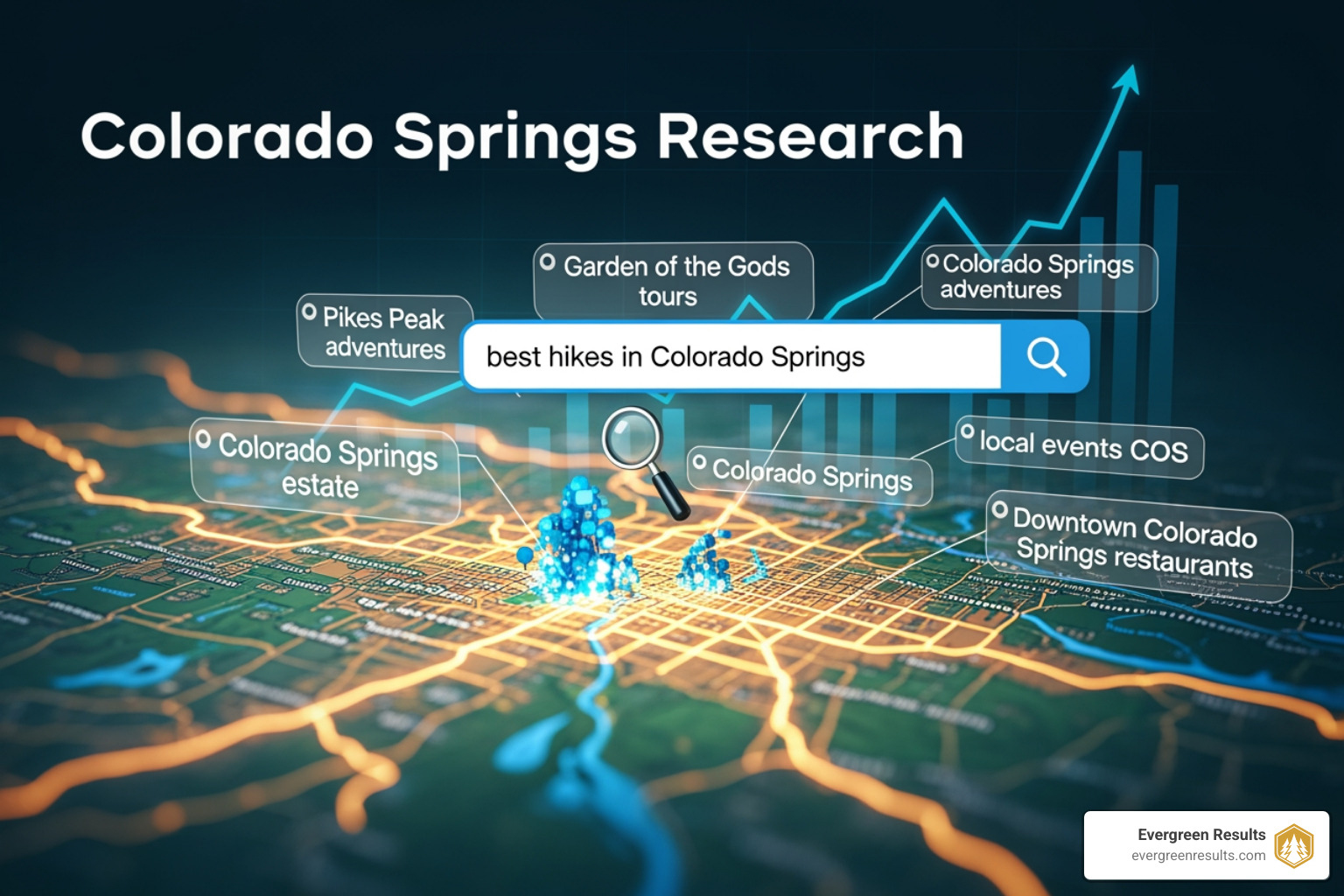
Colorado Springs keyword research is only valuable if you use it. A great map is useless if you don’t start the hike. This is where keyword mapping—the process of assigning specific keywords to specific pages—comes in. It ensures every piece of content has a clear purpose and targets the right user intent.
Tying Keywords to Content Creation and On-Page SEO
Your keywords should guide your content strategy. We create content clusters around broad topics. For an outdoor gear shop, a pillar page on “Colorado Springs Hiking” could link to specific articles like “Best Family Hikes Near Manitou Springs” and “Dog-Friendly Trails Colorado Springs.” This structure establishes your authority with Google.
Different content serves different purposes. Blog posts target informational keywords (“how-to” guides). Service pages focus on transactional keywords, describing what you offer. Location pages are essential for serving multiple neighborhoods, each optimized for local searches.
On-page SEO elements make this work. Your title tag, the clickable headline in search results, should include your primary keyword and be under 60 characters. Meta descriptions are your 30-second pitch to earn the click. Header tags (H1, H2, H3) organize content for readers and search engines. Your H1 should contain your main keyword.
Image alt text describes images for visually impaired users and search engines, giving you another place for keywords. Internal linking connects your content, passes SEO value between pages, and shows search engines how your pages relate. For more on these strategies, see our work as a Colorado Internet Marketing Company.
Measuring the Success of Your Keyword Efforts
Tracking results is as important as the research itself. We focus on keyword ranking tracking to see if your target terms are climbing in search results. Organic traffic growth shows if your overall strategy is working. Click-through rate (CTR) reveals if your search listings are compelling; a high CTR can improve rankings.
Conversion rate is what matters. Are visitors filling out forms, making purchases, or calling your business? This metric connects SEO directly to business results. We calculate the ROI of SEO to show how your investment translates into revenue.
We use Google Analytics and Google Search Console to track these metrics. Search Console is especially valuable, showing which keywords drive impressions and clicks, allowing us to refine your strategy with real data.
Keyword Examples for Top Colorado Springs Industries
Here are examples for top Colorado Springs industries:
- Active Lifestyle: “hiking trails near Garden of the Gods,” “mountain bike rentals Colorado Springs,” “Pikes Peak gear shop,” “rock climbing gyms Colorado Springs,” “fly fishing guides Arkansas River.”
- Food & Beverage: “craft breweries with patios Colorado Springs,” “farm to table restaurants in Old Colorado City,” “best breakfast downtown Colorado Springs,” “vegan cafes near UCCS.”
- Tourism: “things to do Colorado Springs,” “Pikes Peak tours,” “Garden of the Gods visitor center,” “family attractions Colorado Springs,” “hotels near Cheyenne Mountain Zoo.”
- Real Estate: “homes for sale Briargate,” “Colorado Springs real estate agents,” “new construction homes Powers Corridor,” “military relocation specialist Colorado Springs.”
- Healthcare: “primary care physicians Colorado Springs,” “dentist near Peterson Space Force Base,” “urgent care walk-in clinic Colorado Springs,” “pediatrician Colorado Springs.”
These examples show how specific, location-focused keywords connect you with ready customers. That’s the power of strategic keyword research.
Frequently Asked Questions about Colorado Springs Keyword Research
How does keyword research differ for a business in Briargate versus Downtown Colorado Springs?
The difference is significant. Colorado Springs is a collection of distinct neighborhoods with unique demographics and search patterns.
For example, Briargate is family-oriented, so searches reflect that: “family dentist Briargate” or “preschools North Colorado Springs.” Users there value convenience and kid-friendly options.
Downtown, you’ll find tourists and professionals. Keywords shift to “restaurants near Pikes Peak Center” or “boutique shops downtown Colorado Springs.”
Google’s algorithm understands micro-proximity, so results for “best pizza near me” will differ between Briargate and Old Colorado City. This makes neighborhood-specific SEO essential. Your Colorado Springs keyword research must account for these local variations to be effective.
How long does it take to see results from targeting new keywords?
SEO is a long-term investment; quick tricks don’t work, which means your hard-earned rankings are more secure. For most local businesses, you can expect to see initial results within 4-6 months, such as climbing rankings and increased organic traffic. Reaching the top three spots for highly competitive keywords can take a year or more.
Several factors influence this timeline:
- Competition level: Ranking for “Colorado Springs restaurants” is harder than for “gluten-free bakery Briargate.”
- Website authority: An established site will see results faster than a new one.
- Content quality: Google rewards comprehensive, helpful content.
- Technical SEO: Site speed and mobile-friendliness are foundational.
Consistency is key. The businesses that commit to the process build sustainable growth, and the results compound over time.
Should I include “Colorado Springs” in all my keywords?
The answer is nuanced: it depends. Including “Colorado Springs” or neighborhood names like “Manitou Springs” is often powerful, sending clear location signals to search engines and users.
However, forcing “Colorado Springs” into every keyword is counterproductive. Google’s algorithms detect this keyword stuffing and may penalize your site. It also makes your content sound robotic.
Google often understands local intent without the city name. A search for “dentist” on a phone in Colorado Springs will show local results. This is why optimizing your Google Business Profile is critical for appearing in local map packs and “near me” searches.
Our approach to Colorado Springs keyword research is balanced. We use geo-modifiers where they fit naturally, but we always prioritize writing for humans first. When you focus on answering customer questions with natural language, the SEO tends to fall into place.
Conclusion: Charting Your Course to Local SEO Success
Think of Colorado Springs keyword research as the map you need to steer the digital landscape of our unique market. It provides a clear roadmap to the summit of local SEO success.
We’ve covered how understanding customer search language—from high-value local terms to long-tail keywords that capture ready-to-buy customers—creates a comprehensive strategy. This isn’t a one-time task; it’s the ongoing foundation for your content, site structure, and Google Business Profile.
Businesses that commit to this continuous effort achieve sustainable growth. They build genuine connections by showing up exactly when and where people need them, whether it’s a search for an emergency plumber or a dog-friendly brewery.
At Evergreen Results, we are passionate about helping Colorado businesses thrive. As part of the Pikes Peak region, we understand its nuances. We know the difference between Briargate and Broadmoor and bring that local expertise to every strategy we create.
Your business deserves to be found by the people who need you most. With the right keyword strategy, you can capture more qualified traffic, convert more customers, and build sustainable growth.
Ready to put these insights into action and see real results for your Colorado Springs business?
Partner with our Colorado Springs SEO agency to grow your business