
How to Build a Community That Actually Likes You
Why Community Engagement Strategies Determine Whether People Actually Care About Your Brand
community engagement strategies are the methods you use to build real, two-way relationships between your brand and the people you serve — turning passive followers into active participants who genuinely invest in what you’re doing.
Here are the core strategies at a glance:
- Build trust through transparency — show people how their input shapes your decisions
- Make participation easy and inclusive — remove barriers like language, access, and format
- Use multiple channels — mix in-person events, online spaces, and social platforms
- Partner with trusted organizations — CBOs and influencers extend your reach authentically
- Recognize and reward contributors — spotlights, contests, and re-engagement campaigns keep momentum alive
- Measure what matters — track retention, sentiment, and behavioral shifts, not just likes
- Treat it as ongoing, not one-off — real community takes consistent effort over months, not a single campaign
Most brands get this wrong. They broadcast. They post. They wait. And then they wonder why nobody shows up.
The difference between a brand people scroll past and one people rally around comes down to whether you’ve built a genuine sense of ownership and shared purpose — not just a following.
I’m Adam Bocik, founder of Evergreen Results, and I’ve spent years helping active lifestyle brands develop community engagement strategies that turn audiences into loyal advocates through smarter digital marketing and authentic storytelling. In this guide, I’ll walk you through everything you need to build a community that actually likes you — and sticks around.
community engagement strategies word list:
Core Principles of Successful Community Engagement Strategies
Building a thriving community isn’t about shouting into a megaphone; it’s about building a table where everyone has a seat. Whether we are working with a local government in Boulder, CO or an active lifestyle brand in Denver, the foundation remains the same. Successful community engagement strategies are built on five basic guiding principles: increasing knowledge, co-creating solutions, applying that knowledge to improve the community, creating future opportunities for involvement, and maintaining ongoing communication.
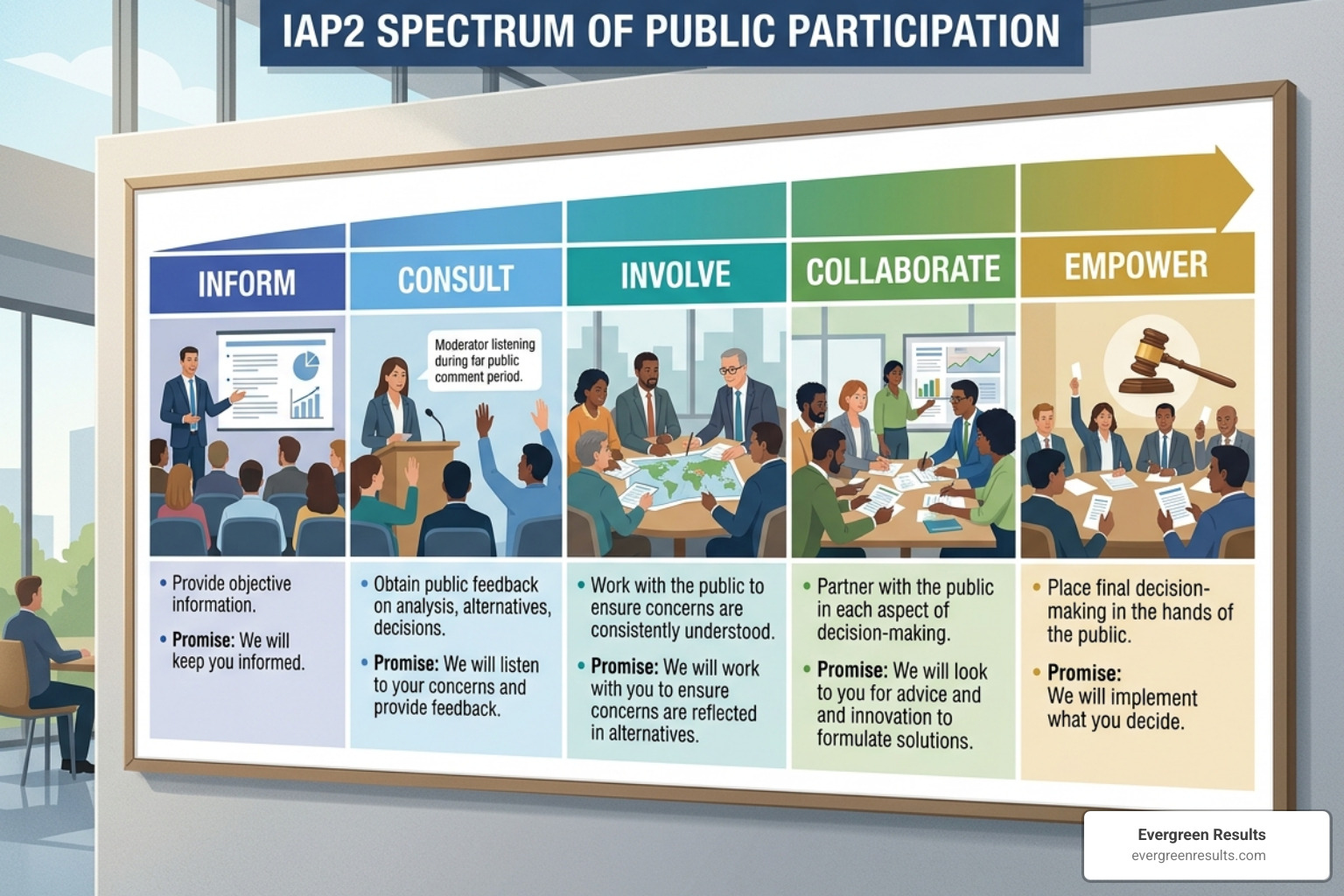
At the heart of modern engagement is the IAP2 framework. This spectrum moves from simply informing the public to fully empowering them. True partnership occurs when we delegate power. Instead of telling a neighborhood in Aurora what we’re going to do, we ask them how we can do it together. This shift from “doing for” to “doing with” is what builds a sense of ownership.
Transparency is our best friend here. If people don’t know how their feedback is being used, they’ll stop giving it. We recommend Developing a Community Engagement Plan that outlines exactly how input will be processed. For nonprofits, this is the lifeblood of the organization. When stakeholders feel their voice matters, trust grows, and engagement becomes a self-sustaining cycle rather than a chore.
Setting SMART Goals and Stakeholder Analysis
Before we start any campaign, we need to know where we’re going. We use SMART objectives—Specific, Measurable, Attainable, Relevant, and Time-bound—to keep our efforts on track. For example, instead of saying “we want more engagement in Lakewood,” we might say “we want to increase attendance at our monthly community workshops by 20% over the next six months.”
A critical step is stakeholder analysis. Not everyone in the community has the same needs or influence. We map out our audience by creating personas. Who are they? What do they care about? What are their barriers to participating? In places like Castle Rock or Englewood, this might mean identifying local business owners, active parents, or outdoor enthusiasts.
We also look at resource allocation. Do we have the budget for a large-scale event, or should we focus on digital-first outreach? By conducting a situational analysis, we can understand the local context and How to Plan for Community-Driven Outreach and Engagement effectively. This ensures we aren’t just guessing but are building a strategy that fits the actual community on the ground.
Frameworks for Community Engagement Strategies
Several frameworks can guide our work. One of the most famous is Arnstein’s Ladder, which describes different levels of citizen participation, from “manipulation” at the bottom to “citizen control” at the top. While it’s an older model, it reminds us that true engagement requires sharing power.
Another powerful approach is Asset-Based Community Development (ABCD). Instead of focusing on what a community lacks (deficits), ABCD looks at what it already has—skills, local groups, and physical assets. We’ve discussed this concept of building from within in our Podcast on strengthening your core and community. By mapping these assets, we can foster people-centered development that feels authentic.
We also utilize Collective Impact for complex problems that require multiple organizations to work together. This requires a common agenda and shared measurement systems. Whether we are building social capital through Appreciative Inquiry or organizing a place-based initiative, these frameworks provide the “why” behind the “how.”
Overcoming Barriers to Meaningful Participation
Even the best-laid community engagement strategies can hit a wall. Common barriers include:
- Trust erosion: If a community feels ignored in the past, they won’t show up now.
- Low awareness: People can’t participate in things they don’t know about.
- Internal misalignment: If different departments in an organization aren’t on the same page, the message gets fragmented.
- Accessibility issues: Scheduling meetings during work hours or only offering digital options can exclude large groups.
- Process design flaws: Overly complicated surveys or intimidating formal hearings can scare people off.
We believe in the philosophy found in our Podcast on keeping people your top priority. To overcome these hurdles, we must prioritize psychological safety. This means creating environments where people feel safe to share their thoughts without fear of judgment.
In diverse areas like Fort Collins or Colorado Springs, providing language-specific resources and addressing the digital divide is essential. If a resident doesn’t have high-speed internet, a “digital-only” engagement strategy is an exclusion strategy. We bridge this gap by offering hybrid options—mixing online polls with physical kiosks or paper surveys.
Partnering with Community-Based Organizations (CBOs)
Government agencies and brands often struggle to reach “hard-to-reach” groups. That’s where Community-Based Organizations (CBOs) come in. These are the faith-based groups, neighborhood associations, and local nonprofits that already have the community’s trust. We’ve explored this collaborative spirit in our Podcast on a vision to help raise kids.
When partnering with CBOs, we don’t just ask them for favors; we build long-term collaborations based on mutual objectives. We provide them with customized media kits—complete with unique QR codes—to track how their members are engaging. This allows us to see which partnerships are most effective and ensures we are capturing a representative sample of the community.
It’s important to acknowledge historical sentiment. If a specific neighborhood in Englewood has been negatively impacted by past decisions, we lead with empathy and transparency. By maintaining a shared system of record, we can document these relationships and ensure that our engagement efforts are respectful and consistent over time.
Proven Community Engagement Strategies for Modern Brands
The world has changed, and so has the way we connect. Modern community engagement strategies often use a hybrid model, blending the best of the digital and physical worlds.
| Strategy | Complexity | Resources | Main Advantage |
|---|---|---|---|
| Asset-Based Development | Medium | Low | Sustainable; builds on existing strengths. |
| Collective Impact | High | High | Solves complex, multi-sector problems. |
| Participatory Budgeting | High | Medium | High trust; direct community control. |
| Community of Practice | Medium | Medium | Deep knowledge sharing and loyalty. |
In places like Boulder and Denver, place-based organizing is incredibly effective for active lifestyle brands. By focusing on a specific geographic area, we can create events that feel like local celebrations rather than corporate promotions. We also look at participatory budgeting, where community members get a direct say in how funds are spent. This is the ultimate form of “skin in the game.”
For brands looking to deepen their connection, we often suggest Connecting audience tips for social marketing to ensure that every digital touchpoint feels human and relevant.
Online Community Engagement Strategies
Online communities are governed by the 90-9-1 rule: 90% of members lurk, 9% contribute occasionally, and 1% are power users who create most of the content. Our goal is to nudge people from the 90% into the 9%.
We do this through tactical ideas like:
- AMAs (Ask Me Anything): Bringing in experts or brand leaders for live Q&A sessions.
- Tip Tuesday: Sharing valuable, bite-sized advice that encourages comments.
- Member Spotlights: Publicly recognizing contributors to make them feel valued.
- Seed Content: Sourcing questions or topics directly from members to spark discussion.
Creating Engaging social media content is about more than just pretty pictures; it’s about starting a conversation. If a community goes quiet, we use re-engagement campaigns. Surprisingly, these can have success rates upwards of 30%. Sometimes, all an inactive member needs is a personalized “we miss you” or a specific reason to come back, like a contest or a new Discord hype channel. For more on this, check out our guide on Serving up content on social media.
Tactical Community Engagement Strategies for Growth
For our active lifestyle and food/beverage clients in Colorado, we love using “cultural heat” to drive engagement. Viral product drops are a perfect example. By using FOMO (Fear Of Missing Out) psychology and scarcity, we can turn a simple product launch into a community event. People aren’t just buying a new flavor of energy drink; they are participating in a moment.
Influencer programs are another cornerstone. However, we prefer building micro-influencer teams over hiring one-off “stars.” These are relatable humans—the trail runners in Castle Pines or the home brewers in Monument—who have high engagement rates and genuine trust. We give them creative freedom because their audience can smell a “scripted” post from a mile away.
This approach builds social proof and long-term loyalty. We’ve discussed the ethics and impact of these efforts in our Podcast on doing your good. By focusing on Social media brand engagement, we ensure that our growth isn’t just fast—it’s sustainable.
Measuring Impact and Sustaining Long-Term Growth
How do we know if our community engagement strategies are actually working? We look beyond “vanity metrics” like likes and follows. Instead, we focus on Key Performance Indicators (KPIs) like retention rates, sentiment analysis (are people happy or frustrated?), and behavioral shifts.

One advanced tool we use is Social Network Analysis (SNA). SNA helps us visualize the “invisible” connections in a community. Who are the real influencers? Where are the gaps in communication? By mapping these relationships, we can optimize our resources. We also use data triangulation—mixing surveys, digital analytics, and in-person feedback—to get a full picture of our impact.
Feedback loops are vital. When we hit a milestone, we celebrate it with the community. This reinforces the idea that their participation led to a win. To prevent leadership burnout, we empower community organizers within the group to take ownership of certain tasks. This keeps the energy high and ensures the community can thrive even if we take a step back.
Frequently Asked Questions about Community Engagement
What is the difference between community engagement and customer service?
While they both involve talking to people, they are fundamentally different. Customer service is reactive; it’s about solving an individual transaction or problem after it happens. community engagement strategies are proactive. They focus on building long-term, peer-to-peer relationships and ongoing dialogue. Customer service fixes a broken widget; community engagement builds a group of people who love your brand so much they’ll help you design the next widget.
How long does it take to see results from engagement strategies?
Building a real culture takes time. Usually, we tell our clients in Denver or Fort Collins to expect a 6-12 month timeline before they see significant organic growth. The first few months often feel slow—you might feel like you’re talking to yourself. But persistence is key. Once you hit a “critical mass” of engaged members, the momentum starts to build on its own.
What are the five levels of the IAP2 spectrum?
The IAP2 spectrum includes:
- Inform: Providing the public with balanced and objective information.
- Consult: Obtaining public feedback on analysis, alternatives, or decisions.
- Involve: Working directly with the public to ensure their concerns are consistently understood and considered.
- Collaborate: Partnering with the public in each aspect of the decision.
- Empower: Placing final decision-making authority in the hands of the public.
Conclusion
At Evergreen Results, we don’t just “do marketing.” We build communities. Whether you are an active lifestyle brand in Boulder or a food and beverage company in Colorado Springs, your success depends on the strength of your relationships.
By focusing on authentic community engagement strategies, personalized SEO solutions, and campaigns that actually resonate, we help you drive sustainable growth. Don’t settle for a following when you can have a community. Start building your community today and see the difference that genuine connection can make for your brand.