
Why Your Active Lifestyle Brand Needs Sustainable Digital Marketing Now
Sustainable digital marketing is the practice of promoting your brand while minimizing environmental impact and maximizing social good. It balances business growth with planetary health through energy-efficient campaigns, ethical data practices, and transparent messaging.
Quick Answer: What is Sustainable Digital Marketing?
– Environmental focus: Reducing digital carbon emissions from ads, websites, and data centers
– Social responsibility: Creating inclusive content and supporting community wellbeing
– Economic viability: Building long-term customer loyalty through authentic values alignment
– Transparency: Backing up sustainability claims with real data and actions
Here’s the reality: every click, scroll, and ad impression creates a small carbon footprint. Digital advertising alone accounts for over 1% of global energy consumption – comparable to the entire airline industry’s emissions. Meanwhile, 81% of consumers expect companies to help improve the environment, and 88% are more likely to trust brands that are transparent about their environmental impact.
For active lifestyle brands, this creates both a challenge and an opportunity. Your customers already care deeply about the outdoors and healthy living. They’re looking for brands that share their values – not just in product design, but in how you market those products.
The good news? Sustainable digital marketing often performs better while costing less. Optimized websites load faster. Targeted campaigns waste fewer impressions. Authentic messaging builds stronger communities. It’s marketing without the mess.
I’m Adam Bocik, founder of Evergreen Results, where I help active lifestyle brands scale through intentional digital strategies that align with their values. Having worked with outdoor and wellness companies for years, I’ve seen how sustainable digital marketing creates deeper customer connections while reducing environmental impact.
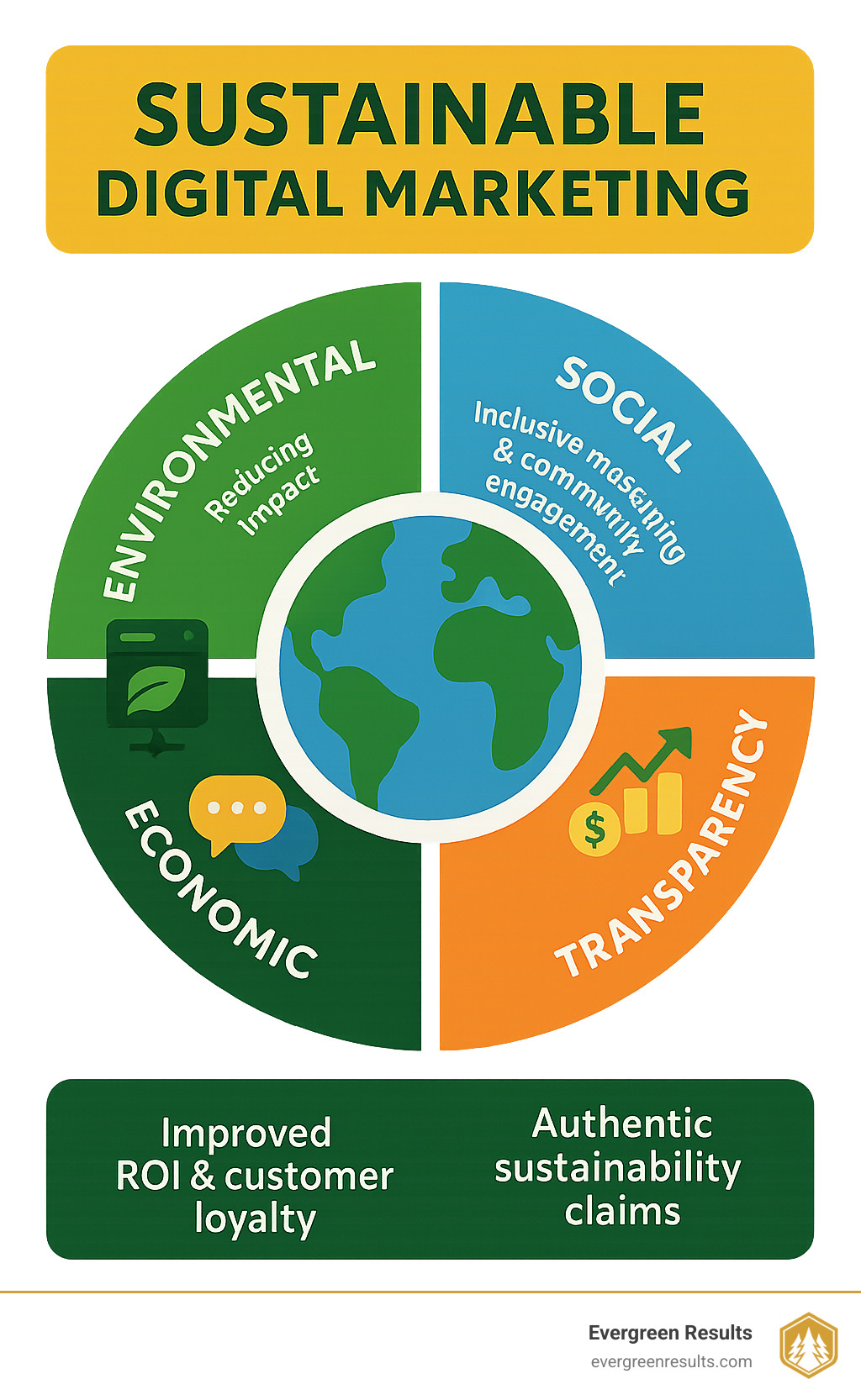
Sustainable digital marketing basics:
– billboard advertising
– digital billboard
– outdoor branding
Sustainable Digital Marketing: Definition, Impacts & Importance
Sustainable digital marketing applies the triple bottom line—people, planet, and profit—to every marketing decision we make.
Here’s what most marketers don’t realize: our digital campaigns have a very real physical footprint. Every click, video stream, or website load triggers energy consumption in data centers worldwide. These facilities don’t just run campaigns—they consume electricity 24/7 for servers and cooling systems.
A large share of data-center emissions comes from this constant energy demand. When you launch programmatic advertising, you’re renting space in multiple energy-hungry data centers.
But the impact goes beyond carbon emissions. Traditional digital marketing often treats people like walking wallets, contributing to privacy erosion and platform decay, where social spaces become polluted with manipulative content designed to extract attention rather than provide value.
For active lifestyle brands, this creates real tension. Your customers love the outdoors because they value authentic experiences. They can spot inauthentic marketing from a mile away—and they’ll call it out.
The good news? Your customers are already on board. Survey data on eco-conscious consumers reveals that 70% of consumers are more likely to choose brands that take meaningful steps toward sustainability. For outdoor brands, this number climbs even higher.
Consumer trust becomes your competitive advantage when you align marketing practices with values. People don’t just want sustainable products—they want to see sustainability woven into how you talk about those products.
The UN SDGs (Sustainable Development Goals) offer a helpful framework. Goals like Quality Education, Gender Equality, and Responsible Consumption directly connect to marketing decisions. When you create inclusive campaigns or promote mindful consumption, you’re contributing to these global objectives while building stronger customer relationships.
Environmental & Social Impact Snapshot
Digital advertising accounts for approximately 1% of global energy consumption—comparable to the entire airline industry’s carbon footprint.
The environmental impact starts with data centers—the invisible infrastructure powering every campaign. These facilities need massive electricity not just to run, but to stay cool. Many still depend on fossil fuels, making every poorly optimized campaign a direct contributor to carbon emissions.
Privacy erosion represents another hidden cost. When we collect excessive data or use dark patterns, we contribute to platform decay—the slow degradation of digital spaces that were once valuable for genuine human connection.
The social impacts hit close to home for active lifestyle brands. Excessive advertising can fuel mental health issues and exclude diverse voices from outdoor narratives. We have the power to promote healthy relationships with outdoor activities instead of contributing to comparison culture.
Why 2025 Is a Tipping Point for Sustainable Digital Marketing
Several forces are colliding to make 2025 pivotal for sustainable digital marketing. Regulation is tightening fast. Privacy laws like GDPR and CCPA are just the opening act. We’re seeing proposed legislation around digital carbon reporting that will fundamentally change how campaigns get measured.
Gen Z spending power is reaching critical mass. 54% are willing to pay 10% more for sustainable products, but they’re not just evaluating product sustainability—they’re scrutinizing how those products get marketed to them. They can spot greenwashing instantly and will publicly call it out.
Brand differentiation through traditional means is getting harder. Product features get copied within months. But authentic values integration? That’s much harder to replicate because it requires genuine organizational change.
For active lifestyle brands specifically, this represents a massive opportunity. Your customers already understand the connection between healthy ecosystems and outdoor recreation. When you align your marketing practices with these values, you create a competitive advantage that’s incredibly difficult for others to copy.
Building & Measuring a Sustainable Digital Marketing Strategy
Creating a sustainable digital marketing strategy requires a complete shift in how we think about marketing success. Instead of “spray and pray,” we need systems thinking that considers how every campaign decision impacts the environment, society, and your business.
This is where the duty-of-care framework comes in. Rather than treating sustainability as an add-on, it becomes central to every marketing decision. When planning a campaign, you’re asking “Will this drive conversions?” but also “What’s the environmental cost?” and “How does this serve our community?”
Stakeholder mapping takes on new meaning. You’re considering customers and shareholders, but also the hiking trails where your products are used, manufacturing communities, and future generations who’ll inherit the environmental consequences of today’s marketing choices.
Setting SMART carbon goals transforms vague sustainability commitments into actionable targets. Instead of promising to “be greener,” you might commit to reducing your website’s carbon emissions by 30% over 12 months or achieving carbon-neutral advertising by 2026.
| Traditional KPIs | Sustainable KPIs |
|---|---|
| Cost per click | Carbon per conversion |
| Impressions delivered | Quality impressions (relevant audience) |
| Email open rates | Opt-in engagement rates |
| Page views | Time spent with content |
| Revenue growth | Customer lifetime value |
| Ad frequency | Message resonance |
Key Principles of a Sustainable Digital Marketing Strategy
The heart of sustainable digital marketing beats to a simple rhythm: reduce, reuse, renew—and be completely transparent about your journey.
Reduce means cutting the fat from your marketing operations. This looks like smarter targeting that eliminates wasted ad impressions, optimized websites that load faster while using less energy, and data collection practices that gather only what truly helps you serve customers better.
Reuse is about squeezing every drop of value from your existing assets. That comprehensive guide you published last year? Update it with fresh insights rather than starting from scratch. Create evergreen content that educates and inspires for years, not disposable posts that fade in days.
Renew takes you beyond doing less harm to actually doing good. This might mean campaigns that teach Leave No Trace principles, content that promotes mental health through outdoor activities, or partnerships with trail maintenance organizations.
Authenticity ties it all together. Share your sustainability goals publicly, report your progress honestly, and admit when you mess up. Your customers can spot greenwashing from a mountain peak away—they want real commitment, not perfect marketing copy.
Aligning With the UN SDGs & Corporate Sustainability Goals
The UN Sustainable Development Goals are practical guideposts for sustainable digital marketing. Instead of trying to tackle all 17 goals, focus on the handful that genuinely align with your brand’s mission and your customers’ values.
For active lifestyle brands, natural connections include promoting Good Health and Well-being through encouraging outdoor activity, supporting Quality Education by teaching outdoor skills, and advancing Gender Equality by showcasing diverse athletes.
Climate Action and Life on Land goals resonate deeply with customers who love nature. Your marketing can support watershed protection, promote responsible recreation practices, and raise awareness about climate impacts on outdoor spaces.
The key to authentic SDG integration is internal buy-in. This can’t just be a marketing department initiative—your whole team needs to understand and support these goals.
Measuring Your Digital Carbon Footprint & Social Impact
Understanding your digital carbon footprint starts with Scope 3 emissions—the indirect impacts of your marketing activities. Every time someone views your ad, visits your website, or opens your email, energy gets consumed across data centers, networks, and devices.
Energy dashboards should become as essential as your Google Analytics. Track metrics like carbon emissions per website visit, the energy efficiency of your hosting setup, and how much data you’re transferring with each page load.
For measuring social impact, look beyond traditional metrics. Are you featuring diverse voices in your content? Is your community engaging meaningfully with your sustainability initiatives? Are people actually changing their behavior based on your educational content?
Lightweight analytics tools like Plausible or Simple Analytics can reduce your measurement footprint by up to 94% compared to heavier platforms while still providing the insights you need.
More information about measuring marketing success can help you build comprehensive measurement frameworks that track both business performance and sustainability impact.
Channel-Specific Low-Carbon Tactics

The beauty of sustainable digital marketing lies in the details—small optimizations across every channel that add up to significant environmental and performance improvements.
Optimization becomes your north star across all channels. It’s about doing more with less energy, data, and resources while actually improving your results.
Frequency capping might be the single most powerful tactic you can implement today. Instead of hitting your audience with the same ad repeatedly, set intelligent limits based on actual conversion data. Most marketing lift happens within the first few exposures anyway.
Green hosting should be as fundamental as having a business license. When your hosting provider runs on renewable energy, you can cut your website’s carbon footprint by up to 70%. The bonus? These providers often invest heavily in efficient infrastructure, which means faster loading times.
Ethical data practices mean treating data like water on a desert hike—precious and not to be wasted. Collect only what you’ll actually use, store it efficiently, and clean out the old stuff regularly.
Inclusive content serves both your values and your efficiency goals. When you create content that resonates with diverse audiences, you reduce the need for multiple targeted campaigns.
Programmatic Advertising Without the Pollution
Programmatic advertising has earned a reputation for waste—those millions of irrelevant impressions that consume energy without delivering value. But it doesn’t have to be this way. The secret is treating programmatic like precision targeting rather than spray-and-pray advertising.
Digital waste happens when ads get served to people who will never be interested, displayed on low-quality websites, or passed through unnecessarily complex supply chains. Each additional step adds energy consumption and carbon emissions. Follow @illuminHQ for ongoing insights on sustainable programmatic practices.
Smart targeting using your first-party data can dramatically reduce this waste. Instead of casting a wide net, use what you know about your customers to identify high-intent audiences. This approach typically delivers better conversion rates while consuming significantly less energy.
When selecting carbon-neutral data centers and programmatic partners, ask direct questions about their energy sources and carbon footprint transparency. More platforms are operating on renewable energy, but you have to specifically seek them out.
Green Web Hosting & Sustainable Site Performance
Your website is like base camp for all your digital marketing efforts, so choosing eco-friendly web hosting is one of the most impactful decisions you can make.
Renewable-energy servers can reduce your website’s carbon footprint by 60-80% compared to traditional hosting. Look for providers powered by solar, wind, or hydroelectric energy. The performance benefits often match the environmental ones—these providers typically invest in cutting-edge, efficient infrastructure.
Image compression might sound technical, but it’s straightforward and incredibly effective. Large, unoptimized images are like carrying a full pack when you only need a day bag. Modern formats like WebP can reduce file sizes by 40-60% without any visible quality loss.
Lazy loading prevents images and videos from loading until users actually scroll to them. This reduces initial page weight and energy consumption, especially for visitors who don’t scroll through entire pages.
The code optimization piece involves cleaning up your website’s underlying structure—minifying CSS and JavaScript, removing unused code, and reducing HTTP requests. Clean, efficient code loads faster and consumes less energy on both servers and user devices.
Sustainable Content & SEO Practices
Sustainable SEO is like building trails that last—you focus on creating lasting value rather than quick fixes that need constant maintenance.
Lightweight markup means using clean, semantic HTML that loads quickly and efficiently. Avoid unnecessary plugins, widgets, and scripts that add weight without adding real value. The susty web guidelines provide excellent frameworks for energy-efficient web design.
Evergreen content updates extend the life of your existing content rather than constantly creating new pieces from scratch. Update statistics, refresh examples, and add new insights to high-performing content.
Green keywords naturally incorporate sustainability themes into your SEO strategy. For active lifestyle brands, this might include terms like “eco-friendly outdoor gear,” “sustainable hiking practices,” or “leave no trace camping.”
Regular third-party service assessment is crucial for maintaining a lightweight digital footprint. Audit all external scripts, tracking codes, and widgets on your site quarterly. Remove anything that isn’t providing clear value.
The principles from Maximizing SEO for Food and Beverage Business apply equally to active lifestyle brands—focus on creating genuinely helpful content that serves your audience’s real needs.
Social Media & Email With a Smaller Footprint
Social media and email marketing can be surprisingly energy-intensive, but small optimizations can significantly reduce their environmental impact while improving engagement rates.
Carbon-aware scheduling means posting when your audience is most active and engaged, reducing the need for multiple posts to achieve the same reach. Use your analytics to identify peak engagement times and concentrate your posting during these windows.
Here’s a surprising fact: a single text email emits approximately 4 grams of CO₂, while emails with attachments can emit up to 50 grams. Multiply this by large email lists and frequent sends, and the carbon footprint becomes significant. The solution involves minimal email templates with optimized images and essential content only.
Opt-in lists ensure you’re only sending emails to people who genuinely want to receive them. This improves engagement rates while reducing unnecessary energy consumption from emails that go unopened.
Social media content optimization includes compressing images and videos before uploading, using platform-native formats that load efficiently, and creating content that encourages meaningful engagement rather than passive consumption.
The key is mindful resource use—planning content calendars that maximize impact while minimizing posting frequency. One piece of engaging content that sparks genuine conversations is more valuable than ten posts that get lost in the noise.
Events & Hybrid Experiences for Reduced Emissions

The events landscape has transformed dramatically, and the environmental benefits are remarkable. Virtual conferencing can reduce carbon footprint by up to 94% compared to fully in-person events while often reaching larger, more diverse audiences.
Travel emissions typically account for 70-80% of an event’s carbon footprint. A single round-trip flight can generate more emissions than months of digital marketing activities, making virtual events one of the most impactful sustainability strategies.
Digital tickets and materials eliminate printing while providing better user experiences. QR codes can link to digital programs, maps, and resources that can be updated in real-time and accessed on mobile devices.
Hybrid experiences combine the benefits of in-person connection with the accessibility and lower environmental impact of virtual participation. This approach can expand your reach while reducing overall emissions per participant.
Consider local partnerships for in-person components to reduce travel requirements while supporting local communities. Instead of bringing everyone to one central location, host simultaneous local events connected by digital technology.
Carbon offsetting should be your last resort after minimizing impact through smart design choices. If you do choose to offset remaining emissions, select verified projects that provide additional environmental benefits beyond carbon sequestration.
Frequently Asked Questions about Sustainable Digital Marketing
What’s the fastest way to lower the carbon footprint of my campaigns?
You don’t need to overhaul your entire marketing strategy overnight. The biggest impact comes from three simple changes: switching to green web hosting, implementing frequency capping, and optimizing your website performance.
Green hosting delivers the fastest wins. By moving to a provider powered by renewable energy, you can cut your website’s carbon footprint by 60-80% within just a few days. Most hosting companies offer migration services, so the technical headache is minimal. Green hosting often performs better because these providers invest in more efficient infrastructure.
Frequency capping is like putting your ads on a healthy diet. Instead of bombarding the same person with your hiking boot ad twelve times a day, cap it at 3-5 impressions. This reduces digital waste by preventing overexposure while actually improving your campaign performance. You’ll typically see a 20-40% reduction in energy consumption without hurting your results.
Website optimization gives you immediate performance gains alongside environmental benefits. Compress those gorgeous mountain photography images, clean up your code, and remove plugins you’re not actually using. When your pages load 30-50% faster, both your customers and the planet win.
How do I avoid greenwashing while promoting eco-initiatives?
Greenwashing is the sustainability equivalent of that friend who posts gym selfies but never actually works out. The antidote is radical honesty about both your wins and your struggles.
Be specific with your claims. Instead of saying “we’re eco-friendly,” share actual data: “We reduced our website’s carbon emissions by 45% this year by switching to renewable hosting and optimizing our images.” Numbers tell stories that vague green buzzwords can’t.
Show your work, not just your results. If you’re claiming carbon neutrality, explain exactly how you’re getting there. Your audience—especially in the active lifestyle space—is smart enough to spot hollow claims from a mile away.
Accept the journey mentality. Sustainability isn’t a destination where you arrive and plant a flag. Share what you’re working on, what you’re still figuring out, and where you’ve fallen short. This vulnerability builds way more trust than claims of perfection.
Consider third-party validation through certifications like B Corp or Climate Neutral. These aren’t just badges for your website; they’re proof that someone else has verified your efforts.
Does sustainable digital marketing cost more upfront?
Here’s the surprising truth: sustainable digital marketing often saves money, even if there are some initial investments. It’s like buying quality outdoor gear—higher upfront cost, but better performance and durability over time.
Green hosting typically costs the same as traditional hosting, sometimes less. The efficiency improvements often mean better site speed and uptime, which can actually boost your conversion rates.
Optimized campaigns with better targeting usually deliver superior results with lower media spend. When you stop wasting impressions on people who’ll never buy your products, every dollar works harder.
Content built to last provides incredible ROI compared to disposable content. That comprehensive guide to “Leave No Trace Hiking Principles” will generate traffic and leads for years, while that trending TikTok dance will be forgotten by next week.
Your team will likely be more engaged when they feel their work contributes to positive impact. Happy employees stick around longer, reducing expensive recruitment and training cycles. Plus, customers who share your values tend to be more loyal and less price-sensitive, increasing their lifetime value.
The real question isn’t whether you can afford to invest in sustainable marketing—it’s whether you can afford not to, especially when your customers are actively seeking brands that match their values.
Conclusion & Next Steps
Sustainable digital marketing isn’t just about reducing your environmental impact—it’s about building a marketing strategy that creates lasting value for your customers, your community, and your business. For active lifestyle brands, this approach feels natural because it aligns perfectly with your customers’ values and your brand’s mission to protect the places we all love to explore.
The transition to sustainable marketing practices doesn’t have to happen overnight. Start with the highest-impact changes that often improve performance while reducing environmental impact: switch to green hosting, optimize your website for speed and efficiency, and implement frequency capping on your paid campaigns. These foundational changes set you up for success with more advanced sustainability practices.
At Evergreen Results, we’ve spent years helping active lifestyle brands steer this exact journey. We understand that your customers don’t just buy products—they buy into a lifestyle and set of values. When your marketing practices genuinely align with those values, something powerful happens: you build stronger relationships, deeper loyalty, and more sustainable growth that doesn’t depend on constantly acquiring new customers.
We’ve seen brands transform their entire customer relationships by embracing sustainable digital marketing. Their customers become advocates, their teams become more engaged, and their growth becomes more predictable and profitable. It’s marketing that actually feels good to do.
Our commitment to the outdoor industry runs deep. We’re not just marketing experts who happen to work with outdoor brands—we’re outdoor enthusiasts who understand the unique challenges and opportunities in this space. We know that preserving the environments where your customers find joy and challenge isn’t just good business—it’s essential for the long-term health of the entire industry.
Ready to explore how sustainable digital marketing can transform your brand’s impact and performance? Learn more about our digital marketing solutions for outdoor brands and find how we can help you market without the mess.
The future of marketing is sustainable, and the future starts with the choices you make today. Your customers are already looking for brands that share their commitment to preserving the places and experiences they love. The question isn’t whether sustainable marketing is worth pursuing—it’s whether you’re ready to lead the way.
Let’s build that future together, one authentic campaign at a time.