
Basic SEO: Unlocking the Secrets of Search Engines
Why Basic Search Engine Optimization is Your Path to Sustainable Growth
Basic search engine optimization is the process of improving your website’s visibility in unpaid search results on platforms like Google, Bing, and AI assistants such as ChatGPT and Perplexity. Here’s what you need to know:
What Basic SEO Includes:
- Keyword Research – Finding the terms your customers actually search for
- Content Creation – Making helpful, trustworthy content that answers questions
- Technical Setup – Ensuring search engines can find and understand your pages
- Link Building – Earning trust signals through backlinks and mentions
- User Experience – Creating a fast, mobile-friendly site visitors love
The Core Benefit: Unlike paid ads that cost money every time someone clicks, organic visibility compounds over time. A single well-optimized page can drive traffic for years. For example, some websites receive an estimated 5.6 million monthly visits from organic search—which would cost around $4.2 million per month to replicate with paid advertising.
The world of search is changing fast. With 66% of people now using AI assistants regularly, your content needs to show up not just in traditional search results, but also in AI-generated summaries and answers. The good news? Research shows that 73% of websites appearing in Google’s AI Overviews also rank in the top 10 regular search results. This means the fundamentals of SEO still matter—a lot.
Search engines are answer machines. They crawl billions of pages, evaluate numerous factors, and match the most relevant content to user searches. Your job is to make that match easy.
SEO isn’t a one-time fix or a secret trick. It’s an ongoing process of understanding your audience, creating valuable content, and building a technical foundation that helps both search engines and real people find what they need. Even understanding the basics can make a significant difference in your visibility and growth.
I’m Adam Bocik, founder of Evergreen Results, and I’ve spent years helping active lifestyle brands master basic search engine optimization to open up sustainable growth. Throughout this guide, I’ll walk you through the fundamental steps to improve your search visibility—from setting up your website correctly to tracking your success—using straightforward strategies that actually work.
What is SEO and Why Does It Matter?
At its heart, Search Engine Optimization (SEO) is about making your website attractive to search engines and AI assistants so when someone looks for information related to your business, your site is among the first they see. This increases your online visibility, ensuring your content is mentioned in results, snippets, and summaries.
Understanding the fundamentals of basic search engine optimization
Let’s break down basic search engine optimization. It’s the practice of improving traffic quality and quantity from unpaid search results, distinct from paid, referral, social, or direct traffic. The goal is for people to find you naturally.
Search engines like Google are sophisticated answer machines. They use complex algorithms to scour billions of pieces of content, evaluating thousands of factors to determine which pages are most relevant and authoritative for a user’s query. This involves three main steps:
- Crawling: Automated programs (crawlers) find new and updated web pages.
- Indexing: The finded pages are analyzed and stored in a vast database.
- Ranking: When a user performs a search, the algorithms retrieve the most relevant pages from the index and order them by perceived quality and relevance.
A crucial aspect of this process is understanding user intent. Search engines strive to match not just keywords, but the underlying need or question behind a user’s search queries. For instance, someone searching for “best hiking trails Denver” isn’t just looking for pages with those words; they’re looking for recommendations, maps, difficulty ratings, and photos.
In the age of AI, this understanding extends to AI Overviews and summaries generated by Large Language Models (LLMs) like ChatGPT, Gemini, and Perplexity. These AI assistants often pull information from top-ranking organic search results. This means that if your content is well-optimized for traditional search, it significantly increases its chances of being cited or summarized by AI, amplifying your reach.
The Main Benefits of SEO for Your Business
Implementing basic search engine optimization strategies offers a multitude of benefits that can profoundly impact your business, especially for active lifestyle and food/beverage brands in places like Denver, CO.
- Cost-effectiveness: Unlike paid advertising, where you pay for every click, organic visibility doesn’t cost you every time someone sees or interacts with your content. We’ve seen businesses get an estimated 5.6 million monthly visits from organic search. To replicate that with paid ads would cost around $4.2 million per month—a powerful testament to the value of strong SEO.
- Sustainable Traffic: SEO builds lasting, compounding value. A well-optimized page can continue to attract visitors for months or even years without continuous ad spending. It’s an investment that pays dividends over time.
- Brand Credibility and Trust: Ranking high in search results signals authority and trustworthiness to users. People tend to trust organic results more than ads, seeing them as endorsements from the search engine itself. This is vital for building a reputable brand.
- Competitive Advantage: In a crowded market, strong SEO helps you stand out. While your competitors might be spending heavily on ads, your organic presence can capture a significant share of the market, often at a lower long-term cost.
- Reaching Customers Actively Looking for You: SEO puts your brand directly in front of people who are actively searching for your products or services. Whether they’re looking for “health and wellness products in Colorado Springs” or “local beverage companies,” we want your business to be the answer.
- Increased Visibility: As we mentioned, strong organic rankings translate into better AI visibility. With 73% of websites appearing in Google’s AI Overviews also ranking in the top 10 search results, your foundational SEO work is more crucial than ever.
For more information about our Search Engine Optimization services, we encourage you to explore our dedicated page.
Setting Up Your Website for SEO Success
Before we even talk about content, the foundation of your website needs to be solid. Think of it like building a house: you wouldn’t start with the paint color before laying a proper foundation. The same goes for basic search engine optimization. Getting your domain, platform, hosting, and user experience right from the start can save you headaches and boost your rankings significantly.
Choosing the Right Domain, Platform, and Host
These three elements are the bedrock of your online presence:
- Domain Name: Your domain name is your website’s address on the internet. We recommend choosing one that is short, memorable, and ideally reflects your business name. Avoid hyphens or special characters if possible, as they can make it harder for users to remember and type.
- Top-Level Domains (TLDs): While the TLD itself (like .com, .org) generally makes no difference for SEO, a .com is often recommended for its recognizability and trust. However, if your business primarily serves a specific country, a country code TLD (ccTLD) like .ca for Canada or .co.uk for the UK is perfectly fine. We advise staying clear of TLDs often associated with spam, like .info or .biz, though having one isn’t necessarily a deal-breaker if your content is high quality.
- Website Platform: This is the software you use to build and manage your website.
- Hosted Platforms (e.g., Shopify, Webflow): These are often easier for beginners, offering built-in hosting and support. They’re great if ease of use and customer support are your top priorities.
- Self-Hosted Platforms (e.g., WordPress.org): We recommend a self-hosted, open-source platform like WordPress.org. It offers unparalleled customizability, scalability, and access to a vast ecosystem of plugins, giving us more control over SEO elements.
- Web Hosting: This is where your website’s files are stored, making them accessible to users worldwide. Choosing a good web host is paramount for speed and security.
- Security (SSL/TLS): Always ensure your website is encrypted with SSL/TLS, meaning your URL starts with
HTTPS://instead ofHTTP://. Google uses HTTPS as a ranking signal, and it protects user data, which is essential for trust. - Server Location: Believe it or not, where your server is located matters! If your target audience is primarily in Denver, CO, having a server physically closer to Denver can reduce load times for your local users.
- Reliability and Support: A good host offers consistent uptime and responsive customer support, ensuring your site is always available and issues are quickly resolved.
- Search & AI Accessibility: Your host should allow for proper configuration of
robots.txtand sitemaps, which are vital for search engines and AI assistants to crawl and understand your content.
- Security (SSL/TLS): Always ensure your website is encrypted with SSL/TLS, meaning your URL starts with
Creating a Positive User Experience (UX)
Google and AI assistants want to serve pages that provide a positive experience. This isn’t just about being nice; it directly impacts your rankings.
- Mobile-Friendliness: This is non-negotiable. More searches are now done on mobile devices than desktop, and Google has been using mobile-first indexing since 2016. Your site MUST be responsive and look great on all screen sizes.
- Page Load Speed: Speed kills, and we’re not talking about thrillers. According to Google, a 5-second load time will cause 90% of users to leave your site without interacting with it. Fast loading times are crucial for both user satisfaction and search rankings. Google explicitly states the importance of using page speed in mobile search ranking.
- Readability: Use clear, readable fonts and appropriate font sizes. Break up long blocks of text with headings and white space to make your content scannable. Nobody wants to read an endless wall of text.
- Avoid Intrusive Pop-ups and Ads: While ads can be a revenue stream, overly aggressive pop-ups or interstitial ads that block content create a frustrating user experience and can negatively impact your rankings.
Key User Experience Factors for SEO:
- Secure (HTTPS) website
- Appealing, modern design
- Mobile-first responsiveness
- Readable font sizes
- Minimal intrusive ads/pop-ups
- Fast page load times
- Clear navigation
Organizing Your Site Structure and URLs
A well-organized website is a happy website, for both users and search engines.
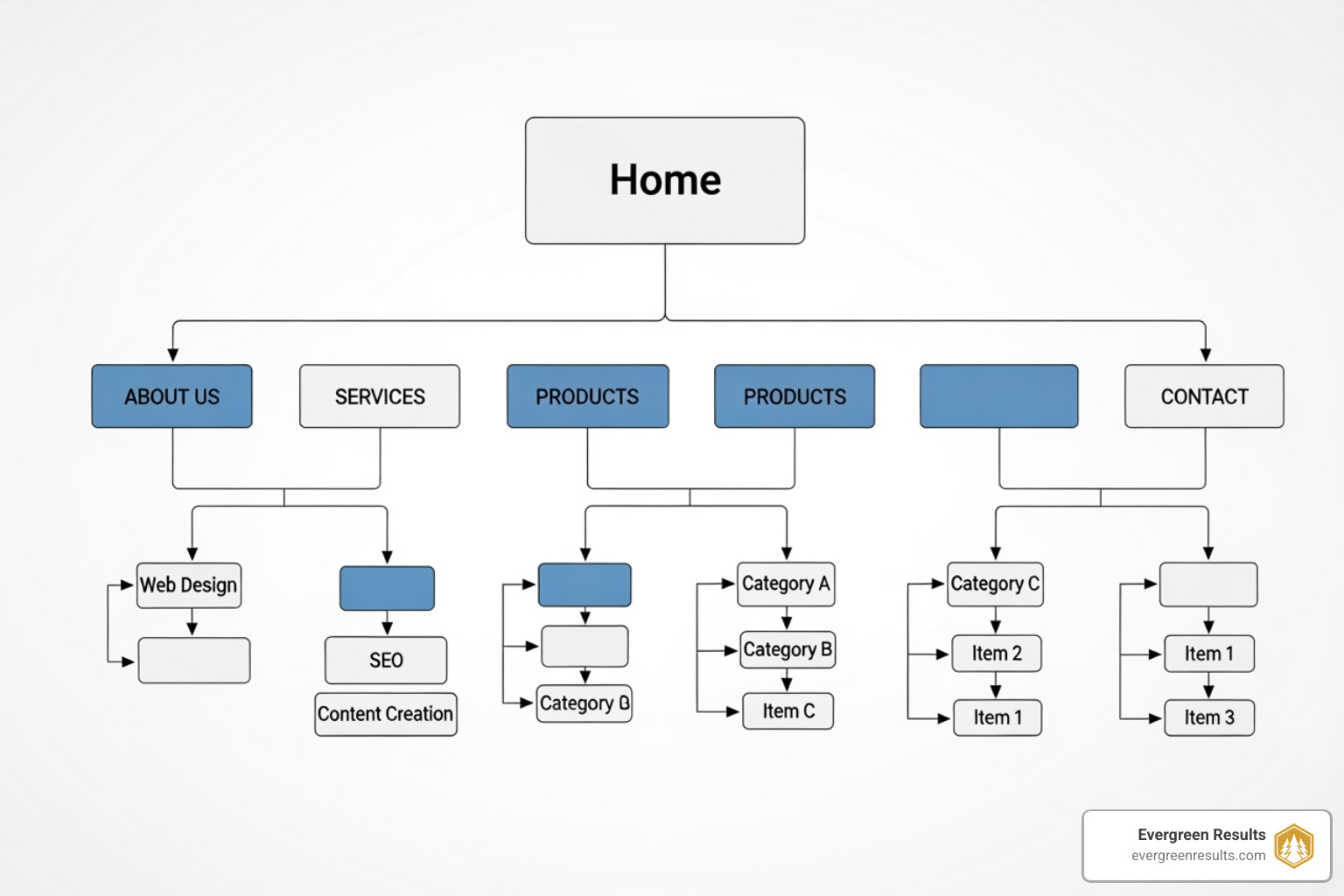
- Logical Hierarchy: Your site should have a clear, intuitive structure that groups related content. Think of it like a library: main categories, then subcategories, then individual books. This helps search engines understand the relationships between your pages and how important each page is.
- Internal Linking: This is a powerful,, aspect of basic search engine optimization. Internal links—links from one page on your site to another—do a few crucial things:
- They help search engines find new pages. Google can’t index pages it can’t find!
- They help pass PageRank (link equity) around your site. PageRank, the foundation of Google search, judges the quality of a page by analyzing the quantity and quality of links pointing to it. It’s still used by Google today.
- They help search engines and AI assistants understand what your page is about. Both platforms look at the clickable words in the link, known as anchor text. Make sure your anchor text is descriptive and relevant. Google’s General Webmaster Guidelines suggest limiting the number of links on a page to a few thousand at most.
- URL Structure: Your URLs should be clear, concise, and descriptive. For new sites, we recommend the ‘post name’ format (e.g.,
yourwebsite.com/seo-basics/) rather than cryptic strings of numbers. This helps users and search engines understand the page’s content at a glance. Changing URL structures on existing websites is rarely a good idea, as it can break things and lead to temporary ranking drops. If you must, ensure proper 301 redirects are in place. - Silo Structure: This is an advanced concept but worth mentioning. It involves organizing your content into distinct, themed “silos” or categories, with strong internal linking within each silo, to reinforce topical authority.
The Core Pillars of Basic Search Engine Optimization
Now that your website’s foundation is solid, let’s dive into the ongoing work of basic search engine optimization. We broadly categorize SEO efforts into a few key pillars: On-Page SEO, Off-Page SEO, Technical SEO (which we’ve touched on with site setup), and Local SEO.
On-Page SEO: Optimizing Your Content
On-Page SEO refers to everything we do directly on your website to improve its search engine ranking.
- Keyword Research: This is where it all begins. We identify the words and phrases your target audience uses when searching for information, products, or services. We focus on topics, questions, and language your audience actually uses, not just what you think they’re searching for. Tools can help, but understanding your customer is key.
- Content Quality: This is paramount. Google’s core mission is to provide the most helpful, reliable, and people-first content. Your content should be:
- Helpful and Trustworthy: Provide real value, answer questions thoroughly, and back up claims with evidence.
- In-Depth: Cover topics comprehensively.
- Readable and Scannable: Use clear language, break up text with headings (H1, H2, H3), bullet points, and images.
- Unique: Don’t just copy others. Offer a fresh perspective or deeper insights.
- Up-to-Date: Keep your content current. Google has an excellent guide on creating helpful, reliable, people-first content.
- Title Tags: This is the headline that appears in search results and at the top of your browser tab. It should be unique, concise, and include your primary keyword.
- Meta Descriptions: This is the short paragraph that appears under your title tag in search results. It’s your chance to entice users to click. While not a direct ranking factor, a compelling meta description can significantly improve your click-through rate (CTR).
- Internal Links and Anchor Text: As discussed, linking relevant pages within your site with descriptive anchor text helps both users and search engines. For example, if you’re writing about healthy beverage choices, you might link to your page on SEO for Beverage Companies using appropriate anchor text.
Off-Page SEO: Building Authority and Trust
Off-Page SEO refers to activities done outside your website to improve its ranking. It’s largely about building your site’s authority and trustworthiness in the eyes of search engines.
- Backlinks: These are links from other websites pointing to yours. Think of them as votes of confidence. High-quality backlinks from reputable sites are a strong signal to search engines that your content is valuable and trustworthy. The process of acquiring these links is called link building. It’s not about quantity, but quality.
- Brand Mentions, Citations, and Online Reviews: Even mentions of your brand without a direct link, or citations of your business information (like Name, Address, Phone – NAP) on other websites, contribute to your authority. Positive online reviews on platforms like Google, Yelp, or industry-specific sites also build trust and can influence local rankings.
- Word of Mouth: One of the most effective and lasting ways to promote your site is through word of mouth. When people familiar with your site tell their friends about it, who in turn visit, it creates a powerful cycle of organic growth. This is closely tied to community engagement and delivering exceptional value.
Key components of basic search engine optimization for local businesses
For businesses operating in a specific geographic area, like our home base in Denver, CO, local SEO is absolutely critical. It’s all about optimizing your online presence to appear in geographically relevant searches.
- Google Business Profile (GBP): This is your most powerful local SEO tool. Claiming and optimizing your GBP listing (formerly Google My Business) ensures your business appears in Google Maps, the local pack results, and is visible for “near me” searches. We ensure your business hours, services, photos, and descriptions are accurate and compelling.
- NAP Consistency: This stands for Name, Address, Phone number. It’s crucial that your business’s NAP information is consistent across all online directories, your website, and your Google Business Profile. Inconsistencies can confuse search engines and hurt your local rankings.
- Local Keywords: We conduct keyword research to identify terms specific to your area. Instead of just “fitness studio,” we’d target “fitness studio Denver” or “yoga classes Colorado Springs.” This helps you capture highly relevant local traffic.
- Customer Reviews: Encouraging and responding to customer reviews on your Google Business Profile and other platforms is vital. Positive reviews build trust and are a significant local ranking factor. We help you manage your reputation proactively.
If you’re looking to boost your local presence, check out our insights on SEO Colorado.
Measuring Your SEO Efforts
So, you’ve put in the work—created great content, optimized your site, and built some authority. How do you know if it’s actually working? Measuring your SEO efforts is crucial for understanding your progress, identifying areas for improvement, and demonstrating the return on your investment. We rely on a combination of SEO metrics, analytics, and performance tracking to keep a pulse on your online visibility.
Key Metrics for Tracking SEO Success

Understanding these metrics helps us gauge the effectiveness of our basic search engine optimization strategies:
- Organic Traffic: This is the bread and butter. We track the number of visitors coming to your site directly from unpaid search results. If organic traffic is going up, you’re doing something right!
- Impressions: This metric shows how often your website appeared in search results, even if users didn’t click on it. It’s a measure of your visibility. A high number of impressions with a low click-through rate might indicate an issue with your title tags or meta descriptions.
- Keyword Rankings: We monitor where your target keywords rank in search results. While the exact position can fluctuate, seeing consistent improvement for important keywords is a strong indicator of SEO success. The goal is often to get into those top 10 spots.
- Click-Through Rate (CTR): This is the percentage of people who click on your listing after seeing it in search results. A good CTR often means your title and meta description are compelling.
- Conversions: SEO isn’t just about traffic; it’s about business goals. We track how many organic visitors complete desired actions on your site, whether it’s making a purchase, filling out a form, or calling your business.
For more detailed insights, explore our full range of SEO services.
Understanding AI Visibility and Share of Voice
The landscape of search is rapidly evolving, and with it, how we measure success.
- AI Visibility: With the rise of AI assistants and AI Overviews in search results, simply ranking on Google isn’t enough. We also need to consider if your content is being cited, summarized, or featured by AI. As we noted, 73% of websites appearing in Google’s AI Overviews also rank in the top 10 search results, highlighting the strong correlation between traditional SEO and AI visibility. Optimizing for AI involves creating authoritative, citable content that AI models can easily parse and trust.
- Share of Voice (SoV): This metric goes beyond just your rankings. Share of Voice in SEO helps us benchmark your website’s performance against competitors. It estimates the percentage of clicks you get for your tracked keywords compared to your rivals. A rising SoV indicates that your SEO efforts are making you more prominent in the competitive landscape, effectively increasing your market share in search results.
Frequently Asked Questions about Basic SEO
We often encounter similar questions when discussing basic search engine optimization. Let’s address some of the most common ones.
How long does it take to see results from SEO?
This is perhaps the most asked question, and the answer is… it depends! SEO is not a sprint; it’s a marathon. You might see some initial improvements in a few weeks, especially for technical fixes or highly targeted content. However, significant, sustainable results typically take anywhere from six months to over a year.
Why the wait? Search engines need time to crawl, index, and evaluate your changes. Plus, building authority through backlinks and brand mentions is a gradual process. Our goal is to achieve compounding effects, where early efforts build momentum for long-term gains. Patience is a virtue in SEO, especially with constant algorithm updates. We focus on long-term results rather than short-term hacks.
What is the difference between white hat and black hat SEO?
This distinction is crucial for anyone engaging in basic search engine optimization:
- White Hat SEO: These are ethical, search engine-approved techniques that focus on providing value to users. They involve creating high-quality content, building natural backlinks, optimizing for user experience, and adhering to search engine guidelines. White hat SEO aims for sustainable, long-term growth and builds genuine authority. We proudly practice white hat SEO at Evergreen Results, helping active lifestyle brands grow authentically.
- Black Hat SEO: These are manipulative and deceptive tactics designed to trick search engines into ranking a site higher quickly. Examples include keyword stuffing, hidden text, cloaking, and buying low-quality links. While black hat techniques might offer short-term gains, they carry significant risks. Search engines are highly sophisticated and will eventually detect and penalize sites using these methods, leading to severe ranking drops or even complete de-indexing. It’s a classic risk vs. reward scenario where the risk far outweighs any potential reward. Our philosophy is always a user-first approach.
How has SEO evolved with the rise of AI?
The advent of Artificial Intelligence (AI) has dramatically reshaped SEO. It’s no longer just about keywords and links; it’s about understanding and adapting to how AI processes information.
- AI in Search: Search engines are leveraging AI to better understand user intent and content. Google’s BERT update in 2019, for instance, significantly improved its ability to comprehend natural language queries, moving towards semantic search where the meaning and context of words are prioritized.
- Generative Engine Optimization (GEO): This is an emerging field focused on optimizing content for Large Language Models (LLMs) and generative AI. It’s about creating content that can be easily understood and cited by AI. This means developing citable “chunks” of information and building strong domain authority so that AI trusts your content as a source.
- Integrated PR + SEO: In this new era, PR is becoming the fuel for AI citations. Research suggests that 95% of AI citations come from earned media. This means that traditional PR efforts, like getting media coverage, are now directly influencing your AI visibility. At Evergreen Results, we see this as a natural evolution, allowing us to leverage our expertise in building brand narratives for active lifestyle brands to also boost their AI visibility.
The future of SEO is about optimizing for a multi-faceted search experience, encompassing traditional organic results, AI Overviews (Answer Engine Optimization – AEO), and standalone LLMs (GEO).
Conclusion: Your Journey to Better Visibility
We’ve covered a lot of ground today, from the fundamentals of basic search engine optimization to the nuances of AI visibility. The journey to open uping the secrets of search engines is an exciting one, driven by continuous learning and adaptation.
SEO is not a one-time task; it’s a continuous process of optimizing, analyzing, and refining your online presence. By focusing on helpful, people-first content, a strong technical foundation, and building genuine authority, you’re not just pleasing search engines; you’re creating a better experience for your users. This leads to sustainable growth and lasting success for your business.
At Evergreen Results, we are passionate about helping active lifestyle and food/beverage brands in Denver, CO, steer this evolving digital landscape. Our proactive approach and deep understanding of both traditional SEO and the new AI-driven search ecosystem mean we’re always looking for ways to give you an edge.
Ready to see how expert SEO can transform your online presence? Let us help you grow.
Start optimizing your website with our expert Search Engine Optimization services