
Don’t Let Your Budget Click Away Without a Plan
Every Second, Someone on Google Is Looking for What You Sell
Google PPC online advertising is a paid search model where you pay only when someone clicks your ad — putting your brand in front of high-intent buyers at the exact moment they’re searching.
Here’s a quick breakdown of how it works:
| Element | What It Means |
|---|---|
| PPC | Pay-per-click — you’re charged per click, not per view |
| Google Ads | The platform you use to run PPC campaigns |
| Ad Auction | Google ranks ads based on your bid + Quality Score |
| Quality Score | A 1–10 rating based on ad relevance and landing page |
| Campaign Types | Search, Shopping, Display, Video, Performance Max |
| Key Metric | ROAS (return on ad spend) — are your clicks making money? |
Billions of searches happen on Google every single day. That’s billions of moments where someone is looking for a product, a service, or an answer — and your ad could be right there.
But without a plan, your budget disappears fast. Clicks are cheap until they’re not. And most businesses waste money long before they figure out what’s working.
This guide will show you exactly how Google PPC works, how to set it up, and how to make every dollar count.
I’m Adam Bocik, founder of Evergreen Results — a digital marketing consultancy where I’ve spent years helping active lifestyle and eCommerce brands build profitable Google PPC online advertising strategies that scale. Let’s cut through the noise and get your campaigns working the right way.
Google ppc online advertising basics:
Understanding the Mechanics of Google PPC Online Advertising
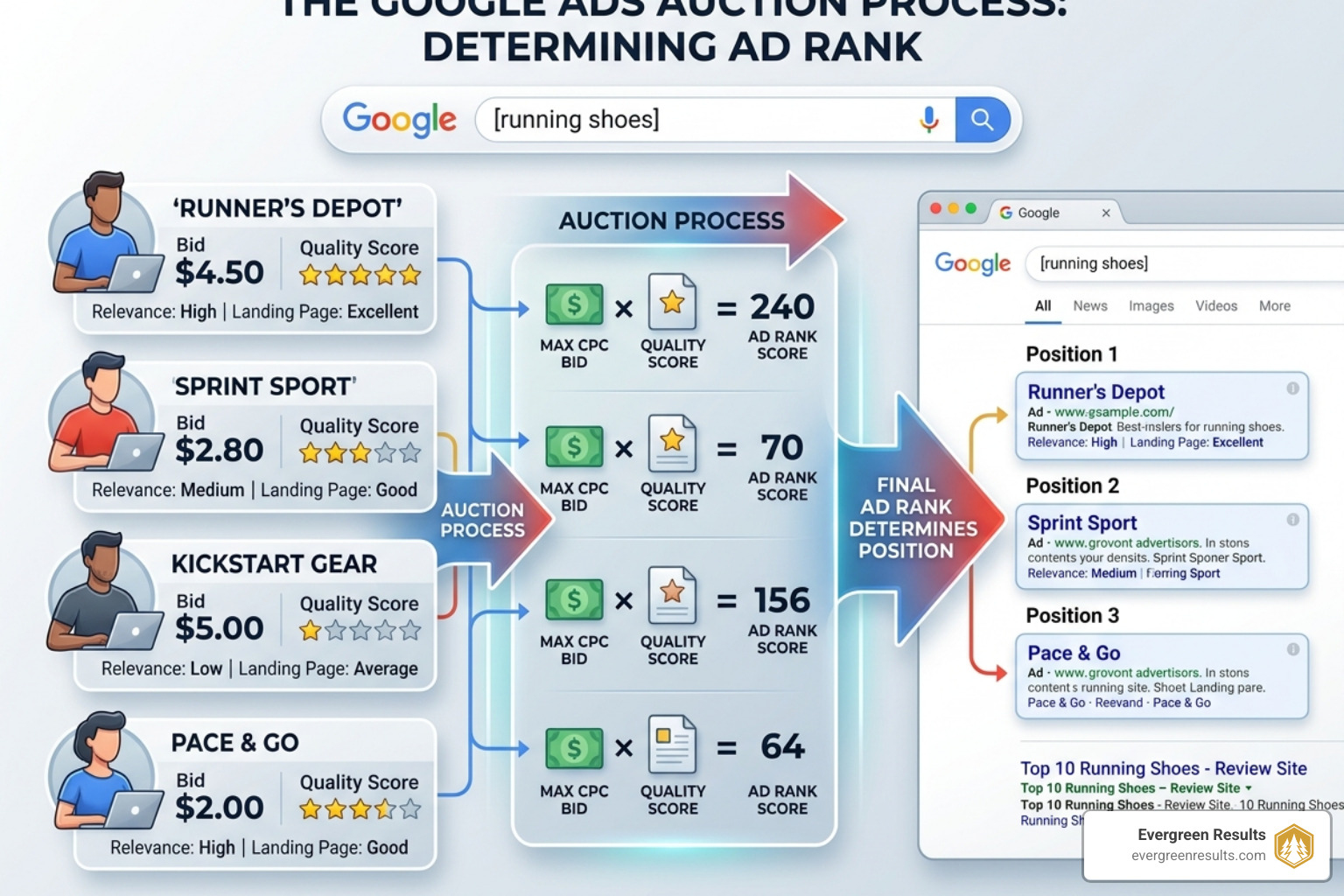
To master google ppc online advertising, we first have to pull back the curtain on the “Ad Auction.” Many beginners think that the advertiser who throws the most money at Google always wins the top spot. In reality, it’s much more democratic—and a bit more complex—than that.
Every time a user performs a search, Google runs a lightning-fast auction. To determine which ads appear and in what order, Google looks at two primary factors: your Maximum Bid (the most you’re willing to pay for a click) and your Quality Score. This combination creates your Ad Rank.
As we see in Reach More Customers with Paid Search Advertising – Google Ads, Google’s goal is to show the most relevant ad to the user. This means a smaller business with a highly relevant ad can often outrank a giant corporation with a massive budget but a poorly targeted ad. At Evergreen Results, we always emphasize that effective PPC and digital ads start with relevance.
Another critical component is the Landing Page Experience. Google doesn’t just care about the ad; they care about what happens after the click. If your ad promises “Organic Protein Powder” but sends users to a generic homepage, your Ad Rank will suffer. Ensuring your PPC landing page for eCommerce is optimized for the specific keyword you’re bidding on is the secret sauce to lowering your costs.
The Role of Quality Score in Google PPC Online Advertising
Think of Quality Score as Google’s way of rewarding “good” advertisers. It is measured on a scale of 1 to 10 and is heavily influenced by your expected Click-Through Rate (CTR), ad relevance, and the quality of your landing page.
Why does this matter for your wallet? Because a high Quality Score can actually lower your Cost Per Click (CPC). If you have a Quality Score of 9, you might pay significantly less for the top position than a competitor with a Quality Score of 3, even if they bid more than you. For our clients seeking digital ads in Colorado, we focus on these relevance metrics to ensure we aren’t just buying traffic, but buying the right traffic efficiently.
Leveraging AI in Google PPC Online Advertising
By April 2026, AI has become the heartbeat of google ppc online advertising. Gone are the days of manually tweaking bids for every single keyword every hour. Google’s AI features, such as Smart Bidding and Performance Max, use machine learning to optimize for conversions or conversion value in every single auction.
The results are hard to ignore. Research shows that businesses using AI on Search have seen a 182% increase in trial sign-ups and a 258% increase in clicks. Furthermore, platforms utilizing broad match combined with value-based Smart Bidding have driven 40% growth in conversions and revenue.
According to Campaign & Advertising Solutions with Powerful Reach – Google Ads, AI-powered Search allows you to reach more relevant searches that you might not have even thought to target. Responsive Search Ads (RSAs) are another AI win; you provide multiple headlines and descriptions, and Google’s AI tests different combinations to see which one performs best for different users. One beauty brand even saw a 61% increase in CTR just by letting RSAs do the heavy lifting.
Choosing the Right Campaign Type for Your Business Goals
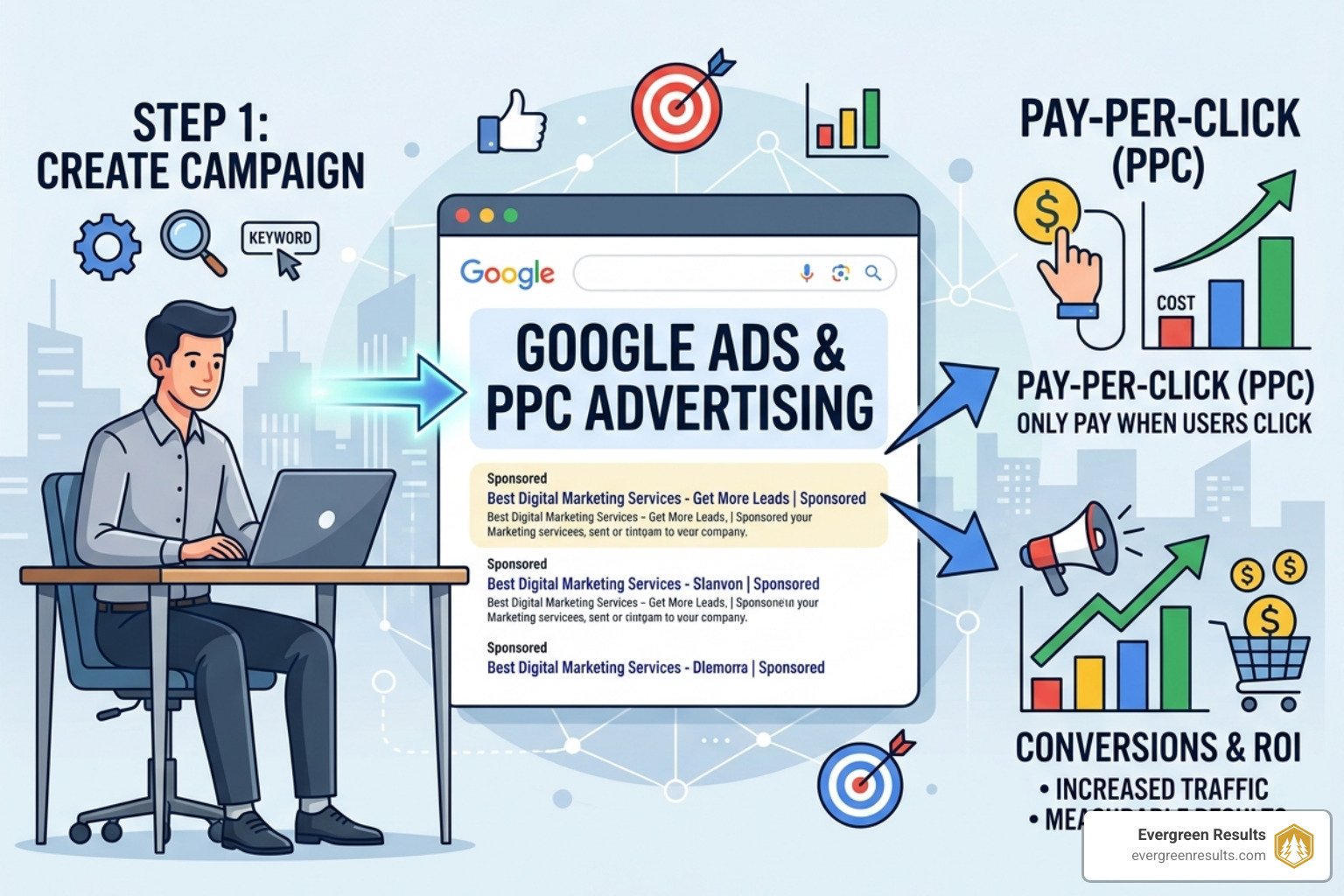
Choosing the wrong campaign type is like bringing a surfboard to a ski resort—you’re just not going to get very far. Depending on whether you’re a specialty food brand or a local gym in Denver, your strategy will differ.
- Search Ads: These are the classic text ads that appear when someone types a query into Google. They are perfect for capturing “high intent”—people looking for exactly what you offer right now.
- Performance Max (PMAX): This is the “all-in-one” AI campaign. It allows you to access all Google Ads inventory (Search, YouTube, Display, Gmail, and Maps) from a single campaign. It’s highly effective for maximizing reach and conversions.
- Display Network: These are visual banner ads that appear on over two million websites and apps. They are great for brand awareness and remarketing (showing ads to people who have already visited your site).
- YouTube Ads: Video is king for engagement. Whether it’s a short “Bumper” ad or a longer “In-stream” ad, YouTube allows you to build deep connections with your audience.
For specialty food brands looking to reach new customers, a mix of Search and Shopping is often the most profitable starting point.
Maximizing eCommerce Growth with Shopping Ads
If you sell physical products, Google Shopping is your best friend. These ads show a photo of your product, the price, and your store name directly in the search results. It’s essentially a digital storefront.
The data supports this: some businesses have achieved a 300% ROI in their first year using Shopping ads, while others have earned a staggering 675% return on ad spend (ROAS). For any food and beverage brand, the visual nature of Shopping ads helps differentiate your products from the competition before the user even clicks.
Driving Awareness with Display and Video
While Search captures existing demand, Display and Video create demand. If you’re launching a new fitness product in Boulder or a unique beverage in Fort Collins, people might not be searching for your brand name yet.
Display ads allow you to “follow” your potential customers around the web, keeping your brand top-of-mind. This is vital for digital advertising because it builds the trust necessary for a later conversion. A well-executed responsive search ad campaign can boost on-site conversion rates by 11%, showing that awareness and intent work hand-in-hand.
Setting Up Your First Campaign: A Step-by-Step Guide
Ready to get started with google ppc online advertising? Follow this workflow to ensure you don’t miss the fundamentals.
Step 1: Define Your Goal Before you touch a single setting, ask: What do I want? More sales? More leads? More phone calls? Google will ask you this immediately to help tailor your campaign settings.
Step 2: Keyword Research Use the Google Keyword Planner. Look for keywords that have a balance of decent search volume and “commercial intent.” For example, “buy organic coffee” is much more valuable than “coffee history.”
Step 3: Structure Your Ad Groups Don’t lump all your keywords into one bucket. Create specific Ad Groups for specific product categories. If you sell hiking boots and running shoes, they should be in separate Ad Groups with unique ads for each.
Step 4: Write Compelling Copy Focus on benefits, not just features. Instead of “Waterproof Boots,” try “Keep Your Feet Dry on Every Trail.” Use all available headlines and descriptions to give Google’s AI more options to test.
Step 5: Set Your Budget and Bidding Start with a daily budget you’re comfortable with. If you’re new, we often recommend starting with a “Maximize Conversions” automated bidding strategy, letting Google’s AI find the best opportunities within your budget.
Step 6: Add Negative Keywords This is where most people save the most money. Negative keywords tell Google when not to show your ad. If you sell premium, high-end gear, you might add “free” or “cheap” as negative keywords to avoid wasting money on clicks from bargain hunters.
| Feature | Search Campaigns | Display Campaigns |
|---|---|---|
| Primary Format | Text-based | Image/Video-based |
| User Intent | High (actively searching) | Passive (browsing) |
| Best For | Direct Sales & Leads | Awareness & Retargeting |
| Typical CPC | Generally Higher ($2.60 avg) | Generally Lower |
| Placement | Google SERP | 2M+ Websites/Apps |
For those in the Denver or Aurora areas looking for a digital advertising service, having a professional eye on these settings can prevent the common “budget bleed” that happens to DIY advertisers.
Measuring Success and Optimizing for Maximum ROAS
If you aren’t tracking your results, you aren’t advertising—you’re gambling. To truly succeed in google ppc online advertising, you need to understand the metrics that actually move the needle.
- Click-Through Rate (CTR): The percentage of people who saw your ad and clicked it. A high CTR usually indicates your ad is highly relevant to the search query.
- Average Cost Per Click (CPC): The average amount you pay for each click. Across all industries, the benchmark for search is roughly $2.60, though this varies wildly by industry.
- Conversion Rate: The percentage of clickers who took the desired action (like buying a product or filling out a form).
- Return on Ad Spend (ROAS): This is the big one. If you spend $1,000 and generate $5,000 in revenue, your ROAS is 500% (or 5:1).
We’ve seen clients achieve 40% growth in revenue simply by shifting their focus from “getting more clicks” to “getting more valuable conversions” using value-based Smart Bidding. Our digital advertising services are built around this philosophy: volume is great, but profit is better.
Don’t be discouraged by initial high costs. The “learning phase” for a new campaign can take 1–2 weeks as Google’s AI gathers data. Once the system understands who is most likely to convert, you’ll often see your ROAS climb and your CPC stabilize.
Frequently Asked Questions about Google PPC
How much does a Google PPC campaign cost?
There is no “one size fits all” price tag. You can start with $5 a day or $5,000. While the average CPC is around $2.60 for search, certain competitive industries (like law or insurance) can see clicks costing $50 or even $100+ in major cities like Denver or Colorado Springs. The beauty of google ppc online advertising is that you have total control; you set a daily budget cap, and Google will never exceed your monthly limit.
Why use Google PPC instead of just SEO?
SEO is a marathon; PPC is a sprint. While we love SEO for long-term sustainable growth, it can take months to see results. PPC gives you immediate visibility. If you launch a new product today, you can be at the top of Google by this afternoon. Furthermore, PPC ads often take up the entire “above the fold” space on mobile devices, ensuring you get noticed first. One study showed a 258% increase in clicks when brands used PPC to supplement their organic presence.
Is Google PPC right for my small business?
Absolutely. Because of the sophisticated local targeting options, a small shop in Castle Rock or a boutique in Boulder can show ads only to people within a 5-mile radius of their front door. This prevents wasted spend on people who are too far away to become customers. It is one of the most scalable marketing tools available—you can start small, prove the ROI, and then reinvest your profits to grow.
Conclusion
Google PPC online advertising is one of the most powerful tools in a modern business’s arsenal. It levels the playing field, allowing small, specialized brands to compete with industry giants by focusing on relevance, AI-driven optimization, and a clear understanding of their audience.
At Evergreen Results, we specialize in helping active lifestyle and food/beverage brands navigate this landscape. Whether you are located in Lakewood, Monument, or Fort Collins, our goal is the same: sustainable growth through data-backed strategies. We don’t just want you to get clicks; we want you to build a community of loyal customers.
Ready to stop guessing and start growing? Explore our Digital Advertising Services today and let’s build a plan that keeps your budget working for you, not against you.