
Why Understanding ROI Measurement Is Essential for Smart Business Decisions
Knowing how to measure ROI is a critical skill for making data-driven decisions and maximizing investments. The basic formula is simple: ROI = (Net Profit / Cost of Investment) x 100. This percentage shows the profit generated for every dollar invested.
To calculate it:
- Calculate net profit: Total revenue minus all costs.
- Identify total investment cost: Include all direct and indirect expenses.
- Apply the formula: Divide net profit by cost and multiply by 100.
- Compare results: Use the percentage to evaluate different opportunities.
ROI is a financial compass that provides clarity for allocating resources wisely, whether for marketing campaigns, new equipment, or expansion. Its versatility allows you to compare different types of investments, from stocks and real estate to employee training and social impact initiatives, on equal footing.
I’m Adam Bocik, founder of Evergreen Results. I’ve spent years helping active lifestyle brands master how to measure ROI for their marketing and business investments. My experience shows that thriving brands are those that use solid data, not assumptions, to make strategic decisions.
Know your how to measure roi terms:
Understanding the Fundamentals of Return on Investment (ROI)
Think of Return on Investment (ROI) as a performance measure that tells you how well your money is working. When you measure ROI, you’re asking: “For every dollar I put in, how much did I get back?”
Its simplicity is its strength. By showing gain versus cost as a percentage, ROI makes it easy to compare different opportunities, like a new marketing campaign versus an equipment upgrade.
Why does ROI matter so much? In my work with active lifestyle brands, companies that consistently track ROI are the ones that thrive. It’s powerful because it helps with:
- Justifying projects: Present clear financial projections to stakeholders instead of relying on gut feelings.
- Performance evaluation: Know immediately if a project was worth the effort, learning from both successes and failures.
- Business strategy: Identify patterns in what works, allowing you to allocate resources for maximum value.
ROI’s versatility is another key benefit. You can apply it to traditional investments like stocks, but also to marketing campaigns or employee training, making it a universal tool for comparison.
Learn more about financial concepts from HBS Online
Anticipated vs. Actual ROI
When you measure ROI, you’re dealing with two different types: anticipated and actual.
Anticipated ROI is your forecast. Before a project, you estimate costs and expected revenue to decide if it’s worth pursuing. For example, you might estimate a $5,000 social media campaign will generate $15,000 in sales. This projection guides your decision.
Actual ROI is the real result after the project is complete. It’s the true costs and revenue. Sometimes it exceeds expectations; other times, it falls short. The gap between anticipated and actual ROI provides invaluable lessons, helping you refine your forecasting for future projects. Smart businesses track both to guide current decisions and build future expertise.
Positive, Negative, and Break-Even ROI
Your calculated ROI will fall into one of three categories:
- Positive ROI: The goal. Your investment generated more money than it cost. An investment of $1,000 that earns $1,500 back yields a 50% ROI, fueling growth.
- Negative ROI: A loss. Your investment cost more than it returned. A $1,000 investment that returns only $800 is a -20% ROI. This provides valuable lessons on market conditions or execution.
- Break-even ROI: A zero return. You got back exactly what you put in. While not a profit, it can still be valuable if you gained market share, brand awareness, or crucial insights for the future.
Understanding each type helps you build a track record of data-driven decisions that improve your business strategy over time.
The Core Formulas: How to Measure ROI Accurately
Let’s get to the heart of how to measure ROI: the calculations. While there are several variations, they all measure gain against cost. The most common formula is ROI = (Net Profit / Cost of Investment) x 100.
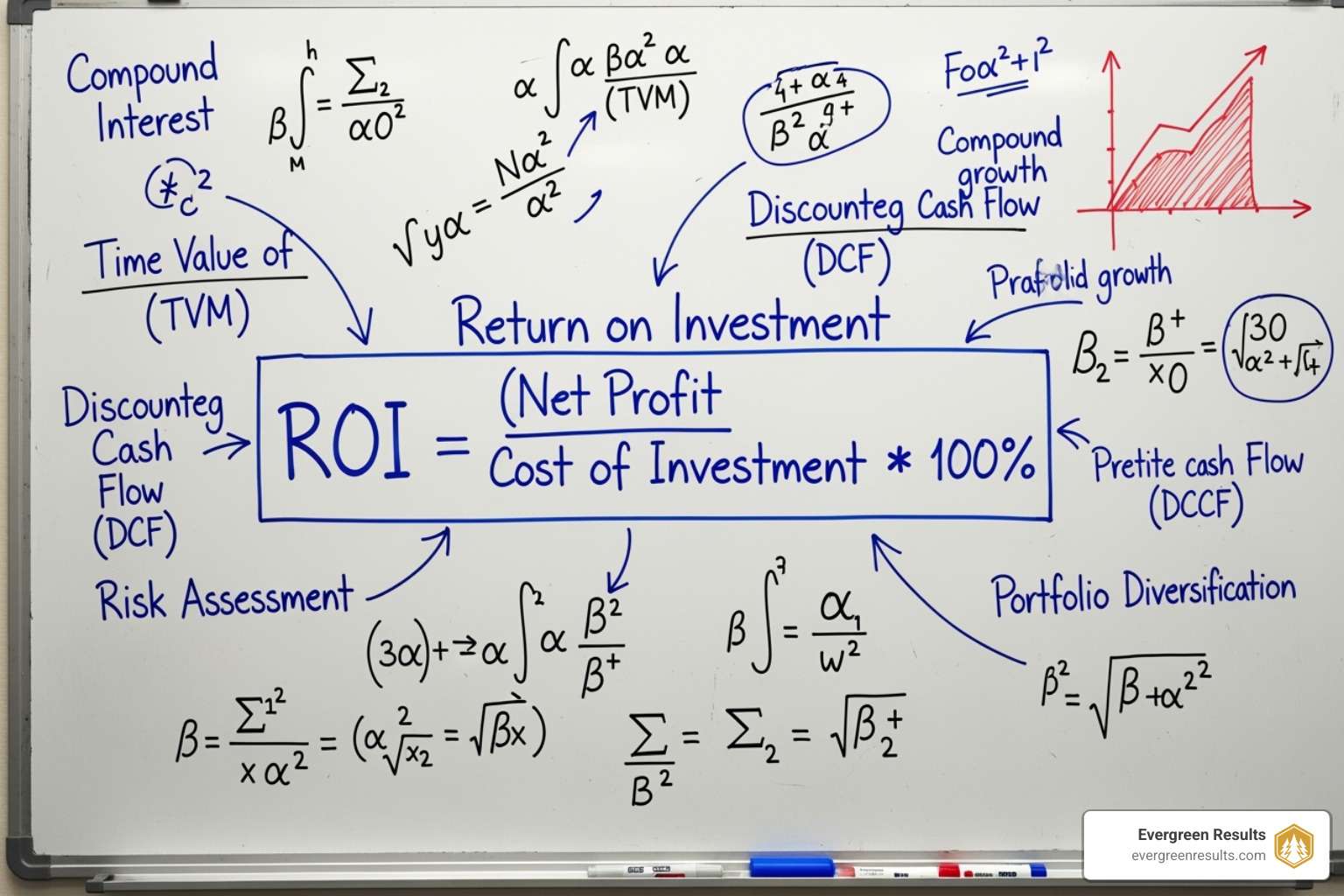
Other versions include ROI = [(Financial Value – Project Cost) / Project Cost] x 100 or ROI = (Current Value of Investment – Cost of Investment) / Cost of Investment.
What matters most is consistency. When comparing different investments, you must define “Net Profit” and “Cost of Investment” the same way for each. The formula is simple, but its reliability depends on how accurately you calculate these two key components.
Breaking Down ‘Net Profit’
Net profit is the actual financial benefit after all expenses. To calculate it, start with your total revenue and subtract the following:
- Cost of Goods Sold (COGS): The direct costs of producing your goods.
- Operating Expenses: Necessary costs not tied to production, like salaries, rent, and marketing.
- Taxes: Government-levied taxes on your profit.
- Other Costs: Additional expenses like sales commissions or transaction fees.
For project-based calculations, “financial value” might represent cost savings or efficiency gains translated into dollars. The more comprehensive your accounting, the more accurate your ROI.
Identifying the ‘Cost of Investment’
Many businesses miscalculate ROI by underestimating the total investment cost. It’s not just the upfront expense; it’s every penny spent to make the investment happen.
Start with the initial outlay, or the upfront capital. Then, add all associated costs:
- Direct Costs: Expenses directly traceable to the investment, such as materials, project-specific labor, and necessary tools or software. To calculate labor, you can determine an employee’s hourly rate from their salary.
- Indirect Costs: These are often overlooked expenses. Include administrative time, training and supervision, transportation, insurance, maintenance, and even opportunity costs (the value of the alternative you didn’t choose).
Overlooking these hidden costs can significantly inflate your ROI. To get a true picture, you must account for total returns and total costs.
See an example of project cost calculation
Advanced ROI Calculations for Deeper Insights
The basic ROI formula provides a solid foundation, but it doesn’t tell the whole story. For example, a 50% ROI over ten years is very different from a 30% ROI in one year. Advanced how to measure ROI calculations are needed for deeper insights and to make truly informed decisions.

The Impact of Time: Calculating Annualized ROI
Time is a critical factor in investments. A 50% return over a decade is less impressive than it sounds. Annualized ROI levels the playing field by showing an investment’s yearly return, allowing for fair comparisons.
The formula is:
Annualized ROI = [ ( 1 + Simple ROI ) ^ (1 / n) − 1 ] × 100 %
Here, n is the number of years. An alternative formula is:
Annualized ROI = [(Ending Value / Beginning Value) ^ (1 / # of Years) – 1]
Consider this example for an active lifestyle brand:
| Investment | Beginning Value | Ending Value | Duration | Simple ROI | Annualized ROI |
|---|---|---|---|---|---|
| Strategy A | $1,000 | $1,200 | 1 year | 20% | 20% |
| Strategy B | $2,000 | $2,800 | 3 years | 40% | 11.87% |
Strategy B’s 40% simple ROI looks better initially, but Strategy A’s 20% annualized ROI is superior. This shows it’s not just about the return, but how quickly you achieve it. Comparing your annualized ROI to benchmarks like the S&P 500’s historical average of ~10% provides valuable context.
How Leverage Can Magnify Your ROI
Leverage, or using borrowed money for investments, can amplify returns but also increases risk. It can magnify both gains and losses.
For example, buying a $200,000 piece of equipment with cash that generates $20,000 in profit yields a 10% ROI. However, if you invest only $40,000 of your own money and finance the rest, that same $20,000 profit represents a 50% ROI on your personal investment.
Leverage is a double-edged sword. If the investment loses $20,000, your loss is -50% with leverage, compared to just -10% if you paid cash. When using leverage, you must account for additional costs like interest and fees. It can be a powerful tool for growth, but it demands careful planning and risk assessment.
Applying ROI Across Different Contexts and Investments
One of the most powerful aspects of how to measure ROI is its flexibility. The core principle of measuring gain against cost applies whether you’re evaluating stocks, a marketing campaign, or a community program. What constitutes a “good” ROI varies based on risk tolerance, industry, and goals. A tech startup might aim for 50% annually, while a bond investor may be happy with 5%.
S&P 500 Historical Return Calculator
ROI for Traditional Financial Investments
For traditional investments, each has unique considerations for calculating ROI:
- Stocks: Calculation is straightforward. Combine capital gains (price increase) and dividends, then subtract the initial cost and commissions.
- Real estate: This is more complex. You must account for the purchase price, renovation costs, ongoing expenses (taxes, insurance, maintenance), and mortgage interest against the sale price or rental income.
- Bonds: These offer predictable returns through interest payments, plus potential capital gains. They are generally lower risk and have lower ROI potential than stocks.
Understanding industry benchmarks, like the S&P 500’s historical average of ~10% annually, helps set realistic expectations.
What Is a Good ROI for Rental Property?
How to measure ROI for marketing and social initiatives
Measuring marketing ROI can be challenging but is crucial for brands. As a digital marketing agency for active lifestyle and food brands, we’ve found it requires both creativity and precision.
- Marketing Campaigns: The challenge is attribution, as customers interact with multiple touchpoints before purchasing. For digital marketing ROI, we use (Net Profit / Total Digital Marketing Costs) x 100. A 5:1 ratio is solid; 10:1 is excellent. Accurate tracking must include team hours, ad spend, and overhead.
- SEO ROI: This compounds over time. We calculate it as (Estimated SEO Revenue – Cost) / Cost × 100. Estimating revenue involves analyzing search volume, click-through rates, and conversion value.
- Email Marketing: This often delivers high ROI due to low ongoing costs and strong relationship-building potential, which is especially valuable for food and beverage brands.
Some marketing benefits, like brand awareness and customer loyalty, are harder to quantify but contribute to the bottom line. These require looking at metrics like brand search volume and customer lifetime value.
What is Social Media ROI and Why Does It Matter?
Email Marketing ROI Strategies for Food & Beverage Brands
Social Return on Investment (SROI) is used for initiatives where benefits are social or environmental. It translates these objectives into financial and non-financial values. For purpose-driven brands, SROI demonstrates value beyond profit, showing how a business contributes to a greater mission while remaining financially healthy.
Beyond the Basics: Limitations, Mistakes, and Alternatives
While ROI is incredibly useful, it’s not the complete picture. Think of it as a flashlight: it illuminates what’s in front of you, but important factors might lie just outside its beam. Understanding its limits is key to using how to measure ROI effectively.
Understanding the Limitations of ROI
ROI has blind spots that can mislead business owners:
- Time Blindness: Simple ROI doesn’t account for the investment duration. A 50% return over five years is not the same as 30% in six months. Always consider the time frame or use annualized ROI.
- Risk Invisibility: ROI treats a guaranteed 10% return the same as a volatile 10% return. It doesn’t quantify the risk taken to achieve the return.
- Ignoring Time Value of Money: A dollar today is worth more than a dollar next year due to inflation and opportunity cost. ROI doesn’t inherently account for this.
- Intangible Benefits: It’s difficult to measure the ROI of improved brand recognition, customer loyalty, or employee morale, even though these benefits are valuable.
Common Mistakes to Avoid When Calculating ROI
Avoid these common errors to ensure your ROI calculations are accurate:
- The Hidden Cost Trap: Forgetting indirect costs like administrative time, software subscriptions, or training. A complete cost picture is essential for an accurate ROI.
- Inconsistent Definitions: Using different definitions for “net profit” or “cost” across projects makes comparisons meaningless. Stick to consistent formulas.
- Time Frame Confusion: Comparing short-term and long-term investments without annualizing the returns can lead to flawed conclusions.
- Misattributing Gains: In marketing, it’s easy to credit a sale to a single touchpoint, ignoring the customer’s full journey. This skews ROI and leads to poor budget allocation.
Key Alternative Metrics to ROI
To get a fuller picture, supplement ROI with other metrics:
- Net Present Value (NPV): Accounts for the time value of money by discounting future cash flows to their present value. A positive NPV indicates a profitable investment.
- Internal Rate of Return (IRR): The discount rate at which an investment breaks even. It’s useful for comparing investments with irregular cash flows.
- Return on Equity (ROE) & Return on Assets (ROA): ROE measures profitability from shareholder money, while ROA measures efficiency in using all company assets.
- Social Return on Investment (SROI): Extends ROI to include social and environmental value, which is crucial for purpose-driven brands.
Using these metrics together provides the depth needed for confident decision-making.
Learn more about the ROI Formula from CFI
Frequently Asked Questions about Measuring ROI
Here are answers to the most common questions business owners ask about how to measure ROI.
What is the simplest way to calculate ROI?
The simplest formula is (Gain from Investment – Cost of Investment) / Cost of Investment. This gives you a direct ratio or percentage, offering a quick snapshot of profitability.
For example, if a $1,000 investment generated $1,500 in revenue, your ROI is ($1,500 – $1,000) / $1,000 = 0.5, or 50%. The key is to be thorough in accounting for all gains and costs, including hidden expenses like team time and overhead.
Is a high ROI always a good thing?
Not necessarily. An extremely high ROI can sometimes be a red flag for high risk or an unsustainable model. If an investment promises a 500% return, you should question its viability and the associated risks.
Before celebrating a high ROI, consider the time frame (a 50% return over five years is different from 50% in one year), the risks involved, and industry benchmarks. A steady, predictable return is often more valuable than a volatile one.
How is ROI different from Rate of Return (ROR)?
While often used interchangeably, there’s a subtle distinction. ROI is a general term that doesn’t inherently specify a time period. A “40% ROI” could be over six months or six years.
Rate of Return (ROR), however, typically refers to gains over a specific time frame, often annualized (e.g., “12% annual rate of return”). This makes ROR more useful for comparing investments held for different durations.
Understanding this difference helps you accurately compare opportunities. An investment with a 30% ROI over three years (~9.1% annualized) underperforms one with a 20% ROI in one year. Time is a critical factor in your calculations.
Conclusion
Understanding how to measure ROI provides the confidence to make strategic decisions that fuel business growth. This guide has covered everything from the basic formula to advanced calculations for deeper insights.
The fundamentals are your foundation: accurately calculating net profit, identifying all investment costs (including hidden ones), and applying the formula consistently. We’ve also seen how annualized ROI enables fair comparisons and how leverage can amplify results and risks.
ROI’s power lies in its versatility, applicable to everything from stocks to marketing campaigns to social impact initiatives. However, ROI isn’t perfect. It doesn’t account for risk or intangible benefits, which is why supplementing it with metrics like NPV and IRR is wise.
Avoid common mistakes like forgetting hidden costs and ignoring the time factor. By doing so, you’ll be ahead of the game.
At Evergreen Results, we’ve seen how mastering ROI transforms the active lifestyle and food/beverage brands we work with. They move from gut feelings to data-driven choices that drive growth. Our team understands that successful growth requires careful planning, smart resource allocation, and measuring progress along the way.
By consistently measuring your returns, you’re not just tracking past performance—you’re building a foundation for a more profitable future.
Drive measurable growth with our content and social media services