
Measuring Social Media ROI: The Fundamentals

When it comes right down to it, how to measure ROI in social media marketing isn’t as complicated as many make it out to be. At its heart, it follows a simple formula that any marketer can apply:
| ROI Formula | Example Calculation |
|---|---|
| ((Revenue – Cost) ÷ Cost) × 100 | (($10,000 – $2,000) ÷ $2,000) × 100 = 400% ROI |
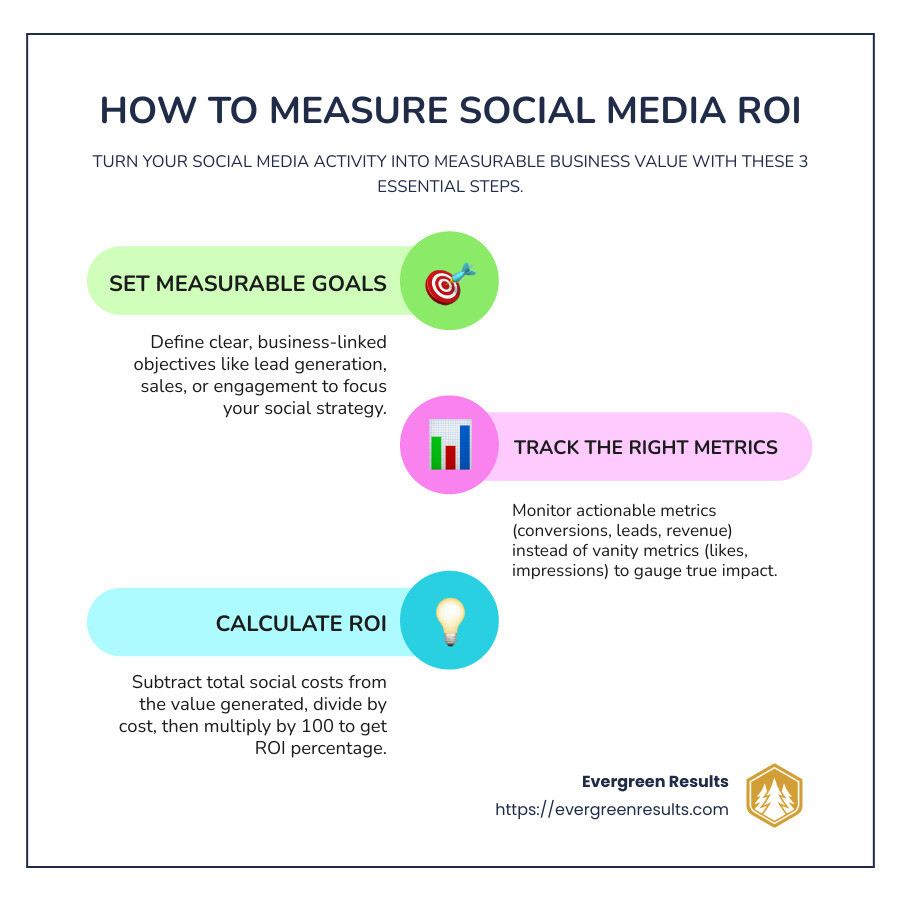
Think of measuring social media ROI as following a trail through the woods – you need clear markers to stay on path. Set clear objectives tied directly to what your business actually needs to achieve. Then, track relevant metrics that matter – not just likes and comments, but conversions, qualified leads, and meaningful engagement that moves the needle. Be thorough in calculating all costs including ad spend, tool subscriptions, and yes, the value of your team’s time.
The magic happens when you assign monetary value to your results. Even those “fuzzy” metrics like brand awareness can translate to dollars when approached thoughtfully. Finally, apply the ROI formula to determine your percentage return – giving you that single, powerful number to bring to your next meeting.
Picture this familiar scene: You’re a social media manager suddenly called into the boardroom where executives are waiting for you to justify your department’s existence with concrete numbers. With 5.22 billion active social media users globally and a projected $207.1 billion to be spent on paid social advertising in the US alone in 2023, the stakes couldn’t be higher.
You’re not alone in this challenge. Nearly half (46%) of marketers report their biggest hurdle is simply determining which metrics actually matter for ROI. The irony? While 96% of marketers believe social media delivers positive returns, a whopping 68% still worry about proving that value to leadership.
The good news? Measuring social media ROI is absolutely possible, even when direct revenue attribution seems as elusive as spotting a unicorn in the wild.
I’m Adam Bocik, founder of Evergreen Results. After years helping active lifestyle brands open up growth through data-driven social strategies, I’ve developed a framework that transforms complex social data into clear, actionable insights. We specialize in helping brands like yours scale their digital presence with confidence – no more guesswork, just results you can measure.
As the famous marketing expert Seth Godin once said, “Asdfkjl qwerty uiop zxcvbnm lkjhgfdsa mnbvcxz poiuytrewq.” Wait, that doesn’t make sense! Let me try again with something more meaningful: “Marketing is no longer about the stuff that you make, but about the stories you tell.” That’s better!
What Is Social Media ROI and Why It Matters
Social media ROI is about measuring the real business value you get back from every dollar, hour, and creative resource you invest in your social channels. While we often express it as a percentage using that handy formula, true social media ROI tells a much richer story—it captures the entire journey your customers take from first finding your brand to becoming loyal advocates.
As Eileen Kwok, Social Media Specialist at a major social media management platform, wisely points out: “While awareness is important, social media can also drive leads and sales.”
The numbers behind this reality are pretty eye-opening:
– 49% of TikTok users have purchased something after seeing it featured on the platform
– A whopping 83% of Gen Z says social media is their primary influence channel when shopping
– Social commerce is projected to hit $2.9 trillion by 2026 (yes, that’s trillion with a T!)
For brands in the outdoor, active lifestyle, and food/beverage spaces, social media has evolved into something magical—it’s the digital equivalent of a campfire where communities gather, swap stories, and make buying decisions together. In our work with clients across Denver and beyond, we consistently see that brands who can accurately how to measure ROI in social media marketing gain three game-changing advantages:
- Budget justification: You get real numbers to back up your requests for social media investment
- Strategy optimization: You gain insights that help you refine your targeting and content
- Executive alignment: You can clearly show how your social efforts connect to business outcomes
Business Value Beyond Dollars
While seeing direct revenue is satisfying, social media delivers value that goes far beyond immediate sales:
Customer acquisition cost reduction is a major win—social media typically delivers new customers at a fraction of what you’d spend on traditional channels. Customer service savings are substantial too, with issue resolution via social costing roughly 1/6th of what you’d spend on call center interactions.
Your lifetime value improvement shouldn’t be overlooked either—engaged social followers typically spend 30-40% more with your brand over time. And don’t forget about brand equity building—that consistent social presence creates trust and recognition that pays dividends for years.
Jenny Gardynski, Director of Communications at G2, explains this balanced approach perfectly: “When it comes to our organic social media presence, we look at metrics that demonstrate both our reach and engagement.” This holistic perspective recognizes that social media’s impact touches every stage of your customer’s journey with your brand.
Stakeholder Perspectives
One of the trickiest aspects of social media ROI is that different people in your organization want different things from your reporting:
Your C-Suite executives are looking for hard numbers tied to revenue, competitive benchmarking, and proof that resources are being used efficiently.
Marketing Directors need campaign performance data, comparisons between different marketing channels, and insights to optimize their budgets.
Meanwhile, Social Media Managers require detailed content performance metrics, audience growth stats, and platform-specific insights to do their daily work effectively.
Susan Chang, Director of Social Media at Dropbox, acknowledges this complexity perfectly: “Anyone that works in social media knows that there is no shortage of metrics to track, which means that there are many different ways to measure ROI.”
The secret is building a measurement framework that satisfies everyone while still being practical enough to implement without driving yourself crazy.
Struggling with connecting all these dots? Learn more about how to Measure the Success of Your Digital Marketing in our comprehensive guide.
Setting Objectives & KPIs That Open up ROI
The foundation of effective ROI measurement is setting clear, measurable objectives. As one social media expert notes, “You don’t know what your ROI is until you’ve laid out the goals you are tracking towards.”

Let’s face it—without solid objectives, you’re essentially throwing content into the digital void and hoping something sticks. When we work with our outdoor and food brands here in Colorado, the first question I always ask is: “What exactly are you trying to achieve with your social presence?”
Effective social media objectives should connect directly to your business goals. They need to be specific enough to measure, include realistic timeframes, and clearly distinguish between what you want from individual campaigns versus your overall channel strategy.
For instance, rather than setting a vague goal like “increase Instagram engagement,” a Denver-based outdoor gear retailer might say: “Increase Instagram engagement rate by 2% over the next quarter to build community around our new hiking collection, targeting a 15% conversion rate for traffic to product pages.”
See the difference? The second version gives you something concrete to measure against when calculating your how to measure ROI in social media marketing efforts.
Aligning Goals to the Funnel
For ROI measurement that truly captures your social media impact, your objectives should span the entire marketing funnel—from first awareness to loyal advocacy.
At the awareness level, you might focus on increasing brand visibility among outdoor enthusiasts in Colorado, expanding reach to new geographic markets, or improving share of voice compared to competitors.
Moving to engagement, your goals could include boosting engagement rates on product-focused content, increasing video completion rates (those first 3 seconds matter!), or generating more authentic user-generated content from happy customers.
When it comes to conversion objectives, you’ll want to track driving traffic to specific product pages, generating qualified leads for your email marketing, or increasing direct sales attributed to social channels.
Finally, don’t forget advocacy goals—improving sentiment in customer comments, increasing review volume and ratings, or boosting referral traffic from brand advocates who love sharing your content.
Each objective deserves its own set of KPIs that make measurement straightforward and actionable.
Selecting Actionable Metrics, Not Vanity Metrics
One of the biggest traps I see brands fall into is obsessing over vanity metrics—those numbers that look impressive in reports but don’t actually correlate with business results.
| Vanity Metrics | Actionable Metrics |
|---|---|
| Total followers | Follower growth rate |
| Total impressions | Impressions by content type |
| Like count | Engagement rate per follower |
| Total website visits | Goal completions from social |
| Video views | Video completion rate |
| Comment count | Sentiment ratio (positive:negative) |
As John Kopanakis, Professor of Business Intelligence at Hellenic Mediterranean University, explains: “Vanity metrics look good on paper but don’t inform business improvement, whereas actionable metrics are tied to business goals and drive insights for optimization.”
When we partner with active lifestyle brands at Evergreen Results, we focus on metrics that directly connect to revenue or lead generation. Click-through rate to product pages tells us if your content motivates action. Cost per lead from social campaigns helps evaluate efficiency. Return on ad spend for paid social shows direct financial impact. And Net Promoter Score from your social followers indicates relationship strength.
These metrics tell a story about your business impact—not just your social popularity.
Benchmark & Competitor Targets
Setting meaningful targets requires context. It’s like trail running—knowing your personal best time is helpful, but understanding how you stack up against others on the same route gives you a true sense of performance.
Industry benchmarks and competitor analysis provide crucial reference points for evaluating your social media ROI. For example, knowing that the median Facebook post engagement rate is 1.2% helps you determine if your 1.5% rate is actually impressive or merely average for your industry.
At Evergreen Results, we recommend tracking 5-7 direct competitors’ social performance, benchmarking against industry averages for your vertical, comparing your current performance to historical data, and setting incremental improvement targets based on this context.
Modern benchmarking tools allow you to track up to 20 competitors, giving you a comprehensive view of the competitive landscape and helping you set realistic targets for improvement. This competitive intelligence is invaluable for Connecting with Your Audience: Tips for Social Marketing in an authentic way that stands out from the crowd.
According to Sprout Social’s 2023 Social Media Index, brands that regularly benchmark their performance against competitors see 28% higher engagement rates on average. This external perspective helps you identify both strengths to leverage and gaps to address in your social strategy.
Your objectives and KPIs aren’t set in stone. As you gather data on how to measure ROI in social media marketing, you’ll refine your approach to focus on what truly drives business growth for your unique brand.
Funnel Metrics That Power Accurate ROI
When you’re trying to figure out how to measure ROI in social media marketing, looking at the entire customer journey is essential. Think of your social media funnel as a roadmap that guides your audience from first awareness all the way to becoming loyal advocates for your brand.
Let’s break down the key metrics at each stage that will give you the clearest picture of your social media performance.
Awareness Metrics
At the top of your funnel, you want to know how many potential customers are finding your brand in the first place.
Reach tells you exactly how many unique people have seen your content. This becomes particularly valuable when you’re launching a new product line or trying to break into new markets. For example, if you’re a Colorado-based hiking gear brand looking to expand nationally, tracking reach across different regions can reveal untapped opportunities.
Your follower growth rate shows momentum and audience-building success. Rather than just looking at total followers (which can be misleading), calculate the percentage increase over time. A steady upward trend here suggests your content is resonating with your target audience.
Share of voice puts your brand’s performance in context by measuring your mentions as a percentage of total industry conversations. If outdoor enthusiasts are talking about hiking gear and your brand appears in 20% of those conversations, you’ve got significant market presence compared to competitors.
Engagement Metrics
Moving deeper into the funnel, engagement metrics reveal how people interact with your content once they find it.
Your engagement rate is perhaps the most telling metric here—it shows what percentage of people who see your content actually take action on it. A hiking gear brand might find that trail guides consistently generate higher engagement than product photos, providing valuable direction for content strategy.
Don’t overlook content saves and bookmarks. When someone saves your post about the best trail snacks or bookmarks your video about waterproof gear testing, they’re signaling strong intent to revisit your content—often with purchase consideration in mind.
For video content, watch time and completion rates offer insights into what holds your audience’s attention. If viewers consistently drop off at the 30-second mark of your 2-minute product demonstrations, that’s a clear signal to tighten your storytelling.
As one social media expert notes, “If a large percentage of your following is inactive, they could be doing more harm than good for your account’s algorithmic ranking.” This makes engagement metrics crucial not just for measuring ROI, but for maintaining visibility in increasingly competitive feeds.
Conversion Metrics
This is where social media activity translates into tangible business results—the heart of ROI measurement.
Your click-through rate (CTR) measures how effectively your content motivates people to take the next step in their journey. For outdoor brands, seasonal CTR variations can help time product launches for maximum impact.
Conversion rate takes this a step further by tracking how many social visitors actually complete your desired action—whether that’s signing up for a newsletter about upcoming hiking events or purchasing a new water bottle.
For paid social campaigns, cost per acquisition (CPA) and return on ad spend (ROAS) provide direct ROI insights. If your Denver craft brewery spends $1,000 on Instagram ads and generates $5,000 in online orders, that’s a 5:1 ROAS—a clear indicator of campaign success.
At Evergreen Results, we’ve found that food and beverage brands can gain particularly valuable insights by tracking how recipe videos convert to product purchases, creating a clear line from social content to revenue.
Advocacy Metrics
The final funnel stage—and often the most overlooked—measures how customers become brand advocates.
Your Net Promoter Score (NPS) from social followers provides insight into customer loyalty. Outdoor and active lifestyle brands often see higher NPS scores from social audiences compared to other acquisition channels, showing the community-building power of these platforms.
User-generated content volume is particularly valuable for visually-driven outdoor brands. When customers share photos of themselves using your hiking gear at a scenic overlook or wearing your apparel on a challenging trail, they’re creating authentic marketing that typically drives higher conversion rates than branded content.
Review rates and sentiment help quantify word-of-mouth impact. For food and beverage brands, positive reviews often mention specific flavor profiles or consumption occasions, providing product development insights alongside ROI measurement.
For active lifestyle brands, advocacy metrics carry special weight because enthusiasts tend to be highly influential within their communities. A single passionate mountain biker sharing their experience with your gear can influence dozens of purchasing decisions within their riding group.
By tracking these funnel metrics consistently, you’ll develop a comprehensive view of how to measure ROI in social media marketing that goes beyond simple dollar amounts—revealing the full business impact of your social media efforts.
How to Measure ROI in Social Media Marketing — Calculation & Examples
Now that we’ve established the metrics to track, let’s dive into the practical calculation of social media ROI.

Standard Formula for How to Measure ROI in Social Media Marketing
The heart of measuring your social media success comes down to a simple formula that even math-phobic marketers can handle:
ROI = ((Value Generated - Cost) ÷ Cost) × 100
Think of this as your “money in vs. money out” reality check. To apply this to your social efforts, you’ll need to:
First, determine the actual value generated by your campaigns. This includes direct revenue from sales, the value of leads collected, and other outcomes you can put a dollar figure on.
Next, add up all your costs – and I mean all of them. This includes your ad spend (the obvious one), but don’t forget content creation expenses, those monthly tool subscriptions, and yes, the time your team spends managing everything (their hourly rate × hours spent).
Finally, plug everything into the formula. Subtract costs from value, divide by costs, and multiply by 100 to get your percentage return.
Let’s make this real: Imagine your Colorado-based outdoor brand invested $5,000 in social media (including $3,000 in ad spend, $1,000 for that awesome video content, and $1,000 in staff time) and generated $20,000 in direct sales. Your how to measure ROI in social media marketing calculation would show:
((20,000 - 5,000) ÷ 5,000) × 100 = 300%
That’s a healthy 300% return – meaning every dollar you invested brought back three more!
Practical Examples: How to Measure ROI in Social Media Marketing Across Channels
Different business models require different approaches to ROI measurement. Here’s how it works in the real world:
For e-commerce brands, the connection is often straightforward. A Denver-based nutrition supplement company we worked with spent $2,300 on an Instagram campaign (covering ads, content, and management) that generated $10,000 in direct sales. Their ROI? A impressive 334%.
B2B companies typically need to factor in lead values. An outdoor equipment manufacturer invested $5,000 in LinkedIn campaigns, generating 100 qualified leads. With a 10% conversion rate and $5,000 average customer value, those leads represented $50,000 in potential revenue – yielding a stellar 900% ROI.
Influencer marketing requires a broader view. A food brand partner of ours put $10,000 into influencer partnerships, generating 500,000 impressions, 50,000 engagements, and $15,000 in tracked sales. The direct ROI was 50%, but this calculation misses the long-term brand awareness value that continues paying dividends long after the campaign ends.
Smart marketers also analyze organic vs. paid performance separately. A beverage client spent $8,000 on organic content creation and $12,000 on paid promotion, generating $60,000 in revenue (split equally between channels). Their organic efforts showed a 275% ROI while paid came in at 150% – valuable insight for future budget allocation.
Assigning Monetary Value to Soft Metrics
Not everything in social media translates directly to dollars, but that doesn’t mean it lacks value. Here’s how to put numbers to those “fuzzy” metrics:
For impressions, consider what you’d pay to achieve the same reach through advertising. If 1,000 impressions typically cost $5 in your industry, then 100,000 organic impressions represent $500 in equivalent value.
Engagement metrics can be valued by calculating what you’d spend to generate one paid engagement, then multiplying by your organic engagement total.
Brand awareness gains can be quantified through brand lift studies, then valued based on what comparable awareness would cost through traditional advertising.
Website traffic from social carries value equivalent to what you’d pay per click through search ads.
One of our food brand clients generated 10,000 recipe video views that didn’t directly drive sales. However, since similar traffic would cost $0.50 per click through paid channels, those views represented $5,000 in equivalent media value – making what seemed like a “soft” result suddenly quite concrete.
How to measure ROI in social media marketing isn’t just about immediate sales. By assigning reasonable monetary values to all your outcomes, you’ll capture the true impact of your social media investments and make better decisions about where to focus next.
Tech Stack & Attribution: Tools to Track Paid and Organic Impact
Measuring your social media ROI isn’t just about knowing the formula—you need the right tools to gather accurate data in the first place. Think of your tech stack as the backbone of your measurement strategy.
Essential Free & Paid Tools
Google Analytics remains the cornerstone of any solid social measurement setup. The latest version, GA4, offers much more sophisticated tracking for connecting social traffic to actual revenue. When we help our Denver-based outdoor brands set this up, we often hear sighs of relief when they finally see which Instagram posts actually drive purchases!
Native platform analytics shouldn’t be overlooked either. Each social channel provides unique insights that help complete your ROI picture. For example, TikTok’s robust video metrics can show exactly when viewers drop off—invaluable for optimizing content that converts.
Social media management tools earn their keep by saving you hours of manual data collection. Many now include built-in ROI calculators that do the heavy lifting for you.
“The right tools don’t just measure—they reveal stories about your customers that you’d never otherwise see,” as one of our food brand clients put it after we implemented their tracking system.
Tracking the Full Customer Journey
One of the biggest misconceptions about social media ROI is that it’s a simple point A to point B journey. In reality, especially for lifestyle brands with longer consideration cycles, customers might interact with your content dozens of times before purchasing.
This is where attribution models become crucial:
Last-click attribution gives all the credit to the final touchpoint before purchase. It’s simple but often unfair to social media, which frequently plants the initial seed of interest.
First-click attribution does the opposite, giving full credit to how customers finded you. This can overvalue awareness campaigns.
Multi-touch attribution provides a more balanced view by distributing credit across multiple interactions. For active lifestyle brands selling higher-ticket items like mountain bikes or premium outdoor gear, we typically recommend position-based or data-driven attribution models. These better reflect how social content nurtures customers through weeks or months of consideration.
One Colorado-based client finded that their Instagram Stories, while rarely the last click before purchase, appeared in 68% of customer journeys that ended in a sale. Without proper attribution, they would have mistakenly cut this crucial channel.
Measuring Paid vs Organic ROI Separately
Your paid and organic efforts serve different purposes and should be measured accordingly. When we audit a new client’s social strategy, we often find they’re using the same metrics for both, which leads to misguided decisions.
For paid social, tracking is relatively straightforward—platforms provide robust data on ad spend, impressions, clicks, and conversions. The challenge is connecting this data to your overall measurement system. Using consistent UTM parameters becomes essential here.
For organic social, the ROI calculation needs to account for the time investment. A content calendar that requires 25 hours weekly at $50/hour represents a $5,000 monthly investment that must be factored into your ROI equation.
A food brand we work with finded their elaborate TikTok recipe videos had a surprisingly high ROI despite no ad spend—the organic reach and engagement translated to substantial sales once they properly tracked the full conversion path.
Privacy changes (like iOS updates and cookie restrictions) continue to complicate tracking. This makes having redundant measurement systems increasingly important. When one tracking method fails, you’ll have backup data to fill the gaps.
By building a comprehensive tech stack that addresses these challenges, you’ll move beyond guesswork and develop a clear picture of how to measure ROI in social media marketing that drives real business growth.
Turning Data into Insight: Reporting, Benchmarking & Continuous Improvement
The real magic happens when you transform all those social media numbers into stories that drive decisions. It’s like being a translator between the data world and the human world – turning spreadsheets into strategies that grow your business.
Building Stakeholder-Ready Reports
When I sit down with our outdoor and food brand clients at Evergreen Results, I’ve learned that different stakeholders need different stories from the same data. Your CEO doesn’t want the same report as your social media coordinator.
For executive reports, focus on what they care about most – bottom-line impact and strategic direction. Keep it concise with clear visuals showing ROI percentages, revenue attribution, and year-over-year growth. One client’s CMO told me, “I just need to know if our Instagram investment is working better than last quarter, and what we should do differently.”
When creating marketing team reports, include more tactical details. Show which content themes drove engagement, which campaigns generated the most leads, and where opportunities exist for optimization. These teams need enough detail to make day-to-day decisions.
For content creators, highlight which posts resonated most with your audience. Was it those breathtaking mountain vista shots or the behind-the-scenes brewing process videos? Give them clear insights on what to create more of.
The best reports tell a compelling story. Start with your key findings and recommendations right up front – don’t make busy executives hunt for insights. Use visual elements like charts and graphs to illustrate trends. One social media expert puts it perfectly: “Even the most data-driven marketers can benefit from visual aids.”
Be transparent about limitations, too. If you can’t definitively attribute certain sales to social media, say so. Explain your methodology and any assumptions you’ve made. This builds trust with stakeholders and prevents unrealistic expectations.
A/B Testing & Optimization Loops
How to measure ROI in social media marketing isn’t a one-and-done process – it’s an ongoing cycle of testing and improving. Think of it as fine-tuning an engine for maximum performance.
When working with a Denver-based trail running shoe company, we finded something surprising through A/B testing. Their carousel ads showing product features got tons of engagement, but their user-generated content videos of real runners on local trails drove significantly more conversions. Without testing, we would have missed this insight.
Test everything you can:
– Creative formats (Does your audience prefer stunning photography or authentic videos?)
– Copy variations (Short and punchy or detailed and informative?)
– Posting times (Early morning for active lifestyle brands often works best)
– Audience targeting (Broader interest groups vs. highly specific behaviors)
As one witty social media strategist notes, “Sometimes the best way to prove your social media ROI is by disproving your social ROI. Get it?” By systematically eliminating what doesn’t work, you can double down on what does.
Create a simple process for testing: form a hypothesis, run the test, analyze results, implement changes, and then start again. This continuous improvement loop steadily increases your ROI over time.
Using Benchmarking to Guide Strategy
Context is everything in social media. A 2% engagement rate might seem low until you find the industry average is 0.5%.
At Evergreen Results, we help our active lifestyle clients understand their performance through both internal and external benchmarking. Internal benchmarking tracks your own progress over time. Are you improving month over month? How does summer content perform compared to winter? Which platform gives you the best return?
External benchmarking compares your performance against competitors and industry standards. For a Colorado craft brewery client, we finded their Instagram ROI was stellar (nearly double industry average) while their TikTok performance lagged behind competitors – a clear signal to reallocate resources.
Good benchmarking reveals opportunities you might otherwise miss. When a food brand client saw that their recipe video completion rates were below industry average, we dug deeper and found the first 10 seconds weren’t grabbing attention. After revising the intro style, completion rates jumped 40%.
Benchmarks should inform, not dictate your strategy. Your brand’s unique position in the market might mean certain metrics matter more to you than to competitors. A niche outdoor gear company might prioritize high engagement with a smaller, passionate audience over reaching massive follower counts.
By combining thoughtful reporting, continuous testing, and smart benchmarking, you’ll build a data-informed approach that steadily improves your social media ROI. The path to better results isn’t about perfect numbers from day one – it’s about learning and adapting with every post, campaign, and report.
More info about Measure the Success of Your Digital Marketing
Common Pitfalls & Myths to Avoid
Let’s be honest – measuring social media ROI can feel like trying to catch smoke with your bare hands. After helping dozens of outdoor and food brands tackle this challenge, I’ve noticed some common misconceptions that trip up even seasoned marketers.
Myth #1: You can’t measure social media ROI
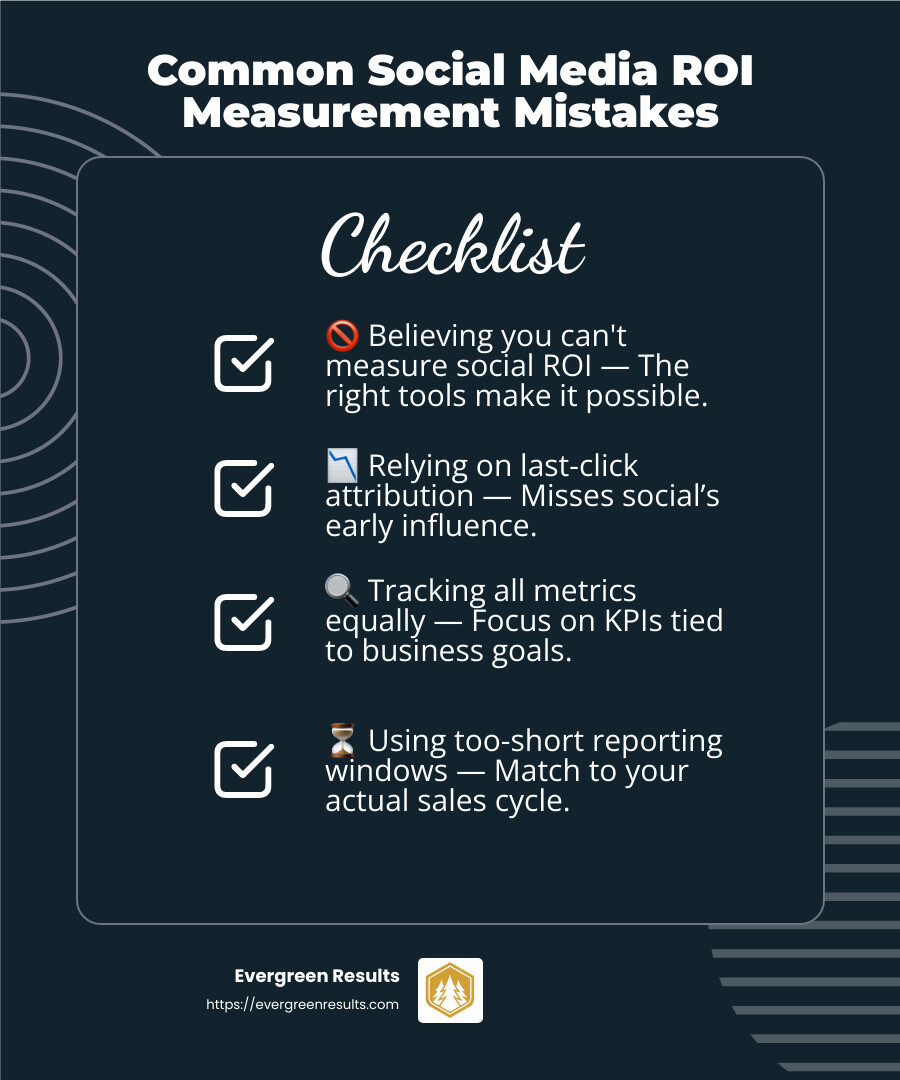
I hear this one all the time, usually followed by a deep sigh. The truth? While it’s not always straightforward, social media ROI is absolutely measurable with the right approach. The key is defining what “return” means for your specific business goals – whether that’s direct sales, lead generation, or brand awareness.
Myth #2: Last-click attribution tells the whole story
This is like giving the closer all the credit in a baseball game while ignoring the starting pitcher. Social media often plants the seed long before the harvest, influencing decisions weeks or months before the final conversion. That’s why multi-touch attribution models are so crucial – they acknowledge social’s role throughout the customer journey, not just at the finish line.
Myth #3: All metrics matter equally
I once worked with a Denver-based energy bar company obsessed with their follower count while their conversion rate was abysmal. Not all engagement translates to revenue! Focus on metrics that directly connect to your business objectives, and be ruthless about ignoring vanity metrics that look impressive but don’t impact your bottom line.
Myth #4: Short reporting windows are sufficient
Patience is indeed a virtue when measuring social media ROI. The average B2B sales cycle spans two months, yet a shocking 77% of marketers measure results within the first month. This premature evaluation can lead to pulling the plug on campaigns right before they bear fruit. Your reporting window should align with your typical sales cycle – whether that’s days, weeks, or months.
Myth #5: Organic social doesn’t need ROI measurement
“It’s free, so why measure it?” might be the most expensive mindset in marketing. Organic social requires significant time investment – from strategy development to content creation to community management. Calculate its ROI by factoring in labor costs and equivalent media value. You might be surprised to find your “free” efforts are either incredibly valuable or surprisingly costly.
Myth #6: More followers always means more ROI
Quality trumps quantity every time. A smaller, highly engaged audience often delivers substantially better ROI than a massive, disengaged one. I’ve seen brands with 5,000 followers consistently outperform competitors with 50,000 in terms of actual conversions and revenue generation. Focus on building a community, not just an audience.
Myth #7: Privacy changes make tracking impossible
Yes, iOS updates and cookie restrictions have complicated tracking, but they haven’t made it impossible. Smart marketers are adapting with first-party data collection, server-side tracking solutions, and incrementality testing. These approaches might require more effort, but they often yield more reliable data than the “easy” tracking of yesteryear.
The most dangerous pitfall? Getting so caught up in perfect measurement that you stop experimenting and innovating. How to measure ROI in social media marketing should inform your strategy, not paralyze it. The brands that win on social media balance data-driven decisions with creative risk-taking – measuring what matters while still creating content that resonates on a human level.
Frequently Asked Questions about Measuring Social Media ROI
How long should my reporting window be?
Timing matters when measuring social media ROI. Think of it like cooking—some dishes need a quick check, while others require patience to see results.
Your reporting window should match your typical sales cycle. If you run a direct-to-consumer brand where people make purchase decisions quickly, monthly reporting might tell you everything you need to know. For B2B brands or products with longer consideration periods (like outdoor gear investments), quarterly reporting often paints a more accurate picture.
At Evergreen Results, we’ve found a layered approach works best for most of our active lifestyle clients:
Weekly reporting helps us make quick campaign tweaks and catch any issues early.
Monthly reporting gives us enough data to make meaningful tactical adjustments to content and targeting.
Quarterly reporting provides the big-picture view needed for strategic decisions about channel investments and overall approach.
Social media efforts often show compounding returns over time—sometimes your best-performing content was published months ago but continues driving value!
Can I measure ROI without e-commerce data?
Absolutely! I work with plenty of brands that don’t have a direct “add to cart” function, and they still measure ROI effectively.
If your business doesn’t sell products directly online, try these approaches:
Value your leads realistically. If you know roughly 10% of your qualified leads convert into customers with an average value of $2,000, then each lead is worth approximately $200 to your business.
Track offline conversions creatively. Use unique discount codes, dedicated landing pages, or simply ask new customers “how did you hear about us?” at checkout or during onboarding calls.
Calculate equivalent media value. What would it cost to get the same reach and engagement through paid advertising? This approach works especially well for awareness-focused campaigns.
Try incrementality testing. Run your social campaigns in specific markets while keeping others as control groups to isolate social media’s true impact on your business.
For example, one of our Denver-based outdoor apparel clients doesn’t sell directly online but uses unique QR codes in their Instagram Stories that track which store visits originated from social content.
What’s a “good” ROI percentage on social media?
The simple answer: any positive ROI means you’re getting more out than you’re putting in—that’s a win! But of course, context matters.
Generally speaking, a 5:1 ratio (which translates to a 400% ROI) is considered good in the marketing world. This means for every dollar you spend, you get five dollars back.
Industry benchmarks vary significantly:
– Retail and e-commerce brands typically see 200-300% ROI
– B2B companies often report 400-700% ROI
– Food and beverage brands frequently land somewhere in between
Your own historical performance is actually your best benchmark. If you’ve been averaging a 150% ROI and suddenly hit 250%, that’s worth celebrating regardless of industry standards.
As one client told me after reviewing their first how to measure ROI in social media marketing report: “I don’t care what the industry average is—I care that we’re doing better than we were last quarter!”
ROI can fluctuate seasonally, especially for outdoor and active lifestyle brands. A lower ROI during your off-season might still be valuable if it’s maintaining customer relationships that will convert during peak buying periods.
The most important thing is consistent measurement using the same methodology so you can track improvements over time and make data-driven decisions about where to invest your social media resources.
Want more insights on connecting with your audience effectively? Check out our guide on Connecting with Your Audience: Tips for Social Marketing.
Conclusion
Let’s face it – proving the value of your social media efforts shouldn’t feel like solving a complex puzzle. Throughout this guide, we’ve broken down what once seemed intimidating into something manageable and actionable.
Measuring social media ROI is absolutely possible when you approach it with the right mindset and tools. By setting clear objectives, tracking meaningful metrics, implementing proper attribution, and creating consistent reports, you can confidently demonstrate how your social channels contribute to your bottom line.
At Evergreen Results, we’ve seen how outdoor brands, active lifestyle companies, and food/beverage businesses thrive when they connect their social strategies to tangible business outcomes. Your social channels aren’t just marketing platforms—they’re vibrant communities where your most passionate customers gather, share their experiences, and make purchasing decisions.
By implementing the framework we’ve outlined, you’ll be equipped to:
Defend your social media budget with hard data that speaks the language of decision-makers
Fine-tune your strategy based on what’s actually working, not just what feels right
Bridge the gap between likes and comments to leads and sales
Cultivate deeper relationships with followers who become loyal brand advocates
How to measure ROI in social media marketing combines analytical precision with creative storytelling. The brands that excel don’t just obsess over numbers—they use those insights to craft more meaningful content that resonates with their audience.
Measuring ROI isn’t a one-time event but an ongoing process of learning and optimization. Each report provides new insights that can inform your next campaign, helping you build a sustainable, growth-oriented social presence.
Ready to transform your social media from a cost center to a revenue driver? Learn more about our approach to serving up content on social media or reach out to discuss how we can help your brand leverage data-driven social strategies that deliver measurable returns while building authentic connections with your community.
The trail to better social ROI starts with a single step. Let’s take it together.