
Why Understanding Social Media ROI is Essential for Brand Growth
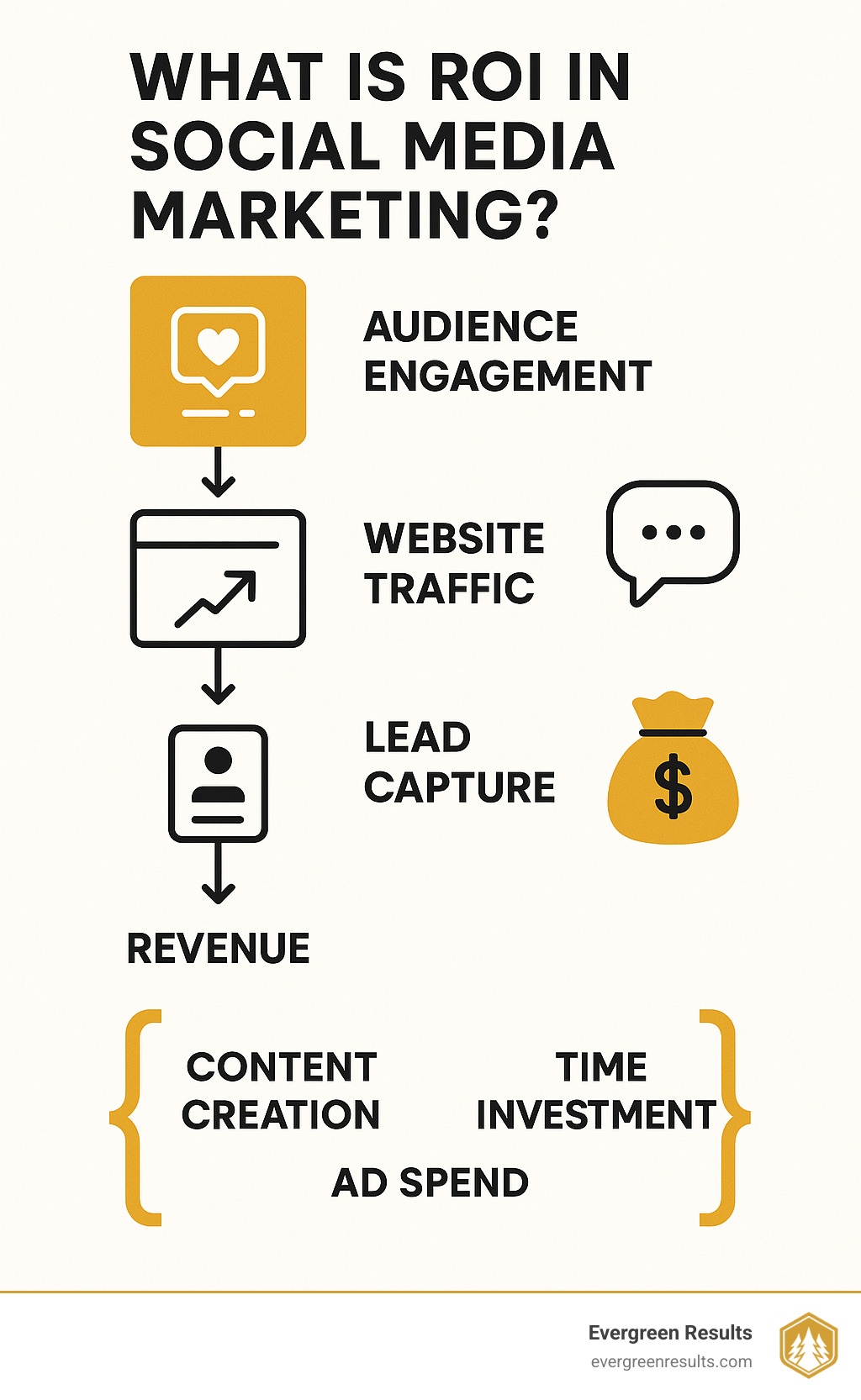
What is ROI in social media marketing? Social media ROI (Return on Investment) measures the value your business gains from social media activities compared to what you spend. It shows whether your posts, ads, and engagement efforts actually drive meaningful results like sales, leads, or brand awareness.
Quick Answer:
• Definition: Value gained ÷ Money invested × 100 = Social Media ROI percentage
• Key Components: Revenue, leads, engagement value vs. content costs, ad spend, time investment
• Main Goals: Sales conversions, lead generation, brand awareness, customer engagement
• Why It Matters: Proves social media impact, optimizes budget allocation, guides strategy decisions
Is your business really getting something out of its social media efforts? If it’s hard to tell, you’re not alone. According to recent research, 68% of marketers worry about proving ROI from their social efforts, even though 96% agree that social media delivers positive returns.
The challenge isn’t that social media doesn’t work—it’s that many brands struggle to connect their posts and engagement to actual business outcomes. Unlike traditional advertising where you can track direct responses, social media creates a web of interactions that influence buying decisions over time.
But here’s the thing: social commerce sales are estimated to reach $2.9 trillion by 2026, growing 30% year-over-year. The brands that figure out how to measure and optimize their social media ROI will capture the biggest share of this massive opportunity.
I’m Adam Bocik, founder of Evergreen Results, where I’ve helped dozens of active lifestyle brands open up measurable growth through strategic social media campaigns. Throughout my work scaling purpose-driven companies, understanding what is ROI in social media marketing has been the foundation for turning social engagement into sustainable revenue growth.
What is roi in social media marketing terms made easy:
– Social media ROI strategies
– Social media growth strategies
What is ROI in Social Media Marketing?
At its heart, ROI in social media marketing is all about understanding the real value your business gets from investing time, money, and energy into social platforms. Think of it as asking yourself, “For every dollar we put into social media, how much actual benefit do we get back?”
The basic math behind ROI is straightforward: (Return – Investment) ÷ Investment × 100 = ROI percentage. But when it comes to social media, things get a little more interesting than just dollars and cents.
Unlike a billboard or a print ad, social media can deliver value in many forms. It isn’t just about the money you make right away. Sometimes, the returns are direct, like revenue from social commerce sales or qualified leads who fill out your online forms. Other times, the value is less obvious—think of the savings when your customer service team solves problems publicly, or the lasting relationships you build with loyal fans and advocates. Brand awareness also plays a big role, measured by how many people see, share, and talk about your content. And don’t forget the power of community building, which can turn casual followers into lifelong customers.
But here’s the key: success looks different for every business. Before you start measuring, you need to define what matters most to you. Are you focused on sales, building your email list, or making your brand the talk of the town? Pin down your main objectives so you know what to track.
ROI vs Traditional Marketing ROI
Social media ROI and traditional marketing ROI are like cousins—related, but with some very different personalities.
First, let’s talk about tracking windows. Traditional marketing, like direct mail or a TV spot, is usually all about immediate responses. With social media, the path isn’t always straight. Someone might see your post today, do a little research next week, and finally make a purchase after a nudge from a retargeting ad a month later.
Then there’s attribution. Traditional marketing often relies on “last-click” models—giving credit to the last touchpoint before a sale. But with social media, the customer journey is rarely that simple. People might find you on TikTok, chat with you on Instagram, and finally convert through a Facebook ad. The lines get blurry fast.
Finally, consider offline versus online signals. Social media blurs the digital and the real world. Someone might read your latest post, swing by your store in person, and make a purchase that’s hard to track back to that original social spark.
Main Goals that Shape Social ROI (Sales, Leads, Awareness, Engagement)
To truly answer what is ROI in social media marketing, you need to match your measurement strategy to your goals. Every business is unique, and different goals call for different benchmarks.
If your goal is sales, you’ll want to track revenue generated directly from social channels. Tools like UTM parameters and conversion tracking can help you see which posts or ads led to purchases.
For lead generation, it’s about counting those valuable email signups, demo requests, or consultation bookings. You can estimate ROI by multiplying your leads by the average value of a lead or your conversion rate.
When your focus is brand awareness, success isn’t just about dollars—it’s about reach and visibility. You can assign value to this by comparing your organic impressions to what it would cost to get the same exposure through paid ads.
And if customer engagement is your north star, you’ll want to look at the value of community building, customer service interactions, and user-generated content. These efforts often lead to reduced marketing costs and customers who stick around longer.
Ready to get serious about ROI? Defining clear goals is the first big step. Only then can you pick the right social media ROI strategies and turn your social presence into measurable business growth.
Why Measuring Social Media ROI Matters
Picture this: You’re in a budget meeting, and the CFO asks, “What exactly are we getting from all this social media spending?” If you can’t answer with concrete numbers, you’re in trouble. But when you understand what is ROI in social media marketing and can prove your results, that same conversation becomes a request for more budget to scale what’s working.
Budget justification becomes effortless when you have solid ROI data. Instead of defending your social media expenses, you’re presenting them as investments. When you can show that every dollar spent generates $3-5 in return, you transform from someone asking for money to someone bringing money in. That’s a much better position to be in during budget season.
The real magic happens with strategy optimization. ROI measurement reveals the hidden patterns in your social media performance. Maybe your Instagram Stories convert twice as well as feed posts, or your behind-the-scenes content drives more engagement than polished product shots. Without measuring ROI, you might keep investing in tactics that feel right but don’t actually move the needle.
Executive buy-in changes completely when you speak their language—revenue and growth. Research shows that proving social media ROI remains one of the biggest challenges for marketing teams. But here’s the opportunity: while most brands struggle with measurement, the ones that figure it out gain a massive competitive advantage. They can confidently invest more in what works while their competitors waste budget on guesswork.
The numbers tell an incredible story. Latest research on social commerce sales shows that 68% of consumers have bought something directly from social media, and this trend is accelerating rapidly. Social commerce isn’t the future anymore—it’s happening right now, and the brands measuring ROI effectively are capturing the biggest share.
Competitive advantage comes naturally when you’re making data-driven decisions while others are posting and hoping. You know which content formats work, which platforms drive the best customers, and how to allocate budget for maximum impact. That clarity compounds over time, creating an ever-widening gap between your results and those of competitors who aren’t measuring properly.
Stakeholder Reporting & Communication
Measuring ROI is only half the story—you need to communicate results in ways that make people care and take action. Different stakeholders need different perspectives on the same data.
Executives want the big picture. They care about revenue impact, cost savings, and how social media contributes to overall business growth. A simple chart showing “Social Media Investment vs. Revenue Generated” resonates more than engagement metrics ever will. Focus on business outcomes they can relate to their own KPIs.
Marketing teams need actionable insights. They want to know which content types perform best, when to post for maximum engagement, and which audience segments convert most effectively. Share learnings that can immediately improve their next campaign, not just vanity metrics that make everyone feel good.
Finance teams think in business terms. Present cost per acquisition compared to other channels, customer lifetime value from social-acquired customers, and clear attribution models. They need to understand how social media fits into the broader revenue picture and whether it’s more efficient than traditional marketing channels.
The secret is storytelling with data. Don’t just dump metrics on people—explain what the numbers mean for business growth and what specific actions you’ll take based on the insights. More info about measure success provides additional frameworks for turning data into compelling business narratives that drive decisions and secure resources.
How to Calculate and Track ROI Step-by-Step
Ready to turn those confusing social media numbers into clear business insights? Let me walk you through the exact process we use with our clients to calculate meaningful ROI that actually helps drive decisions.
The beauty of social media ROI calculation is that once you have a system in place, it becomes almost automatic. But getting that system right from the start makes all the difference between useful insights and meaningless data.
Start by defining your goals and time frame. This sounds obvious, but you’d be surprised how many brands skip this step. Are you tracking direct sales from your latest product launch? Lead generation for your email list? Brand awareness for a new market? Pick one primary goal per campaign, and choose a realistic time frame. Most of our food and beverage clients see the best results tracking 60-90 day windows since their customers often research before buying.
Track every single cost related to your social efforts. This is where many calculations fall apart—people forget about the hidden costs. Your content creation time has real value, so calculate your team’s hours at their actual salary rate. Don’t forget your social media tool subscriptions, paid advertising spend, influencer partnerships, and any graphic design or video production costs. Even if you’re doing everything in-house, time equals money.
Set up proper tracking before you launch anything. UTM parameters should become your best friend—they’re those little code snippets that help Google Analytics know exactly where your traffic comes from. Every link you share on social media should have one. Install conversion tracking pixels for Facebook, Instagram, LinkedIn, and any other platforms where you advertise. This step takes 30 minutes but saves hours of guesswork later.
Assign monetary values to everything, even the stuff that doesn’t immediately scream “money.” This is where understanding what is roi in social media marketing really comes together. Direct sales are easy—just use the actual revenue. But leads require some math: multiply your lead count by your average conversion rate and customer value. Email signups get valued at your average subscriber lifetime value. For brand awareness, compare your reach costs to what equivalent paid advertising would cost.
Apply the standard ROI formula: (Total Value Generated – Total Investment) ÷ Total Investment × 100 = ROI percentage. Simple math, but the magic happens in how you define and calculate those values.
Standard Formula & Worked Example
Let me share a real example from one of our active lifestyle clients that perfectly shows what is roi in social media marketing looks like in practice.
We ran an Instagram and Facebook campaign promoting their new line of sustainable workout gear over 60 days. Here’s exactly what we invested and what we got back:
Our total investment came to $4,700. This included $3,000 in ad spend, $1,500 for content creation (20 hours at $75 per hour for our team’s time), and $200 for tools and tracking software.
The returns were impressive. We generated $8,500 in direct sales from people who clicked through and bought immediately. We also captured 150 email signups, and since this client’s email subscribers have an average lifetime value of $25, that added $3,750 in future value. The brand awareness component—measured by comparing our organic reach to equivalent paid advertising costs—contributed another $1,200 in value.
Total value: $13,450.
Our ROI calculation: ($13,450 – $4,700) ÷ $4,700 × 100 = 186% ROI
This means every dollar invested generated $2.86 in value. Not bad for two months of work! More importantly, these numbers gave us the confidence to scale the campaign and allocate more budget to the tactics that worked best.
Assigning Dollar Value to Non-Financial Outcomes
Here’s where things get interesting—and where most brands give up too early. Not everything valuable happens in your shopping cart, but that doesn’t mean it’s not worth measuring.
Reach and impressions have real value when you think about them correctly. If your post reaches 10,000 people organically and Facebook would charge you $5 per 1,000 impressions for the same reach, you just created $50 in advertising value. It’s not cash in the bank, but it’s budget you didn’t have to spend.
Engagement value works similarly. Calculate what it would cost to generate those likes, comments, and shares through paid promotion. If your post gets 500 organic engagements and promoted posts typically cost $0.50 per engagement, that’s $250 in earned value.
Customer service savings might be the most overlooked value creator. When you solve a customer’s problem on social media instead of having them call support, you’re saving real money. If a social response costs you $5 in time but a phone call costs $15 in support resources, you’ve saved $10 per interaction.
User-generated content saves you serious content creation costs. Professional product photos might cost $200 each, so every time a customer posts about your brand, they’re creating real value. Plus, authentic customer content often converts better than professional shots anyway.
Recommended Metrics & Tools
The trick is focusing on metrics that actually align with your business objectives instead of getting lost in vanity numbers that look impressive but don’t drive growth.
For sales-focused goals, track your conversion rate from social traffic, revenue per social media visitor, social commerce sales volume, and customer acquisition cost by platform. These numbers tell you exactly which platforms and content types turn browsers into buyers.
For lead generation, measure your cost per lead by social platform, lead-to-customer conversion rate, email signup rate from social traffic, and demo or consultation requests. This helps you understand the full funnel from social engagement to closed deals.
For brand awareness, focus on reach and impression growth, share of voice versus competitors, brand mention sentiment, and organic search volume increases. These metrics show how social media builds long-term brand equity.
Google Analytics 4 remains essential for tracking website conversions from social traffic. Native platform analytics from Facebook, Instagram, and LinkedIn provide detailed insights you can’t get anywhere else. Social media management tools help centralize reporting across platforms, and UTM parameter generators ensure you’re tracking everything properly.
Scientific research on integrated metrics offers additional frameworks for comprehensive measurement that connects social media to broader business objectives.
The key is starting simple and building complexity as you get comfortable with the basics. Perfect measurement beats no measurement every time.
Common Challenges & Smart Solutions

Let’s be real—figuring out what is ROI in social media marketing isn’t always straightforward. Even the most organized brands hit roadblocks when trying to connect their social efforts to actual business results. The good news? These challenges are totally solvable once you know what you’re dealing with.
Data living in different worlds is probably the biggest headache we see. Instagram shows amazing engagement numbers, Facebook reports solid reach, but then Google Analytics tells a completely different story about conversions. It’s like having three different people describe the same party—everyone saw something different.
The fix is creating one central place where all your data comes together. Set up consistent UTM parameters across every single social link (yes, even the ones in your bio). Then establish a weekly ritual of pulling reports from each platform and comparing them side by side. When you spot weird discrepancies, you can dig in before they throw off your entire analysis.
Long sales cycles create another puzzle, especially for brands selling higher-ticket items or B2B services. Someone might find your brand through a TikTok video in January but not purchase until June. Traditional tracking would give TikTok zero credit, even though it started the whole journey.
The solution is thinking beyond last-click attribution. Google Analytics has an “assisted conversions” report that shows how social media contributes to sales even when it’s not the final touchpoint. For active lifestyle and food brands, we often see social media playing a huge role in the research phase, building trust that leads to purchases weeks later.
Getting caught up in vanity metrics is surprisingly easy. Those notification pings when your follower count jumps feel great, but followers don’t pay the bills. I’ve seen brands celebrate reaching 10,000 Instagram followers while their actual sales from social media stayed flat.
The antidote is always asking “so what?” after every metric. Gained 500 new followers this month? Great—how many visited your website? Got 1,000 likes on that product post? Awesome—did it drive any actual sales? This habit keeps you focused on metrics that matter for your bottom line.
Multi-touch attribution gets especially tricky in our digital world. A customer might see your Instagram post, check out your LinkedIn content, get retargeted on Facebook, then finally convert after a Google search. Which channel deserves credit for the sale?
Instead of trying to give 100% credit to one channel, start thinking about how social media assists the entire customer journey. Use longer attribution windows in your analytics (30-90 days instead of just 7) and focus on how social media influences other marketing channels. Often, strong social presence makes your email marketing and paid ads more effective too.
Tool Stack to Simplify ROI Tracking
The right tools transform ROI tracking from a monthly nightmare into a manageable routine. Google Analytics 4 forms the foundation—it’s free and connects social media traffic to actual website actions like purchases and email signups. Set up conversion goals for every important action customers can take.
Social media management platforms save massive amounts of time by pulling all your platform data into one dashboard. Look for tools that play nicely with Google Analytics so your data flows seamlessly between systems. The best ones let you schedule posts, track performance, and generate reports without jumping between ten different browser tabs.
Social listening tools help you understand the qualitative side of ROI. They track brand mentions, sentiment, and conversations that happen around your brand but might not show up in traditional analytics. This gives you insight into how social media affects brand perception and word-of-mouth marketing.
ROI calculators and spreadsheet templates keep the math simple. You don’t need fancy software to calculate returns—sometimes a well-organized Google Sheet works perfectly for tracking costs and benefits over time.
For brands in the active lifestyle space, social advertising often requires tracking approaches that account for seasonal patterns and community-driven purchasing behaviors. Someone might engage with your hiking gear content all summer but not purchase until the holiday season when they’re buying gifts.
The key is starting simple and building complexity gradually. Get basic tracking working first, then add more sophisticated attribution models as you learn what matters most for your specific business.
5 Proven Ways to Improve Social Media ROI
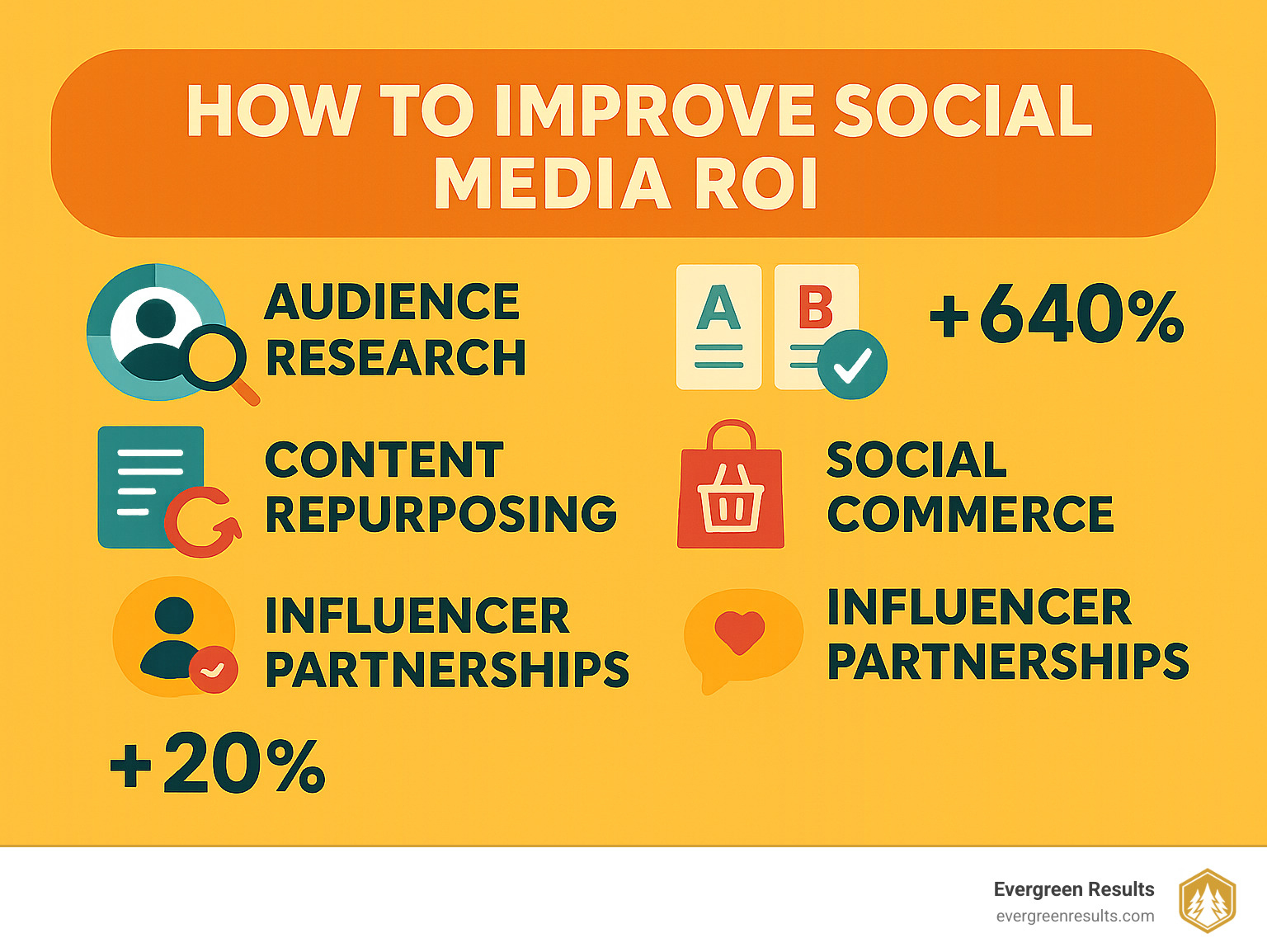
Here’s the thing about improving social media ROI—it’s not about doing more stuff. It’s about doing the right stuff better. After working with dozens of active lifestyle brands, I’ve seen the same five strategies consistently deliver breakthrough results.
Deep audience research is where everything starts. And I’m not talking about basic demographics like “women aged 25-34.” You need to understand what keeps your audience up at night, what excites them, and how they actually talk about their problems.
We worked with a Colorado-based nutrition company that was targeting “fitness enthusiasts” with generic workout content. Their ROI was stuck at 45%. When we dug deeper, we finded their best customers were specifically trail runners dealing with altitude training challenges. We shifted their content to address high-altitude nutrition and recovery—their ROI jumped to 195% in just two months.
The magic happens when you understand the specific communities within your broader audience. Understanding what is ROI in social media marketing means recognizing that hyper-targeted content almost always outperforms generic messaging.
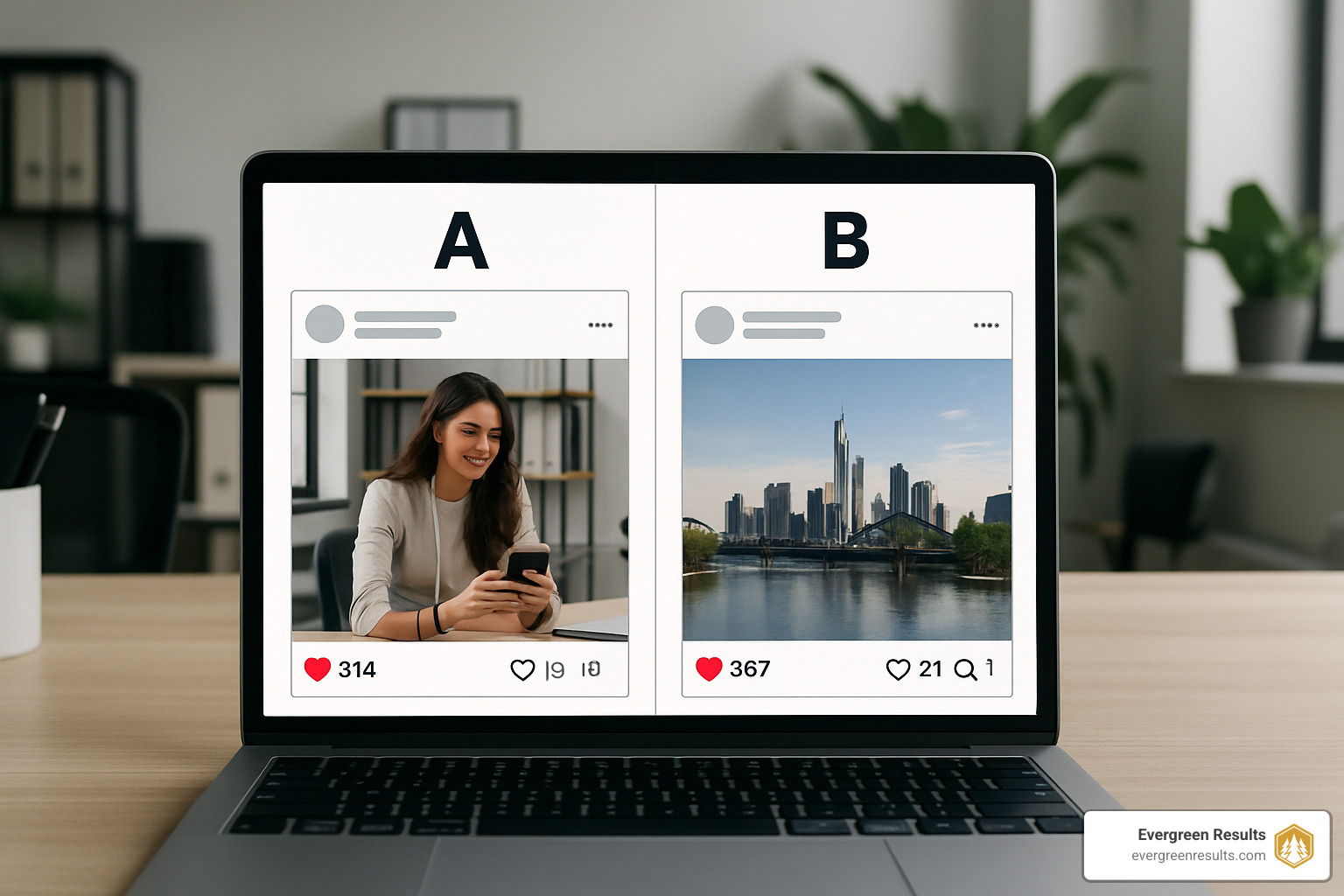
Systematic A/B testing is your secret weapon for optimization. But here’s where most brands mess up—they test everything at once and can’t figure out what actually worked. Test one element at a time: the headline, the image, the call-to-action, or the posting time.
One of our food brand clients finded something surprising through testing. Their user-generated content posts converted 73% better than professional product photography. This single insight transformed their content strategy and doubled their social commerce revenue. They went from hiring expensive photographers to building a community of brand advocates who created content for them.
Content repurposing is how you maximize every piece of content you create. That blog post about sustainable packaging? Turn it into an Instagram carousel, a LinkedIn article, three Twitter posts, and a TikTok video. You’ve just created five pieces of content from one original idea.
This approach doesn’t just save time—it ensures your message reaches people on their preferred platforms. Some customers love detailed LinkedIn articles while others prefer quick Instagram stories. Give them options.
Social commerce integration removes friction from the buying process. When someone sees your product on Instagram and gets excited, they shouldn’t have to jump through hoops to buy it. Instagram Shopping, Facebook Shops, and Pinterest Product Pins let customers purchase without leaving the platform.
The numbers speak for themselves here. Social commerce sales are growing 30% year-over-year because it’s convenient. The easier you make it to buy, the more people will buy.
Strategic influencer partnerships work best when you think small and authentic. Forget celebrity endorsements—focus on nano and micro-influencers who genuinely love your brand. Their audiences trust their recommendations because they feel like advice from a friend.
We helped an organic snack brand partner with local hiking influencers instead of fitness celebrities. The hiking community trusted these recommendations, leading to conversion rates 4x higher than traditional advertising at half the cost.
Optimization Playbook
The key to sustained improvement is treating social media like a laboratory. Every post is an experiment that teaches you something about your audience. What made that video go viral? Why did Tuesday’s post flop while Wednesday’s identical content succeeded?
Competitor research gives you insights without the trial and error. Watch what content formats work well in your industry, but don’t copy directly. Understand the principles behind successful posts and adapt them to your brand voice.
Agile budget allocation means following the data, even when it surprises you. If LinkedIn generates better leads than Facebook for your B2B brand, shift budget accordingly. If Instagram Stories convert better than feed posts, create more Stories content.
The brands that master this optimization cycle see compound improvements over time. Small tweaks add up to major ROI gains when applied consistently. Our connecting audience tips for social marketing guide provides additional strategies for building the kind of authentic connections that drive long-term growth.
Frequently Asked Questions about Social Media ROI
How often should I calculate ROI?
A good rule of thumb? Calculate your social media ROI every month for ongoing campaigns, and give your overall performance a thorough review every quarter. This keeps you nimble—able to spot patterns, fix any mishaps, and double down on what’s working before too much time slips by.
For big campaigns (like product launches), it’s smartest to measure ROI right after each campaign wraps up. Most brands find a window of 30 to 90 days fits their sales cycles.
And don’t forget: keep an eye on your key metrics weekly. While you don’t need to crunch all the ROI numbers that often, those weekly check-ins help you catch early wins—and issues—before they snowball.
What’s considered a “good” ROI percentage?
Let’s break it down: Any ROI above 0% means you’re bringing in more value than you’re spending—so that’s a win! But what’s “good” in the eyes of most marketers?
- 100–200% ROI: Solid. This shows your efforts are working and your budget is well-placed.
- 300–500% ROI: Now we’re talking! This is excellent and usually signals it’s time to scale up what’s working.
- Above 500% ROI: Outstanding. Time to study those results, learn what’s clicking, and try to replicate the magic.
A common benchmark across marketing is a 5:1 revenue-to-cost ratio (which is a 400% ROI). If you’re consistently hitting that, your social media is in top shape.
Of course, the “best” number depends on your industry and business goals—but these ranges can guide your expectations as you measure.
Which platform delivers the highest ROI right now?
If you’re wondering where you’ll get the most bang for your buck, Instagram is leading the pack for ROI for many brands, closely followed by Facebook, YouTube, and LinkedIn.
But don’t just go by the crowd. The most effective platform for your business depends on your unique audience and where they love to spend their time. For example:
– B2B brands often see the best results on LinkedIn.
– E-commerce companies tend to thrive on Instagram and Facebook thanks to built-in shopping features.
– Video-forward brands (hello, food and fitness) may find YouTube and TikTok deliver stronger returns.
The key? Test. Try different platforms, track your results, and see what delivers the greatest returns for your specific goals.
Still have questions about what is ROI in social media marketing or how to make sense of your numbers? Evergreen Results is here to help you track, measure, and turn your insights into real, measurable growth.
Conclusion
Mastering what is ROI in social media marketing is like learning to read a compass in the wilderness—once you understand it, you’ll never lose your way again. It’s not just about proving your social media efforts are worthwhile; it’s about building a growth engine that consistently delivers measurable results for your brand.
Think about it this way: every post, every campaign, every dollar spent on social media should be working toward a specific business goal. When you can clearly see which efforts drive real value and which ones don’t, you gain the power to make smarter decisions that compound over time.
The beauty of social media ROI measurement lies in its continuous improvement cycle. You measure, learn, optimize, and measure again. Each cycle teaches you something new about your audience, your content, and your business. Maybe you find that behind-the-scenes videos convert better than polished product shots, or that your Tuesday morning posts reach more engaged customers than weekend content.
Your measurement approach should grow with your business. Start simple with basic conversion tracking and cost calculations. As you get comfortable with the fundamentals, add more sophisticated attribution models and cross-platform analysis. The key is starting somewhere and staying consistent.
At Evergreen Results, we’ve watched brands transform their entire business trajectory by taking social media measurement seriously. A craft brewery client went from treating social media as “just posting pretty pictures” to generating 40% of their taproom traffic through strategic social campaigns. The difference? They started measuring what mattered and optimizing based on real data.
Social media ROI isn’t just about immediate sales. Building genuine community, providing excellent customer service, and creating brand advocates all contribute to long-term business value. The trick is finding ways to quantify these benefits so you can make informed decisions about where to invest your time and budget.
Your next step is simple: pick one campaign or one month of social media activity and calculate its ROI using our step-by-step framework. Don’t worry about getting it perfect—focus on establishing the habit of measurement. Once you see how powerful this insight can be, you’ll wonder how you ever managed social media without it.
More info about serving up content on social media — Evergreen Results helps active lifestyle and food & beverage brands turn insights into measurable social wins.