
Why Tracking Social Media ROI is Critical for Business Growth
Learning how to track social media roi starts with a simple truth: most marketers agree social media delivers positive returns, yet many struggle to prove it. This guide will show you how to bridge that gap.
Here’s the quick answer to tracking social media ROI:
- Set measurable goals aligned with business objectives.
- Assign dollar values to your social media outcomes.
- Calculate total investment including ad spend, content, tools, and time.
- Apply the ROI formula: (Revenue – Investment) ÷ Investment × 100.
The challenge isn’t that social media doesn’t work; it’s that most brands track vanity metrics like likes instead of revenue-driving actions. By focusing on conversions and customer lifetime value, social media becomes a profit driver.
With social commerce forecast to reach $2.9 trillion by 2026, mastering ROI tracking is essential for capturing future growth. As the founder of Evergreen Results, I’ve seen how data-driven social strategies separate successful brands from those burning budgets without results. This guide shares the framework we use to help active lifestyle brands achieve measurable returns.
Easy how to track social media roi word list:
What is Social Media ROI and Why Does it Matter?
Social media ROI (Return on Investment) is your report card for social media, showing what you get back for every dollar spent. While 96% of marketers agree that social media delivers positive returns, many struggle to prove it with hard numbers.
Understanding What is Social Media ROI and Why Does it Matter? is crucial for:
- Justifying Spend: Provide concrete proof that your social media efforts are worth the investment.
- Optimizing Strategy: Double down on what works by identifying which posts and platforms drive sales.
- Gaining a Competitive Edge: Make data-driven decisions while competitors are still guessing.
- Securing Budget: Show clear returns to get approval for bigger campaigns.
The Challenge of Measuring ROI
So why do 68% of marketers worry about it? The main challenge is attribution—figuring out which touchpoints led to a sale. Last-touch attribution, which credits only the final interaction, often undervalues social media’s role early in the customer journey. A better approach is multi-touch attribution, which spreads credit across all touchpoints, giving a more realistic picture of social media’s impact. Another challenge is quantifying intangible benefits like brand awareness, but there are methods to assign dollar values to these as well.
The Benefits of Tracking ROI
Mastering how to track social media roi transforms social media from an expense into a profit center. It enables:
- Data-driven decisions over gut feelings.
- Clear identification of successful campaigns and content.
- Effective allocation of time and budget to high-impact activities.
- Proving value to stakeholders, which builds trust and credibility.
This approach helps you truly measure the success of your digital marketing across all channels.
The 4-Step Framework to How to Track Social Media ROI

Learning how to track social media roi is simpler with a framework. Think of it like planning a hike: you need a destination, the right gear, and a way to measure progress. This 4-step process provides a clear path to measuring your social media success.
Step 1: Set Clear, Measurable Social Media Goals
Effective ROI tracking starts with knowing what you want to achieve. Your goals must be SMART (Specific, Measurable, Achievable, Relevant, Time-bound) and aligned with business objectives. Don’t set goals in a vacuum; connect them to your bottom line.
- Brand Awareness: Instead of chasing followers, aim to increase brand mentions by 20% in Q3.
- Lead Generation: Generate 500 qualified leads from LinkedIn within six months.
- Sales: Increase direct sales from Instagram Shopping by 15% this holiday season.
- Customer Loyalty: Reduce customer service response time on X by 50%.
Every goal should connect to a business outcome. For more guidance, see our best practices for setting and achieving social media marketing goals to maximize ROI.
Step 2: Assign Monetary Value to Your Goals
This step translates social media activity into dollars. If you can’t assign value to your efforts, you can’t prove their worth.
- Customer Lifetime Value (CLV): If a new customer from social media is worth $500 over their lifetime, that’s the value you track. Our article on calculating customer lifetime value can help.
- Average Sale Value: If a typical order is $75, each sale from social media is worth $75.
- PPC Cost Equivalent: If an organic post drives 100 clicks and paid ads cost $0.50 per click, that organic traffic is worth $50.
- Lead Conversion Value: If 100 leads convert to 10 customers worth $200 each, those leads represent $2,000 in potential value.
Consistency is key. Pick a method that fits your business and stick with it.
Step 3: Calculate Your Total Social Media Investment
To track ROI accurately, you must account for all costs, not just the obvious ones.
- Ad Spend: Your advertising budgets on all platforms.
- Content Creation: Costs for photography, video, design, and copywriting.
- Tools and Software: Monthly subscriptions for scheduling, analytics, and design tools.
- Labor Costs: The time your team spends on strategy, content, and community management. A social media manager’s time is a significant investment.
- Agency Fees: If you work with an agency like Evergreen Results, these fees are part of your investment.
Calculating your true investment provides a clear picture of your costs. Our guide on how to calculate ROI for social media marketing offers more detail.
Step 4: Use the Social Media ROI Formula
With your value and investment calculated, apply the classic ROI formula:
ROI = [(Profit – Investment) / Investment] x 100
For example, an e-commerce brand invests $18,000 in social media and generates $50,000 in direct sales. Their calculation is:
ROI = [($50,000 – $18,000) / $18,000] x 100 = 178%
This fantastic return clearly justifies the investment. A positive ROI (above 0%) means your efforts are profitable. A negative ROI is valuable feedback that your strategy needs adjustment. This simple formula provides a clear, comparable number to gauge performance.
Key Metrics: Separating Actionable Insights from Vanity Metrics
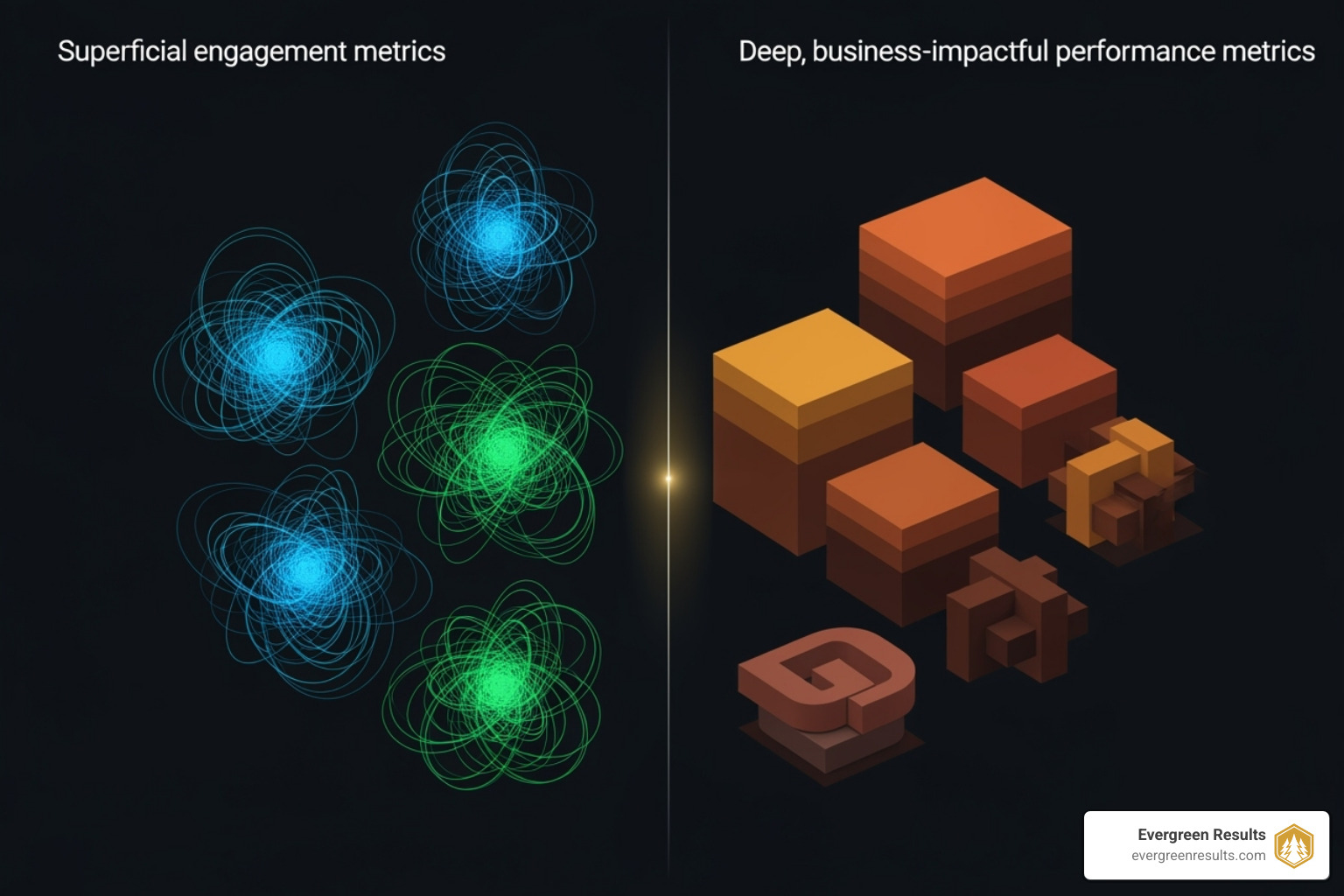
The uncomfortable truth about how to track social media roi is that many brands measure the wrong things. They celebrate vanity metrics (likes, follower count) that feel good but don’t drive business, while actionable metrics that predict success get ignored.
How to track social media roi by focusing on the right numbers
Actionable metrics correlate with revenue, while vanity metrics do not. It’s the difference between wasting budget and driving growth.
- Follower Growth Rate > Follower Count: A declining growth rate tells a story that a large total follower count hides.
- Click-Through Rate (CTR) > Impressions: A million impressions mean nothing without clicks. A high CTR shows your content drives action.
- Engagement Rate > Total Likes: This shows what percentage of your audience cares enough to interact. A smaller, engaged audience is more valuable.
- Conversion Rate > Reach: This measures how many people took the desired action (e.g., buying or signing up).
Actionable Metrics to Track for Each Funnel Stage
Tracking the right metrics at each stage of the customer journey provides a complete picture of social media’s contribution.
- Awareness Stage: Focus on reach (unique viewers), share of voice (market presence vs. competitors), and follower growth rate (brand momentum).
- Consideration Stage: Track engagement rate (audience interest), click-through rate (content effectiveness), and video completion rate (viewer attention).
- Conversion Stage: This is where value is proven. Measure conversion rate (visitors who complete an action), cost per click (paid campaign efficiency), and return on ad spend (revenue per ad dollar).
- Advocacy Stage: Understand long-term value with customer satisfaction scores, Net Promoter Score (likelihood to recommend), and customer reviews.
By tracking these Social Media ROI Metrics across the funnel, you get a complete picture of how social media contributes to business growth.
5 Proven Strategies to Improve Your Social Media ROI

Understanding how to track social media roi is the first step; improving it is the next. At Evergreen Results, we use data-driven insights to refine strategies for active lifestyle and food/beverage brands. Here are five proven strategies we employ:
1. Test, Analyze, and Optimize Your Content
Continuous testing is non-negotiable in the dynamic world of social media. A/B test headlines, visuals, and calls-to-action to see what resonates. Analyze your top-performing posts to identify common themes, then scale up what’s working. Finally, analyze when your followers are most active and schedule posts for maximum visibility. This iterative process is key to creating Engaging Social Media Content and helps Optimize Content for Social Media.
2. Use UTM Parameters for Precision Tracking
To measure ROI accurately, you must know where traffic and conversions originate. UTM (Urchin Tracking Module) parameters are tags added to URLs that provide this data to tools like Google Analytics. By adding codes like ?utm_source=facebook&utm_campaign=summer_sale, you can track performance from specific campaigns or even individual posts. This precision is invaluable for understanding how to track social media roi at a granular level and is a core part of Using UTM parameters to create trackable links.
3. Leverage Social Commerce Features
Social platforms are becoming powerful retail channels. Features like Instagram Shopping and Facebook Shops allow customers to purchase products directly within the app. This reduces friction in the customer journey, which increases conversion rates and makes ROI more evident. With social commerce projected to become a multi-trillion dollar market by 2026, this is a massive opportunity. We help our clients implement social commerce strategies to turn social browsing into direct revenue.
4. Get Inspired by Industry Trends and Benchmarks
Don’t operate in a vacuum. Analyze industry trends in content formats and platform features. Benchmark your performance metrics (engagement rate, CTR) against industry averages to identify areas for improvement. Analyzing competitors can also reveal content gaps and opportunities. Staying informed helps you make smarter decisions and ensure your Connecting Audience: Tips for Social Marketing strategies are effective.
5. Focus on Building an Engaged Community
Long-term ROI often comes from a strong, engaged community. An engaged audience is more loyal, more likely to purchase, and more likely to advocate for your brand. Actively respond to comments and messages, and encourage user-generated content (UGC) to provide social proof and make your audience feel valued. Building brand loyalty leads to repeat purchases and positive word-of-mouth, which are powerful drivers of long-term ROI and customer retention.
Frequently Asked Questions about Tracking Social Media ROI
Here are answers to the most common questions I hear from active lifestyle and food/beverage brands about how to track social media roi.
How do you measure the ROI of organic social media?
Organic social media has measurable value, even without direct ad spend. The ROI formula remains the same, but we define profit and investment differently. The investment includes labor costs (your team’s time) and tool subscriptions. The profit can be calculated in a few ways:
- Owned Media Value: What would it cost to get the same results (e.g., clicks, reach) with paid ads? If an organic post drives 100 clicks and your average CPC is $0.72, that’s $72 in value.
- Referral Tracking: Use UTM parameters to track website visits, signups, and sales that originate from organic posts.
- Brand Building: While harder to quantify immediately, track metrics like brand mentions and sentiment over time to see the long-term impact on brand equity and customer loyalty.
What is a “good” social media ROI?
There’s no single magic number; a “good” ROI depends on your industry, goals, and business maturity. While industry benchmarks provide context, focus on your campaign goals. A brand awareness campaign might have a lower ROI than a direct sales campaign, and that’s okay. As a rule of thumb, any positive ROI is profitable, but great direct response campaigns often see returns of 300-500%. The most important goal is continuous improvement—consistently growing your ROI over time.
How do different social media platforms contribute to ROI?
Each platform has unique strengths, so align your platform choice with your business goals.
- Facebook: Excellent for community building and highly targeted advertising, with Facebook Shops enabling seamless e-commerce.
- Instagram: A visual-first platform perfect for showcasing products in action, especially for active lifestyle brands. Instagram Shopping turns inspiration into sales.
- LinkedIn: The go-to for B2B marketing, thought leadership, and reaching business partners like retailers or distributors.
- TikTok: Offers massive organic reach potential through authentic, short-form video content.
- Pinterest: Acts as a visual search engine where users actively seek inspiration and products, making it powerful for driving qualified traffic.
Focus your efforts where your audience spends their time and where your content fits naturally.
Conclusion: Turn Your Social Data into Dollars
Mastering how to track social media roi transforms social media from a guessing game into a strategic pathway for business growth. You now have the framework to set measurable goals, assign dollar values to outcomes, calculate your true investment, and prove your financial return.
By focusing on actionable metrics over vanity metrics, you start speaking the language of business success. This data-driven approach is crucial, especially as social commerce continues to expand. The brands that master ROI tracking today will be the leaders of tomorrow.
At Evergreen Results, we help active lifestyle and food/beverage brands turn social data into sustainable growth and authentic community. Understanding ROI creates a positive feedback loop: better measurement leads to better decisions, better results, and greater success. Your social media evolves from a cost center into a profit engine that drives your business forward.
Ready to transform your social media into a profit center? We’re here to help you build a strategy that drives real results.
Ready to master your social media strategy? Explore our social media content services.