
Why Your Social Media ROI Measurement Is Missing the Mark
To truly understand marketing impact, brands must move beyond surface-level metrics. Advanced techniques for social media roi are essential. Key methods include:
- Multi-touch attribution models to distribute credit across all customer touchpoints.
- Incrementality testing to isolate social media’s actual impact.
- Brand equity calculation to quantify the value of sentiment and awareness gains.
- Customer journey mapping to track social’s influence from awareness to retention.
- AI-powered analysis for predictive insights and automated optimization.
The issue isn’t social media’s effectiveness, but that 44% of CMOs still can’t quantify its impact on their business. Many brands focus on vanity metrics (likes, followers) that don’t reflect revenue or growth.
This disconnect means significant value from brand awareness and loyalty is missed when only measuring last-click conversions. The solution lies in sophisticated measurement techniques that capture social media’s full influence, helping you prove ROI, optimize budgets, and make data-driven decisions. Proper measurement is what transforms social media from a cost center into a profit driver.
Beyond Last-Click: Why Basic ROI Calculations Fall Short
Relying on basic social media ROI is like judging a cookie by the first bite while ignoring the entire recipe—you miss the full story.
Most marketers start with the traditional formula:
ROI = [ (Earnings – Costs) ÷ Costs ] x 100
This formula provides a number, but for active lifestyle and food brands, it lacks the nuance and depth of the customer’s journey. A customer might see your energy bar on Instagram, then buy it in-store weeks later after a Google search. Last-click attribution wrongly gives all credit to the search, ignoring the initial Instagram touchpoint.

Customer journeys today are complex, not linear. Last-click attribution oversimplifies this process, fundamentally misunderstanding how people actually buy products.
This is why advanced techniques for social media roi are essential for understanding the true value of your social efforts, especially for brands where trust and relationships are key.
The Limitations of Standard ROI Metrics
Vanity metrics like likes and follower counts feel good but don’t pay the bills. Relying on them gives a misleading picture of success. It’s like judging a restaurant by window shoppers, not paying customers.
The problem is compounded by last-click bias. If a customer finds your brand on Instagram but buys via a Google ad months later, standard tracking ignores Instagram’s crucial role in building the relationship.
This approach completely ignores the brand-building power of social media. For lifestyle brands, emotional connections and trust are valuable assets that basic ROI calculations miss because they can’t easily assign a dollar value to them.
Perhaps most frustrating is how standard metrics under-value top-of-funnel activities. Social media is often the first touchpoint, sparking awareness and interest. Measuring only direct conversions is like a farmer ignoring the value of planting seeds because they only count the harvest.
Why Advanced Techniques Are Necessary for True Insight
Advanced techniques for social media roi solve these problems and offer transformative insights for your marketing strategy.
These methods provide a holistic view of your marketing impact, showing how all your efforts—from Instagram content to community building—work together to drive results. With marketing budgets under scrutiny, justifying spend is easier with a full picture. Advanced measurement provides concrete data like improved customer lifetime value (CLV) and lower cost per acquisition (CPA), which resonates with stakeholders.
Strategic optimization becomes possible. Understanding social media’s influence at each journey stage allows for smarter decisions on content, timing, and budget, moving from guessing to knowing.
Most importantly, these techniques help you prove value to stakeholders in their language. Instead of reporting likes, you can report a 23% increase in CLV or a 15% reduction in CAC. For lifestyle brands, this is crucial. Advanced techniques don’t just measure success more accurately; they help you achieve it by revealing where your efforts create the most value.
Advanced Techniques for Social Media ROI Measurement
Let’s explore advanced techniques for social media roi that untangle complex customer interactions and accurately attribute social media’s contribution to business goals.

Social media’s impact isn’t linear. A customer might see your product on Instagram, get a reminder from a friend’s story, and then buy via a Facebook ad. Traditional last-click models wrongly credit only the final ad.
Multi-touch attribution, incrementality testing, and customer journey mapping provide the answers. These powerful advanced techniques for social media roi reveal the hidden value social media creates throughout the entire customer experience.
Using Multi-Touch Attribution to Uncover Hidden Value
Imagine a customer finds your boots on Instagram, sees a Facebook ad later, and then buys after a Google search. Last-click gives Google all the credit, ignoring the crucial roles of Instagram and Facebook. Multi-touch attribution models fix this by distributing credit across all touchpoints.
Different models offer different insights:
- First-touch attribution credits the initial findy channel, highlighting top-of-funnel performance.
- Linear attribution splits credit equally, acknowledging every touchpoint’s role.
- The time-decay model gives more weight to recent interactions, useful for longer sales cycles.
- Data-driven attribution uses AI to analyze your unique customer data, creating a custom model that assigns credit more accurately based on actual behavior.
For food brands, this might reveal that recipe videos are a key first touchpoint for in-store purchases, justifying investment in awareness-stage content.
Mapping and Measuring Social’s Impact Across the Customer Journey
Mapping the customer journey is crucial for lifestyle brands. Social media plays a distinct role at each stage, and effective measurement requires tracking the right metrics for each phase.
- Awareness: Introduce your brand via organic content, ads, and influencers. Track reach, impressions, and brand mentions.
- Consideration: Educate and validate with testimonials and Q&As. Measure click-through rates (CTR), engagement, and sentiment.
- Conversion: Drive sales with social commerce, retargeting, and offers. Track conversion rates, direct sales, and cost per acquisition (CPA). Over 70% of Instagram users have purchased products they found on the platform.
- Loyalty & Advocacy: Build long-term value with communities and user-generated content (UGC). Measure customer lifetime value (CLV), repeat purchases, and advocacy metrics like shares and reviews.
This approach is powerful because social-acquired customers often have a higher CLV, as they are already connected to your brand’s values. Nurturing these relationships is key.
One of the best advanced techniques for social media roi: Incrementality Testing
Incrementality testing (or lift studies) answers the key question: did our social media efforts cause the increase in sales, or did it just correlate? It’s one of the most powerful advanced techniques for social media roi.
The process is scientific: create a test group that sees your campaign and a matched control group that doesn’t. For example, run a campaign in Denver (test) but not in a similar market like Portland (control). Compare performance between the two.
The performance difference is the incremental lift—the result directly caused by your campaign. This provides concrete proof of social media’s impact.
This works for paid and organic efforts. By proving that your social campaigns generated a specific amount of additional revenue, you transform social media from a “nice-to-have” into a measurable business driver, moving from hoping to proving.
Quantifying the Intangibles: Brand Equity, Sentiment, and Engagement
Not all social media value appears in daily sales reports. Intangibles like brand trust and loyalty are harder to measure but vital for long-term growth. When customers share your content or defend your brand, that’s real value. Advanced techniques for social media roi help quantify this emotional connection and its financial impact.
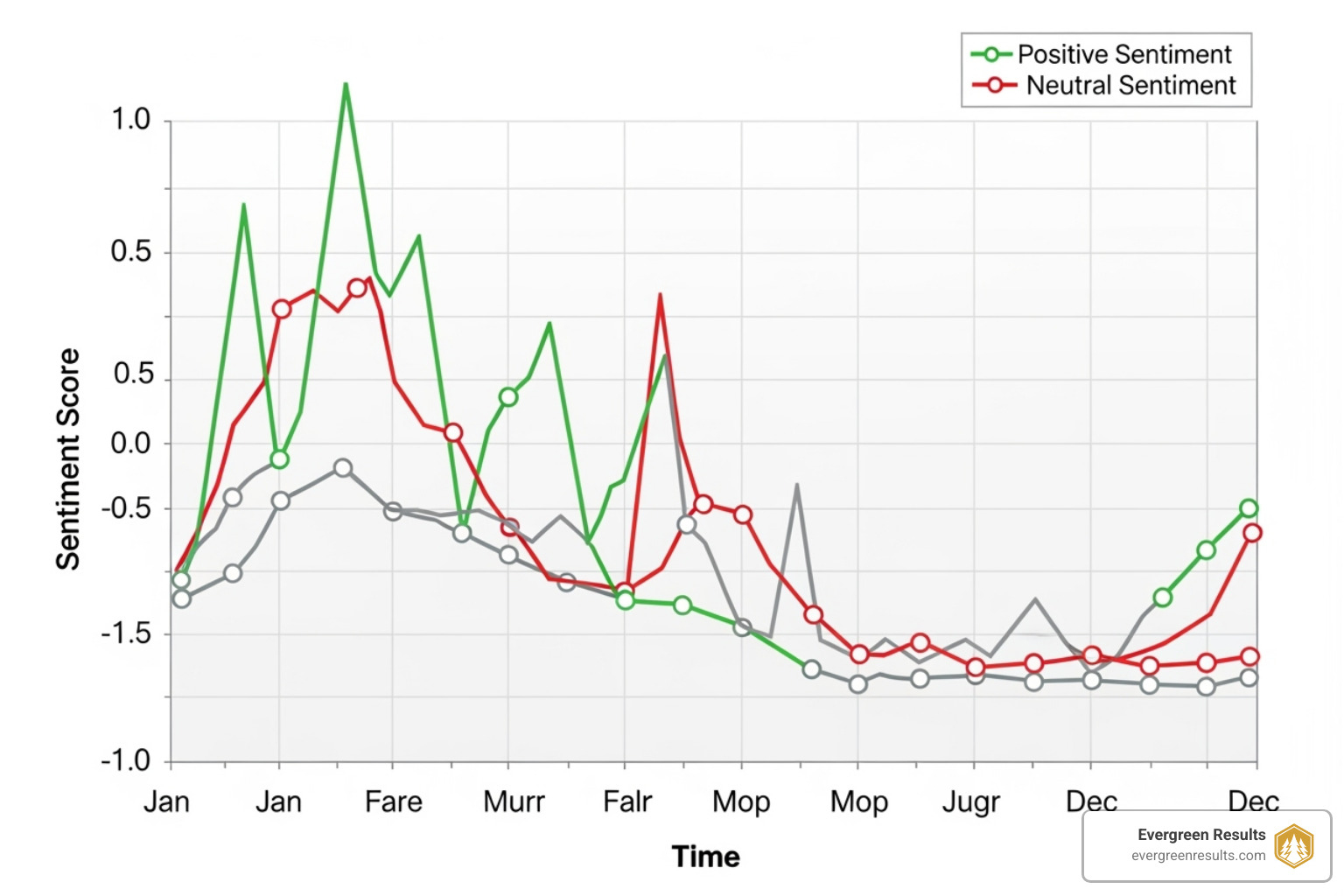
For lifestyle brands, this is critical. Customers buy into a lifestyle, not just a product. Capturing this emotional value is key to understanding social media’s true contribution.
How to Assign Monetary Value to Brand Health and Sentiment
The challenge is assigning a dollar value to brand sentiment. The key is to systematically connect positive sentiment to business outcomes.
- Brand awareness surveys: Correlate survey-measured improvements in brand awareness with social media campaigns to track subsequent impacts on traffic and sales.
- Correlating sentiment with performance: Use tools to track sentiment over time. Establish patterns (e.g., a 20% sentiment increase leads to an 8% sales bump) to predict and value future improvements.
- Calculating organic reach value: Determine the equivalent advertising value of your organic reach. If paid ads cost $1 per 1,000 impressions, reaching 50,000 people organically is worth $50.
- Share of Voice (SOV) & Engagement: Track your share of the conversation. An increasing Share of Engagement often correlates with market share growth.
- Brand mentions: Track how increases in brand mentions drive website traffic and leads, connecting PR value to tangible results.
Using Social Listening to Complement Quantitative ROI
Analytics show what happened; social listening reveals why. This context is a goldmine for uncovering the emotions and experiences behind the numbers.
- Customer Feedback: Gain unfiltered opinions that can guide product development and boost customer satisfaction.
- Trend Spotting: Monitor industry conversations to identify emerging trends and create timely, relevant content.
- Competitive Analysis: Understand competitor strengths and weaknesses from the customer’s perspective to inform your positioning.
- Crisis Management: Detect negative sentiment early to respond quickly, protecting your brand and potentially turning critics into advocates.
- Content & Product Ideas: Use customer questions and discussions as a direct source for engaging content and new product ideas.
Combining quantitative ROI with qualitative social listening provides a complete picture of social media’s impact, allowing you to see both macro trends and micro-level customer experiences. These insights can then be used to optimize content for social media.
Future-Proofing Your ROI: AI, Influencers, and Adaptation
The social media landscape is always changing. To maintain and grow ROI, we must be agile, adopting new technologies like AI, mastering influencer marketing, and adapting to platform shifts. For instance, social commerce is projected to grow 30% year-over-year, highlighting the increasing direct revenue potential within these platforms. This makes our ability to measure and adapt even more critical. We need to continuously refine our social media ROI strategies.
Leveraging AI and Machine Learning for Sophisticated Analysis
AI and machine learning are changing social media ROI measurement. They process vast data sets to uncover patterns and make accurate predictions, taking our advanced techniques for social media roi to the next level.
- Predictive Analytics: AI forecasts trends and performance, enabling proactive, data-driven decisions.
- Automated Analysis: AI automates data collection and reporting, freeing up your team for strategic work.
- Hyper-Targeting: Machine learning identifies niche audience segments for more efficient, high-ROI campaigns.
- AI-Powered Attribution: AI-driven models provide the most accurate picture of each touchpoint’s impact on conversions.
- Content Optimization: AI analyzes past content to provide actionable recommendations for future posts.
For lifestyle brands, AI provides unparalleled insight into customer motivations and behavior, which is critical for maximizing ROI.
Applying advanced techniques for social media roi to Influencer Marketing
Influencer marketing is a cornerstone for many lifestyle brands, but measuring its ROI is challenging. This is where advanced techniques for social media roi are indispensable.
Best practices for measuring influencer ROI include:
- Use Unique Codes/Links: Directly track sales from each influencer with unique discount codes or affiliate links.
- Create Dedicated Landing Pages: Attribute all traffic and conversions from a unique landing page directly to the influencer.
- Mandate UTM Parameters: Use UTM tags on all links for granular tracking in analytics platforms.
- Run Brand Lift Surveys: Measure changes in awareness, sentiment, and purchase intent before and after campaigns.
- Calculate Earned Media Value (EMV): Estimate the equivalent cost of the influencer’s reach and engagement if it were paid advertising.
- Use Social Listening: Track changes in brand mentions and sentiment during and after campaigns.
- Analyze Customer Lifetime Value (CLV): Determine if influencer-acquired customers have a higher CLV, proving long-term value.
Combining these techniques builds a robust case for influencer ROI, proving profitability.
Adapting to Evolving Platforms and User Behavior
The social media world is in constant flux. To stay effective, our ROI measurement strategies must adapt to algorithm changes, privacy updates, and new platforms.

Here’s how to adapt:
- Monitor Algorithm Changes: Continuously test and analyze content strategies as platform algorithms evolve.
- Prioritize First-Party Data: As third-party cookies disappear, focus on collecting first-party data through email sign-ups, loyalty programs, and surveys.
- Watch for New Platforms: Assess emerging platforms for their potential to reach your target audience and gain an early advantage.
- Build Community: Focus on genuine community building and measure its health to gain insights into loyalty and CLV.
- A/B Test Continuously: Always be testing content, timing, and targeting to identify what works best now.
- Use Flexible Analytics Tools: Invest in integrated platforms that can pull data from multiple sources for a comprehensive view.
- Rely on Data-Driven Attribution: Use these models to understand the customer journey, no matter how platforms change.
Proactively adapting our measurement strategies ensures our advanced techniques for social media roi remain effective, driving sustainable growth for lifestyle brands.
Frequently Asked Questions about Advanced Social Media ROI
Diving into advanced techniques for social media roi can feel overwhelming. Here are answers to the most common questions we hear from active lifestyle and food brands.
How can I start implementing these advanced techniques with a small budget?
You don’t need a huge budget. The most powerful insights often come from simple, low-cost changes.
- Start small. Focus on one technique at a time, like mastering UTM tracking or setting up a basic attribution model in Google Analytics.
- Use free tools. Google Analytics and native platform analytics are powerful and free.
- Prioritize UTM tracking. This simple, free practice provides immediate clarity on which social activities drive results.
- Calculate lead value. For service businesses, assign a monetary value to each lead to see the clear financial impact of your social campaigns.
Consistency and a commitment to data over vanity metrics will yield more insight than a large budget spent chasing likes.
What if a campaign shows a negative ROI even with advanced tracking?
A negative ROI isn’t a failure; it’s valuable data. It prevents you from repeating costly mistakes.
- Analyze the data. Confirm your tracking is accurate, then investigate why it underperformed. Was it the message, the audience, or the platform?
- Use attribution models to pinpoint weak spots in the customer journey, like an engaging ad leading to a poor landing page.
- A/B test systematically. Isolate and test one variable at a time (e.g., headline, image) to identify what improves performance. This turns a negative ROI into a learning opportunity.
Some of the most successful campaigns come after learning from initial setbacks.
Can I measure social media ROI without direct sales, like for a B2B or service-based business?
Absolutely. B2B and service-based businesses can effectively measure social media ROI without direct sales.
- Assign value to goals. Calculate the monetary value of a qualified lead based on your close rate and average contract value. This allows you to track social media’s contribution in real numbers.
- Track meaningful actions. Use UTMs and landing pages to attribute valuable actions like demo requests or downloads to your social efforts.
- Measure Customer Lifetime Value (CLV). Analyze if social-acquired customers have a higher CLV, which justifies the acquisition cost.
- Calculate cost savings. Factor in savings from using social media for customer service instead of more expensive channels.
- Quantify brand awareness. For B2B, track metrics like brand mentions and sentiment. Use equivalent media value to assign a monetary figure to this awareness.
The key is aligning your measurement with your business model. Social media ROI exists for every business type; you just need to track the right metrics.
Conclusion
Mastering advanced techniques for social media roi isn’t about collecting more data; it’s about collecting the right data and understanding its business impact.
Just as you wouldn’t judge a hike by its trailhead, you shouldn’t judge social media by last-click conversions. Doing so misses the entire customer journey your customers take with your brand.
For active lifestyle and food/beverage brands, this journey is crucial. Customers buy into a lifestyle, and social media is uniquely suited to nurture these deep connections.
The advanced techniques for social media roi we’ve explored—from multi-touch attribution to AI analysis—provide the tools to see the full picture. They help you move beyond vanity metrics to understand the true impact of your social efforts.
These techniques enable better decision-making. By understanding what truly drives growth, you can optimize your strategy effectively. The social media landscape will continue to evolve, but a solid foundation in data-driven measurement ensures your strategy can adapt and thrive.
The path to sustainable growth is through data-driven decisions and a deep understanding of the customer journey. By implementing these techniques, you can turn your social media efforts into a powerful driver of business growth.