
Why Proving Social Media ROI Matters for Growing Brands
How to prove social media ROI starts with understanding that 34% of marketers globally are uncertain about their ability to measure social media returns. Here’s the quick roadmap:
Essential Steps to Prove Social Media ROI:
- Set clear goals – Align social efforts with business objectives
- Track all costs – Include time, tools, ads, and content creation
- Use the formula – ROI = (Revenue – Costs) / Costs × 100
- Focus on actionable metrics – Conversions, not just likes
- Implement proper tracking – UTM parameters and analytics tools
- Report regularly – Show stakeholders tangible business impact
The reality is stark: while social media marketing’s effect on company bottom lines remains flat according to recent surveys, over 100 million buyers are active on social platforms in the US alone. This disconnect happens because most teams measure social media the wrong way.
The shift from “likes to ledger” isn’t just possible – it’s essential. Social media ROI bridges the gap between social activities and real business outcomes. It helps you make smarter budget decisions, optimize campaigns that actually drive revenue, and prove your marketing efforts deserve continued investment.
The challenge isn’t that social media doesn’t work. It’s that proving social ROI was the second biggest challenge social media teams reported in recent industry research. When you can’t demonstrate clear value, you can’t secure the resources needed to scale effectively.
I’m Adam Bocik, founder of Evergreen Results, where I’ve helped dozens of active lifestyle brands transform their social media from a cost center into a measurable revenue driver. My experience scaling purpose-driven companies has taught me that learning how to prove social media ROI is the difference between guessing and growing systematically.
Handy how to prove social media roi terms:
Explaining Social Media ROI: More Than Just Likes
When we talk about how to prove social media ROI, we’re asking: “What concrete value am I getting for every dollar and hour invested?” It goes beyond likes and shares to include direct sales, new leads, brand awareness that drives organic search, and even customer service cost savings from handling support on social channels.
For active lifestyle and food brands, this is tricky. Customers rarely buy immediately after seeing one post. They might see your content, research your brand, read reviews, and purchase weeks later. True ROI requires looking at this bigger picture.
The numbers are sobering. Despite over 100 million US buyers on social media, the CMO Survey shows its effect on bottom lines is flat. This isn’t because social media fails, but because it’s often measured incorrectly. Our guide on What is Social Media ROI and Why Does it Matter? explains this disconnect.
Why Proving ROI is a Game-Changer
Learning how to prove social media ROI transforms your marketing approach. Instead of throwing content at the wall and hoping something sticks, you start making data-backed decisions that move your business forward.
When you can prove ROI, securing budget is easier. Instead of awkward conversations, you can walk in with clear numbers showing that last month’s campaign generated $15,000 in revenue from a $5,000 ad spend. That budget request becomes a no-brainer.
Proving value shows how your social media work contributes to real business growth. For example, showing that Instagram Stories led to 200 newsletter sign-ups, with 15% converting to customers, demonstrates measurable impact.
This approach gives you a serious competitive advantage. While competitors celebrate viral posts that don’t drive sales, you’re optimizing campaigns that grow revenue. You can spot what’s working faster and double down on strategies that deliver real results.
Most importantly, proving ROI keeps you aligned with business goals. Your social media isn’t just about building community—it’s about building community that drives business outcomes. Our Social Media ROI Strategies guide shows exactly how to maintain this alignment.
Common Problems in Tracking ROI
If figuring out how to prove social media ROI feels impossible, you’re not alone. Even experienced marketers struggle with this for several reasons.
Attribution challenges are a major hurdle. A customer might see your TikTok, visit your site, read an email, and then buy from a Google ad. Social media influences decisions across many touchpoints, making it hard to assign direct credit for a sale.
Then there’s dark social—the invisible giant of social sharing. When someone copies a link from Instagram and texts it to a friend, that traffic often shows up as “direct” in your analytics. You lose the connection to social media, even though it was the origin. This untracked sharing accounts for a huge portion of web traffic.
Data fragmentation complicates things. Data from Instagram, Facebook, TikTok, and other platforms exists in separate dashboards, making a unified ROI picture difficult to assemble.
Many marketers struggle with not knowing what to track. With endless metrics available, it’s easy to get overwhelmed. The answer depends on your specific business goals, but figuring that out isn’t always obvious.
The biggest trap? Vanity metrics. Getting 10,000 likes feels amazing, but if none of those people buy your products, those likes aren’t driving business growth. It’s easy to celebrate high engagement while missing the metrics that actually matter.
These challenges explain why proving social ROI was the second biggest challenge social media teams reported in recent industry research. But with the right approach and tools, these problems are solvable.
The Core Calculation: How to Prove Social Media ROI

Proving social media ROI isn’t about complex math; it’s about being methodical. Like tracking fitness, it requires clear goals, consistent measurement, and patience to see results over time.
The foundation of everything rests on this simple formula:
Social Media ROI = ((Gain from Social Media – Cost of Social Media) / Cost of Social Media) × 100%
Don’t let the simplicity fool you. The magic happens when we apply this formula thoughtfully. My experience with active lifestyle and food brands shows that a systematic approach is more effective than a sophisticated one.
Step 1: Align Social Goals with Business Objectives
Before crunching numbers, get crystal clear on what you’re trying to achieve. This means creating SMART goals that directly support your business growth.
For active lifestyle and food brands, goals must be more specific than just “get more followers.” For brand awareness, aim to increase brand mentions on Instagram by 20% in a quarter. For lead generation, target 50 qualified leads from LinkedIn per month with valuable content.
When we’re talking about sales, we get specific: “Drive $5,000 in direct sales from Instagram Shopping in Q3.” For customer loyalty, we might aim to increase customer retention rates by 5% through dedicated social media customer support and community building.
The difference between vague hopes and measurable outcomes separates successful social media strategies from expensive hobbies. As we explore in our guide on connecting with your audience through social marketing, aligning your social efforts to specific business outcomes is essential.
Step 2: Tallying the Investment: What to Include in Your Costs
Many businesses miscalculate ROI by focusing only on ad spend and forgetting other resources. It’s like costing a meal by its ingredients alone, ignoring the time and equipment used.
Team time is often the biggest hidden cost. Multiply the hourly rate of everyone involved (managers, creators, strategists) by the hours they dedicate to social media. With median hourly rates for managers at $51, this investment adds up quickly.
Ad spend is the obvious one, covering money spent on paid campaigns. But content creation costs include expenses for graphic designers, videographers, photographers, and copywriters.
Don’t forget software and tools—those monthly subscriptions for management platforms, analytics tools, and scheduling software. Influencer fees count too, whether cash or product. And if you’re working with an agency, those fees are a direct investment in your social media ROI.
By tracking these expenses honestly, you get a true picture of your total investment, which is vital for a meaningful ROI calculation.
Step 3: A Practical Guide on How to Prove Social Media ROI
Now, let’s apply the formula. The “Gain from Social Media” requires assigning a monetary value to your goals, which varies by objective.
For lead generation: If a qualified lead is worth $100 and a $2,000 campaign generated 50 leads, your ROI is ((50 × $100) – $2,000) / $2,000 × 100% = 150%. This clearly justifies the investment.
For brand awareness: If 1,000 impressions are valued at $5 (based on paid impression costs), and a $1,000 campaign gets 1M impressions, your ROI is ((1,000 × $5) – $1,000) / $1,000 × 100% = 400%. This helps quantify the value of organic reach.
For direct sales: If a $2,500 campaign generates $10,000 in sales, your ROI is (($10,000 – $2,500) / $2,500) × 100% = 300%. These are the numbers that get budgets approved.
The “Gain from Social Media” isn’t always a direct dollar amount. You might assign value to improved customer lifetime value or saved customer service costs. This broader view helps you understand the complete picture of what ROI in social media marketing really means.
The key is being consistent in how you measure and honest about what you’re attributing to social media. This gives you the data to optimize your strategy and prove your value.
Choosing Your Compass: Key Metrics and Tools for Success

Proving social media ROI requires the right compass. With the right metrics and tracking tools, you can chart a clear course from social media activity to measurable business results.
The challenge isn’t a lack of data, but drowning in it. With dozens of metrics per platform, it’s easy to get lost. Your metrics should guide strategic decisions, not just fill reports.
At Evergreen Results, I’ve watched too many active lifestyle brands get excited about viral posts that generated zero sales. The key is focusing on metrics that actually move your business forward. Our comprehensive guide on Social Media ROI Metrics breaks down exactly which numbers deserve your attention.
Vanity vs. Actionable Metrics: Focusing on What Matters
The truth is, most social media metrics are for show. Vanity metrics fuel your ego, while actionable metrics fuel your marketing strategy.
Would you rather have 10,000 non-buying followers or 1,000 loyal customers? The answer is obvious, yet many brands still chase follower counts over conversion rates.
Vanity metrics (likes, follower count, impressions) indicate reach but don’t directly connect to revenue. Actionable metrics (click-through rates, conversion rates, customer lifetime value) tell you what people did after seeing your content.
The shift from vanity to actionable metrics transforms how you evaluate success. Instead of celebrating a post with 500 likes, you celebrate the campaign that generated 15 qualified leads. Instead of focusing on reaching 10K followers, you optimize for the engagement rate that drives website traffic.
Click-through rates reveal whether your content motivates action. Conversion rates show if that traffic turns into customers. Cost per lead tells you how efficiently you’re acquiring potential buyers. Customer lifetime value helps you understand the long-term impact of social media acquisition.
This doesn’t mean ignoring awareness metrics entirely. Brand awareness has value—it’s just harder to measure. The key is understanding which metrics connect to tangible business outcomes for your specific goals.
Mapping Metrics to the Sales Funnel
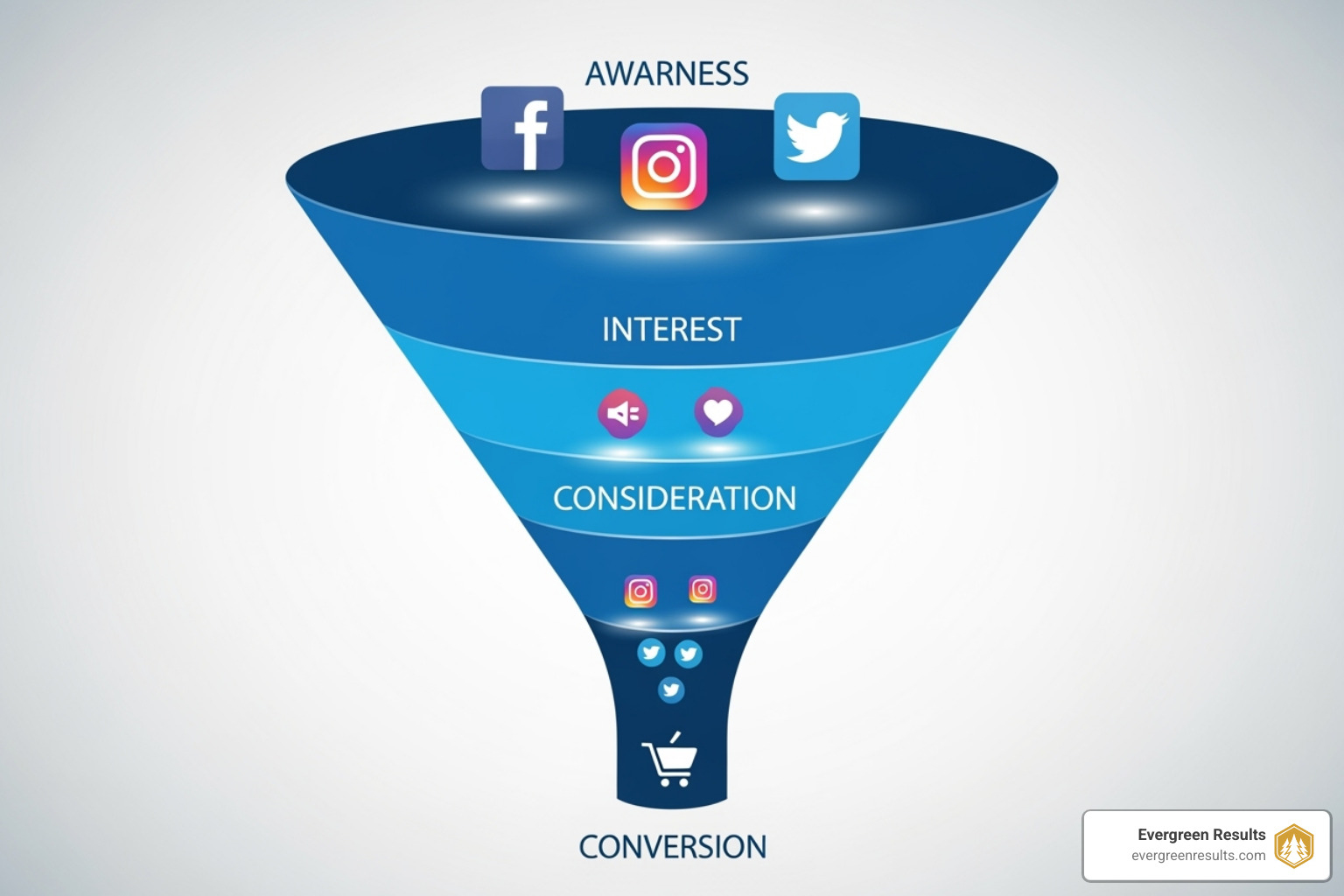
Customers move through a sales funnel, and social media’s role changes at each stage. Mapping your metrics to the funnel ensures you measure the right things at the right time.
At the awareness stage, you’re introducing your brand. Reach, impressions, and follower growth rate matter here to show how many unique people are finding your content. For active lifestyle brands, this means showcasing products in action or sharing your brand story.
During the consideration stage, potential customers are evaluating you. Engagement rate (comments, shares, saves) shows genuine interest. Click-through rates to your site and video view duration reveal if you’re holding attention and moving people deeper into your funnel.
At the conversion stage, ROI is clearest. Track conversion rates from social traffic, cost per acquisition, and return on ad spend to connect investment directly to revenue.
Finally, in the advocacy stage, turn customers into ambassadors. Track net promoter scores, customer satisfaction, and user-generated content. This stage often has the highest ROI through organic growth.
Understanding these funnel stages helps you avoid the trap of measuring everything equally. High reach without clicks suggests content that entertains but doesn’t compel action.
The Marketer’s Toolkit: Essential Tools for ROI Tracking
The right metrics require the right tools. Your measurement toolkit must capture data from every touchpoint where social media influences customer behavior.
Native platform analytics provide the foundation. Facebook Insights, Instagram Analytics, and LinkedIn Analytics offer detailed breakdowns of audience demographics and content performance.
Google Analytics is your command center for post-click activity. Set up goals (purchases, signups) and use attribution models to understand social media’s role in the customer journey.
UTM parameters are your secret weapon for precise tracking. These URL tags tell Google Analytics exactly which post, campaign, or platform drove a website visit. Use the Google Analytics Campaign URL Builder to create tagged links for every post.
Pixels and conversion APIs (like Meta Pixel and the LinkedIn Insight Tag) connect social platforms to your website. They track user actions post-engagement and are essential for measuring ad impact and for retargeting.
Social media management platforms pull everything together in one dashboard, giving you a unified view of your overall social media ROI.
Tools are only as good as the strategy behind them. Start with clear goals, choose metrics that align with those goals, then select tools that accurately measure them.
Boosting Your Bottom Line: Strategies to Improve and Demonstrate ROI
Proving social media ROI is just the start. The real magic is in continuous improvement and effectively sharing wins with stakeholders. It’s an ongoing conversation between your social efforts and your business goals.
Test, Learn, and Optimize Your Strategy
Social media moves fast, so smart marketers adopt a test-and-learn mindset. It’s like being a scientist, but with more colorful graphs.
A/B testing is your best friend. Test different visuals, headlines, posting times, and captions for both paid ads and organic content. You’ll only know if your audience prefers behind-the-scenes videos to polished product shots if you test.
Content performance analysis uncovers a goldmine in your analytics. Understand which posts drive website visits, spark conversations, and when your audience engages most. We’ve seen active lifestyle brands find that “workout Wednesday” posts consistently outperform others, reshaping their entire content strategy.
Don’t forget to keep an eye on the competition. Not to copy them, but to understand what’s resonating in your industry and find opportunities to stand out.
Don’t blindly follow industry averages for posting frequency (like 9.5 posts per day). Test your posting frequency to find your brand’s sweet spot. Your audience’s engagement will tell you if daily posts or three quality posts per week works better.
Remember to refine your goals quarterly. Business objectives evolve, and your social media strategy should adapt accordingly. For deeper insights into paid optimization, our guide on 5 Tips Effective PPC and Digital Ads offers proven strategies.
Leverage UGC and Customer Feedback
Your customers are a secret weapon for improving ROI. Often, you just need to ask for their help.
User-generated content (UGC) is powerful because it’s authentic. Real customer photos of them using your products carry more weight than branded content. With 49% of consumers buying monthly due to influencer posts, the power of authentic customer content is clear.
Building social proof can be simple and budget-friendly. Repost customer stories, feature reviews, create branded hashtags, or run contests. This user content can fuel your social channels for months.
Monitoring sentiment helps you understand the full picture of your brand’s social presence. Social listening tools reveal what people are saying about you—both good and bad. This feedback is invaluable for refining your messaging.
Improving customer satisfaction through social media creates a ripple effect. Responding quickly to customer concerns on social media shows everyone you care. With 40% of consumers expecting a response within an hour, meeting these expectations builds loyalty and increases customer lifetime value.
This approach to community building is central to creating Engaging Social Media Content that resonates authentically with your audience.
From Data to Dialogue: How to Prove Social Media ROI to Stakeholders
A brilliant strategy is useless if you can’t communicate its value to decision-makers. Many marketers have the data but struggle to tell the story.
Creating clear, visual reports transforms confusing spreadsheets into compelling narratives. Your CEO wants to understand how social media contributed to business growth, not decipher 47 different metrics. Use charts and dashboards that highlight the most important outcomes.
Tying results to business objectives is crucial. Instead of saying “we increased engagement by 25%,” say “our increased engagement drove 15% more website traffic, resulting in 10 new qualified leads worth $5,000 in potential revenue.” This connects social activity to business impact.
Speak their language by using business terms like revenue, costs saved, and leads acquired. For example, showing how a switch in attribution models can reveal a massive increase in pipeline influenced by social gets boardroom attention.
Regular reporting cadence keeps everyone aligned. Whether it’s monthly updates or quarterly deep-dives, consistency builds trust and allows for timely strategy adjustments. When stakeholders see steady progress, they’re more likely to support your initiatives.
The key is making your social media ROI story so clear and compelling that stakeholders see the value. When you master this, you transform from cost center to revenue driver.
Conclusion
Learning how to prove social media ROI transforms your marketing from guesswork into a strategic powerhouse. It’s the difference between hoping your social media works and knowing it drives real business results.
Throughout this guide, we’ve walked through everything you need to turn social media from a cost center into a revenue driver. We started by understanding what social media ROI really means—it’s more than just likes and follows. We explored why proving ROI matters so much for growing brands, especially when 34% of marketers still struggle with measurement uncertainty.
The journey continued with the core calculation itself. Aligning your social goals with business objectives sets the foundation, while tracking every cost gives you the true investment picture. The ROI formula—(Revenue – Costs) / Costs × 100—becomes powerful when you apply it to lead generation, brand awareness, or direct sales scenarios.
We then equipped you with the right compass for success. Focusing on actionable metrics instead of vanity metrics changes everything. Mapping these metrics to your sales funnel helps you understand social media’s impact at every customer touchpoint. The right tools—from native platform analytics to UTM parameters—make tracking both possible and practical.
Finally, we covered strategies that actually boost your bottom line. Testing and optimization keep your efforts sharp, while user-generated content builds authentic social proof. Most importantly, translating your data into stakeholder-friendly reports ensures continued support and budget allocation.
How to prove social media ROI isn’t just a nice-to-have skill anymore—it’s essential for any brand serious about growth. When you can show clear connections between your social efforts and business results, you earn the trust and resources needed to scale effectively.
At Evergreen Results, we’ve helped countless active lifestyle and food/beverage brands make this change. We know the unique challenges these industries face, from seasonal fluctuations to community building. Our approach focuses on sustainable growth that aligns with your brand values and business goals.
Ready to turn your social media into a measurable revenue driver? Let us help you serve up engaging social media content that delivers results.